
 By Suro Senen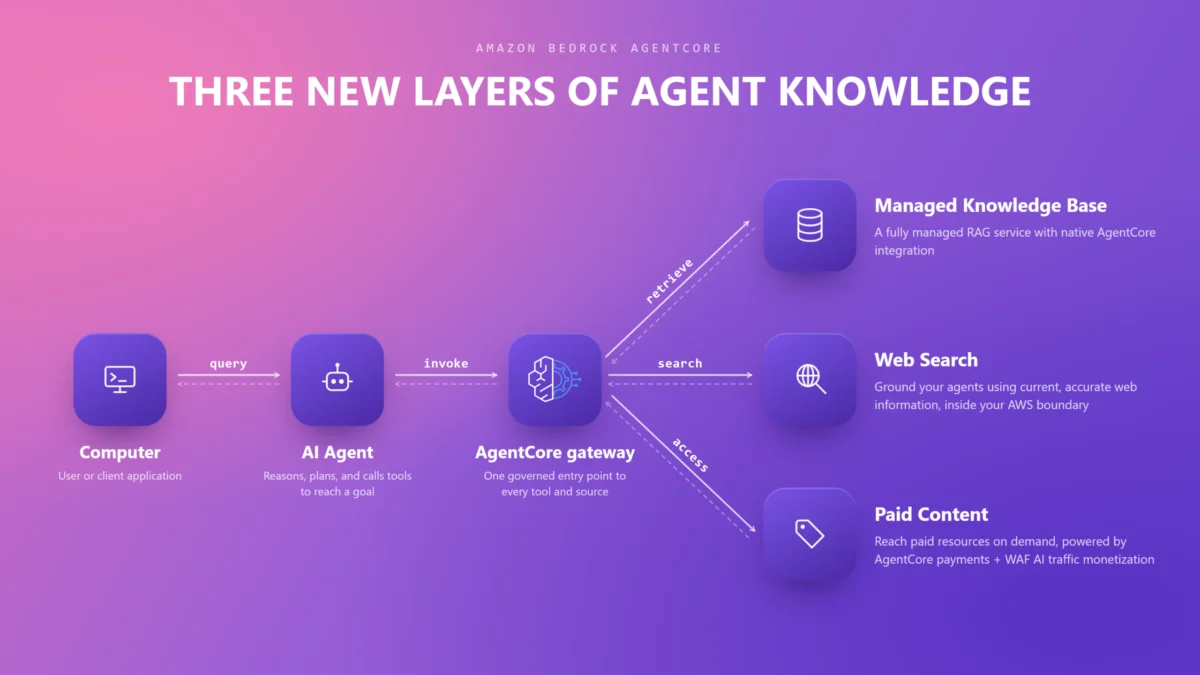
The landscape of generative AI is shifting from passive content creation to active, autonomous execution. At the AWS Summit in New York City, Swami Sivasubramanian, AWS Vice President of Agentic AI, took the stage to redefine how enterprises interact with machine intelligence. The keynote marked a pivotal moment in the industry: the transition from “AI assistants” to “agentic systems” capable of reasoning, planning, and executing complex workflows across organizational boundaries.
For business leaders and developers alike, the announcements made at the Javits Center signal that the era of the “Agentic Enterprise” has officially begun.
The Core Announcements: A New Era for Amazon Bedrock
The centerpiece of the summit was the evolution of Amazon Bedrock, specifically the introduction of new capabilities for Amazon Bedrock AgentCore. AWS is moving beyond simple prompt-response models to create a robust infrastructure where agents can autonomously handle multi-step business processes.
Empowering Agents with Institutional Knowledge
Historically, AI agents have been limited by their training data. AWS has now bridged this gap by allowing developers to connect AI agents to internal organizational data, live web resources, and third-party paid knowledge bases. This “Knowledge Layer” architecture ensures that agents are not merely hallucinating answers but are tethered to the specific, verified context of a company’s operations.
Governance and Scalability
As organizations deploy hundreds of agents, the risk of "shadow AI" and unmonitored decision-making grows. AWS addressed this with new governance controls that scale linearly with agent complexity. These controls allow IT teams to set strict guardrails, ensuring that even as agents gain more autonomy—such as the ability to trigger API calls or update databases—they remain within the boundaries of corporate compliance and security protocols.
Chronology: From Static Tools to Autonomous Agents
The trajectory of AWS’s AI strategy over the past 18 months has been calculated and aggressive. To understand the significance of this week’s news, one must look at the timeline of innovation leading to the 2026 Summit.
- Early 2025: AWS began the integration of RAG (Retrieval-Augmented Generation) at scale, allowing models to look up documents.
- Late 2025: The introduction of "multi-modal reasoning," allowing models to interpret images and logs alongside text.
- Q1 2026: Beta testing of "Agentic Loops," where agents were empowered to iterate on their own tasks without human intervention.
- June 2026 (The Summit): The launch of Amazon Quick autonomous agents and the expansion of the Bedrock AgentCore ecosystem.
This progression shows that AWS is not just building faster models; they are building a "nervous system" for the enterprise, where agents act as the connective tissue between siloed departments like Finance, Sales, and IT Operations.
Supporting Data: Why "Agentic" Matters
The shift toward agentic AI is driven by a critical realization: human productivity has hit a plateau in the digital age. According to internal AWS metrics presented during the keynote, knowledge workers spend roughly 60% of their time on "work about work"—finding information, updating CRM records, and reconciling data across disparate platforms.
The new Amazon Quick autonomous agents are designed to reclaim this lost time. By allowing agents to operate in the background, AWS aims to reduce the "context switching" tax. For example, a finance agent can now autonomously reconcile orders against inventory databases as they arrive, triggering alerts only when human intervention is strictly required.
The efficiency gains are not merely incremental; they are structural. By automating the "draft-flag-recommend" loop, AWS claims that sales teams could see a 30–40% increase in lead velocity, as agents handle the initial synthesis of communication from Slack, email, and CRM platforms.

Official Responses and Strategic Vision
Swami Sivasubramanian emphasized that the future of AI is not in larger models, but in more capable agents. "We are moving from the era of ‘chatting with AI’ to ‘working with AI,’" Sivasubramanian noted during the keynote. "The value isn’t just in the model’s ability to summarize a meeting; it’s in the model’s ability to take the action items from that meeting and execute them across your enterprise stack."
Industry analysts have responded with cautious optimism, noting that AWS is playing a long game. By focusing on governance and security—two areas where AWS has historically held an advantage—the company is positioning itself as the "safe" choice for large-scale enterprise AI adoption.
The Implications: What This Means for Your Business
The rollout of these technologies has profound implications for how businesses will operate in the latter half of the decade.
1. The Rise of "Background Intelligence"
We are entering a phase where the software "thinks" while we sleep. With the new activity feed, the interface for work is becoming personalized. Instead of navigating dozens of tabs, employees will be presented with a prioritized feed that understands their workflow patterns. If an agent learns that you prioritize urgent client emails over internal project updates, the AI will restructure your interface to reflect those priorities.
2. A Shift in Human Roles
As agents take over the heavy lifting of data entry, scheduling, and basic risk assessment, the role of the human employee will shift toward "Agent Oversight." Employees will transition from being individual contributors to "agent managers," responsible for configuring, monitoring, and auditing the work performed by their digital counterparts.
3. The Continuous Learning Cycle
Perhaps the most transformative aspect of the new Bedrock capabilities is the emphasis on continuous learning. Agents are no longer static snapshots of code; they are designed to improve over time by analyzing their own performance in production. When an agent fails to resolve a request, it can now be configured to flag the error for human review, effectively creating a feedback loop that makes the system smarter with every passing day.
Looking Ahead: June 2026 and Beyond
As the AWS Summit in New York City concludes, the takeaway is clear: the friction between human intent and machine execution is evaporating. The announcements regarding Amazon Bedrock and Amazon Quick are merely the first wave of a broader push into autonomous infrastructure.
For organizations looking to remain competitive, the challenge will not be finding an AI model, but rather integrating these agentic systems into existing workflows. The companies that succeed will be those that treat these agents not as external tools, but as digital employees—governed by clear policies, integrated into existing data flows, and empowered to drive real business value.
As we look toward the remainder of 2026, the question is no longer "what can AI do," but rather "what are you willing to let your agents do?" AWS has provided the tools; the architecture of the modern enterprise is currently being rewritten.
Key Takeaways for IT Leaders:
- Governance First: Utilize the new Bedrock controls to ensure agentic autonomy does not exceed risk tolerance.
- Workflow Integration: Move beyond RAG-based chatbots. Focus on agents that can perform multi-step actions (writing to databases, sending notifications, updating CRM).
- The New UI: Prepare for a future where the "dashboard" is a personalized, AI-driven activity feed rather than a static list of applications.
For more information on these announcements, developers are encouraged to review the updated AWS machine learning documentation and the technical deep-dives published on the official AWS blog.
 Neng Nana
  Lina Hope