
 By Jia Lissa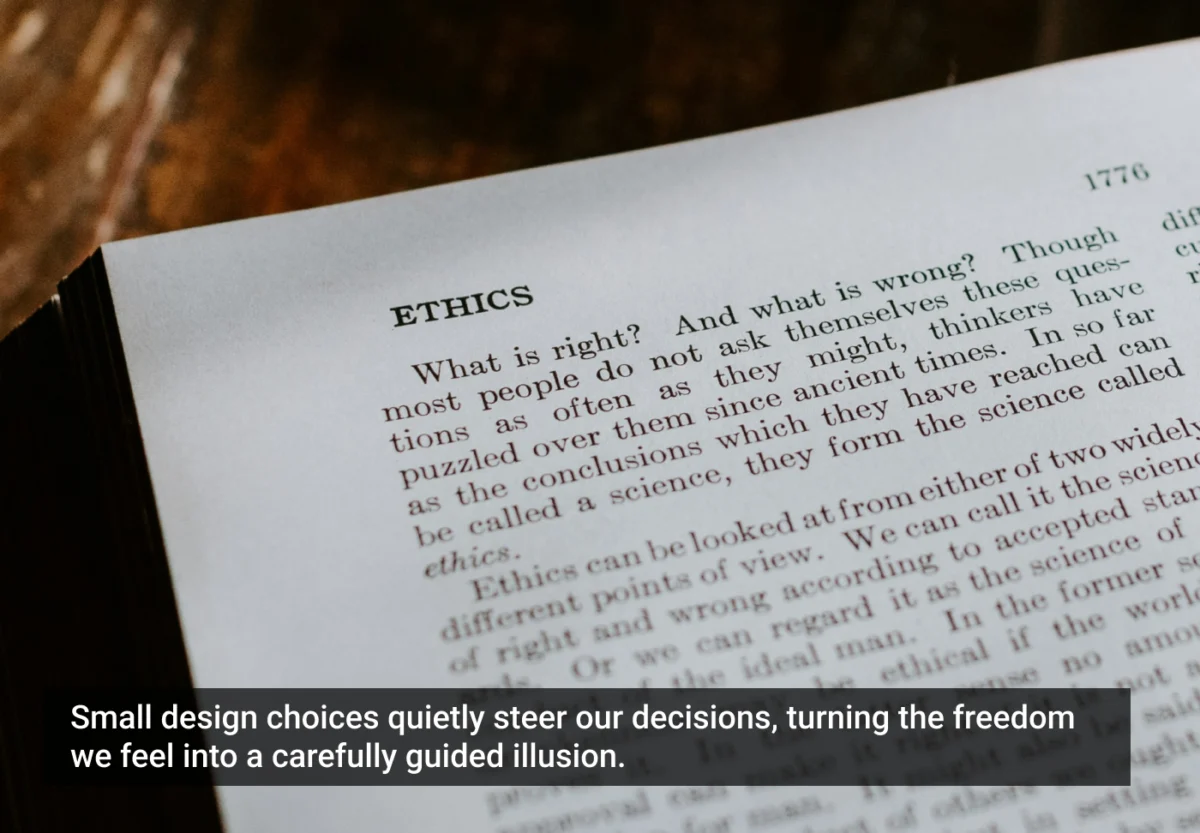
“The greatest enemy of freedom is a happy slave.” — Friedrich von Schiller
In the contemporary digital landscape, we often champion the pillars of empathy, innovation, and user delight. Yet, beneath the surface of the most seamless interfaces lies a subtle, pervasive force: behavioral influence masked as simple usability. As we transition deeper into an era of hyper-personalized, AI-driven experiences, the tension between business optimization and user autonomy has never been more palpable.
The Ethical UX Series was born from an urgent necessity to examine this invisible architecture. It is not an attempt to police creativity or stifle business strategy; rather, it is a call to acknowledge that every micro-decision—from the radius of a button’s corner to the strategic placement of a "cancel" link—shapes user behavior, belief systems, and the fundamental capacity for independent decision-making.
The Illusion of Choice: When Metrics Become Morals
In a professional culture where A/B testing is frequently mistaken for absolute truth and data metrics are elevated to the status of organizational morals, the WorldUXForum has emerged as a global movement advocating for ethical clarity in experience design. We are pushing for a paradigm shift: a mindset where usability meets accountability, where strategy is balanced with profound sincerity, and where digital freedom is preserved through thoughtful, human-centric design.
This exploration dissects the most deceptive of design patterns: the "illusion of choice." It examines how designers and researchers—often unintentionally, but sometimes by calculated design—guide users toward predetermined outcomes while maintaining the veneer of free will.
“Every decision, no matter how small, builds the architecture of choice we live within.” — Daniel Kahneman
The Anatomy of Micro-Decisions
While UX professionals often obsess over grand flow diagrams and conversion funnels, the true power of design resides in the "micro-decisions." A momentary pause, a hesitant click, a glance toward a highlighted option—these actions may seem trivial in isolation, yet collectively, they construct the architecture of user behavior.
When designers manipulate button prominence, tone of voice, scroll velocity, or default system states, they are not merely presenting options; they are framing reality. Over time, these invisible nudges aggregate, subtly guiding users toward specific habits, beliefs, or financial commitments—often without the user ever realizing they have been steered. In behavioral psychology, this is known as "choice architecture." In the digital realm, this architecture is amplified by scale, speed, and a lack of transparency.
Button Hierarchy: The Puppet Strings of Priority
“Design is not just what it looks like and feels like. Design is how it works.” — Steve Jobs
Visual design is rarely neutral. In interface design, "button hierarchy" acts as a form of visual gravity, pulling the user’s focus toward the most profitable path. Most UI frameworks prioritize the "primary" action by making it larger, bolder, or more saturated in color. This is not an aesthetic choice; it is a conversion-tested formula.
Data from the Baymard Institute indicates that roughly 76% of users will instinctively click the most visually prominent button on a page, regardless of the text label. We see this daily in cookie banners: the "Accept All" button is vibrant and unmissable, while the "Customize Settings" option is relegated to a low-contrast, greyed-out link that requires additional, arduous effort to access. This visual imbalance bypasses critical thinking, favoring effortless compliance over informed, intentional decision-making. Ethical UX demands visual and functional parity, ensuring that the user’s choice is based on intent, not visual trickery.
Language as a Behavioral Lever
Copywriting is the invisible hand of user experience. It establishes trust and dictates the rhythm of the interaction. However, the rise of "confirm-shaming"—a technique that exploits guilt, fear, or insecurity to force a specific outcome—has become a blight on modern interfaces.
Consider the common opt-out prompt:
- The Ethical Approach: "No, I do not want to receive updates."
- The Manipulative Approach: "No thanks, I prefer to pay full price and miss out on savings."
A 2022 study conducted at Princeton University revealed that this negative framing in opt-out statements increased user compliance by 34%. The options remained identical, yet the psychological manipulation of the language shifted the outcome. As designers and researchers, our goal must be to inform, not to persuade through shame. Respect in copy builds long-term brand equity; trickery leaves behind "digital scars" that eventually drive users away.
Interface Rhythm and the Urgency of Now
Design is not static; it is defined by its tempo. Interface rhythm determines the window of time a user has to process information before taking action. By introducing rapid transitions, infinite scroll patterns, or aggressive countdown timers, designers create "cognitive urgency."
Amazon’s "1-Click" purchase is the pinnacle of this strategy, intentionally skipping the "reflection stage" of the buyer’s journey. Similarly, hotel booking platforms that flash "Only 2 rooms left!" capitalize on the Fear of Missing Out (FOMO). According to a 2021 study by the Nielsen Norman Group, such artificial time pressure increases impulsive decisions by 42% in mobile environments. Ethical design, conversely, seeks to slow down the interaction just enough to allow the user to pause, consider, and retain the power of reversal.
Personalization vs. The Echo Chamber
Personalization is often hailed as a marvel of modern UX, but it carries a dark side: the erosion of autonomy. When algorithms are tuned strictly for engagement rather than relevance, they trap users in an "invisible echo chamber." By offering users only what the system predicts they want, platforms narrow the user’s worldview and limit their exposure to diverse information.
Pew Research reports that 72% of users feel uncomfortable when they do not understand how platforms arrive at their content recommendations. Ethical personalization requires radical transparency: explainable AI, clear control panels, and simple opt-out pathways that allow users to reset their data profile at any time.
The Ethical UX Standpoint: A Moral Compass
“In a world of invisible influence, ethics becomes the only true visibility.” — Tushar A. Deshmukh
Ethical UX is not an anti-growth philosophy. It is a refinement of intent. It is a conscious pivot from measuring "what converts" to measuring "what respects." We live in a world driven by Key Performance Indicators (KPIs) like Click-Through Rates (CTR), Bounce Rates, and Daily Active Users (DAU). But these metrics rarely account for the "human toll" of optimization. When friction is removed to maximize profit, is freedom also removed? When defaults are pre-set, are decisions truly made?
The WorldUXForum advocates for a new framework for digital architecture:
- Informed Consent: Users should always understand the implications of their choices.
- Visual Parity: Important choices should be presented with equal visual weight.
- Opt-Out Ease: Exiting a service or a subscription should be as easy as joining.
- Radical Transparency: The "why" behind AI and algorithm-driven suggestions must be visible.
The Impact: Consequences and Benefits
The ramifications of ethical lapses are profound. Unethical UX leads to degraded user trust, legal complications, and eventual brand erosion. Meta, for example, faced a €265 million fine in the EU for failing to provide clear data control options—a clear case where an unethical UX decision resulted in massive financial and reputational damage.
Conversely, companies like DuckDuckGo have built their entire brand identity on the foundation of transparent, privacy-first UX. By rejecting the manipulative patterns of the mainstream, they have cultivated an intensely loyal user base that trusts the product implicitly.
Why This Matters in 2025 and Beyond
As we move toward a future dominated by AI-integrated platforms, the ability to guide users responsibly—or manipulate them silently—is expanding exponentially. Every pixel is a message; every interaction is a moral position. We must ask ourselves: Will we use our influence to nudge toward profit, or to nurture the human experience?
The future of digital design will not be judged by efficiency alone, but by empathy. It will be judged not by how many people used the product, but by how many felt respected while using it.
Personal Reflections from the Field
Over the past two decades, I have navigated the evolution of UX, from the early days of basic web architecture to the complex, predictive ecosystems of today. I have mentored thousands of professionals and worked with both startups and global enterprises. I have seen teams lose their way, buried under the pressure of quarterly dashboards, and I have seen the transformative power of design that puts human dignity first.
This series is not a demand for perfection. It is an invitation to pause. It is a reminder that we are the architects of the digital spaces where humanity spends its waking hours. Let us choose to build with integrity.
This article is part of the ongoing "Ethical UX Series" by the WorldUXForum. Stay tuned for our next installment: "The Psychology of Nudges: Why the Smallest Design Element Can Shift the Biggest Outcomes."
Suggested Reading & References
- Kahneman, D. (2011). "Thinking, Fast and Slow."
- Thaler, R. H., & Sunstein, C. R. (2008). "Nudge: Improving Decisions About Health, Wealth, and Happiness."
- WorldUXForum (2024). "Principles of Digital Integrity."
- Princeton University (2022). "Dark Patterns at Scale: Findings from the Human-Computer Interaction Lab."
- Nielsen Norman Group (2021). "The Impact of Cognitive Load on Digital Conversion."
This article was originally published on LinkedIn Pulse.
 Ammar Sabilarrohman
  Neng Nana
  Sagoh
Sagoh 