
 By Siti Muinah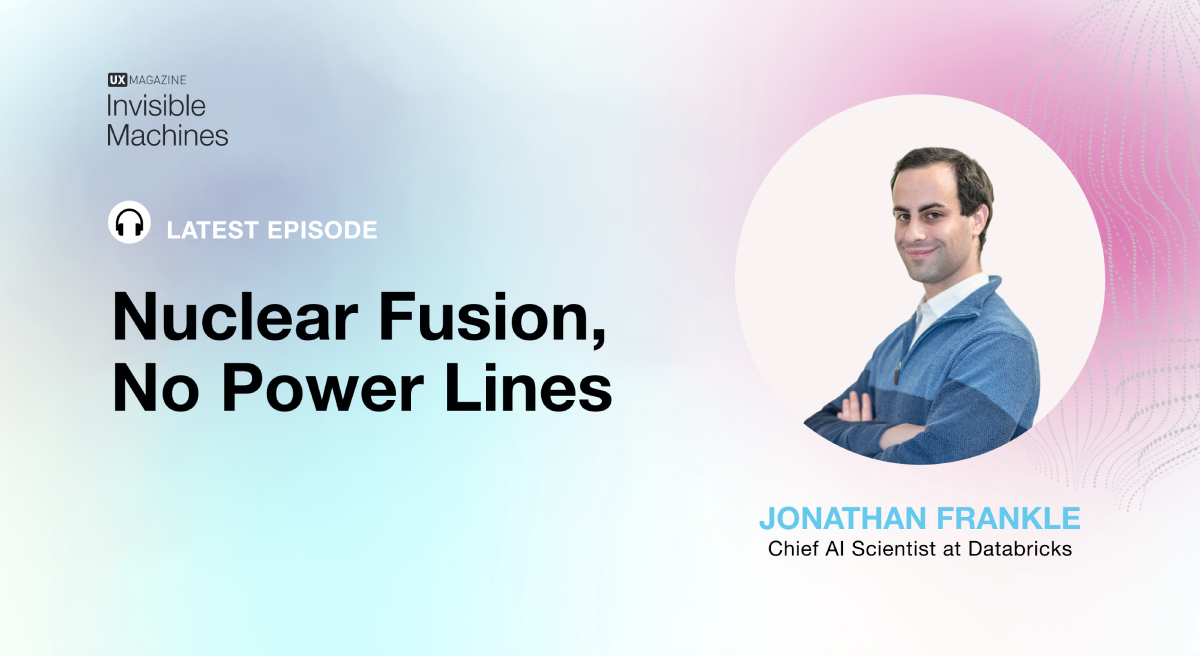
Three years ago, Jonathan Frankle, then Chief Scientist at MosaicML, sat down with the Invisible Machines team to demystify the nascent world of Large Language Models (LLMs). He introduced the world to the concept of "data mixology"—a culinary metaphor for the precise, often messy art of curating the datasets that bake the intelligence into our digital models. He warned against the "Betty Crocker" approach to AI: assuming that simply throwing ingredients together would result in a reliable product.
Today, Frankle returns to the conversation, now as Chief AI Scientist at Databricks. While the scientific rigor remains, his diagnosis of the industry has shifted from the kitchen to the power plant. His core thesis is as provocative as it is sobering: We have successfully engineered nuclear fusion—a source of raw, boundless, and often volatile intelligence—but we have entirely neglected to build the power lines. We lack the grid infrastructure—specification, testing discipline, and composable tools—required to connect this raw power to human intent.
I. Main Facts: The Fusion Paradox
The AI industry is currently caught in a cycle of "more is better." Larger models, longer context windows, and deeper parameter counts have become the industry’s vanity metrics. However, Frankle argues that this obsession with raw power overlooks the fundamental engineering challenge: the gap between an LLM’s capability and its utility.
The Missing Grid
Frankle suggests that we are currently living in the "Fortran days" of artificial intelligence. Much like the early days of computing, we possess the raw processing capability, but we lack the high-level abstractions—the "Java" or "C" equivalent—that allow practitioners to describe what they want, edit it with predictability, and verify the output.
Current AI workflows are largely opaque. When a user queries a model, they are often guessing at the parameters of success. Without standardized ways to define "requirements," businesses are essentially performing a high-stakes guessing game, hoping that their model’s internal logic aligns with their specific business goals.
II. Chronology: From Data Mixology to Infrastructure Crisis
To understand where we are, we must look at the evolution of Frankle’s perspective over the last three years.
- 2021-2022: The Mixology Phase: The industry was focused on the "recipe." Academic benchmarks like HellaSwag were the gold standard, and the conversation centered on training efficiency. Frankle correctly identified that these benchmarks were disconnected from real-world user intent.
- 2023: The Context Window Craze: The industry pivoted toward "RAG" (Retrieval-Augmented Generation) and massive context windows. The dream was simple: if we feed the model every document we own, we won’t need to train it anymore.
- 2024: The Infrastructure Realization: As Databricks works with over 12,000 enterprises, the reality has set in. Dumping data into a model doesn’t create intelligence; it often creates "noise." Performance frequently degrades as the context window grows, introducing distractors and irrelevant data. The industry is now realizing that we need better "power lines"—the protocols that govern how data flows into the reasoning engine.
III. Supporting Data and Technical Reality
The technical reality of LLMs is that they are not magic; they are systems. Frankle highlights two critical technical truths that enterprises must grapple with:
1. Prompts Are Parameters
One of the most profound reframes in the discussion is the realization that "prompt engineering" is simply a form of model training. When a user tweaks a prompt to get a better result, they are optimizing natural-language parameters rather than floating-point weights. This is not a "soft" skill; it is a hidden layer of software development that currently lacks version control, regression testing, or formal documentation.
2. The Garbage-In, Garbage-Out (GIGO) Principle
Whether data enters the system through pre-training, RAG, or simple prompt stuffing, the output quality is strictly governed by input quality. Organizations that dump decades of uncurated, outdated, or contradictory internal documents into their systems are effectively "manufacturing falsehood at scale."
Frankle notes that we are currently far from a world where we can cleanly separate "knowledge" from "reasoning." Until that split is achieved, organizations remain trapped in what he calls "trillion-parameter uncertainty."
IV. Official Perspectives: The Engineering Discipline
Frankle’s perspective at Databricks is shaped by the practical hurdles of enterprise adoption. He emphasizes that the "research" side of AI has outpaced the "engineering" side.
The Call for Unit Testing
In traditional software engineering, no developer would push code to production without a suite of unit tests, integration tests, and regression checks. Yet, in the AI space, many organizations are deploying models based on "vibes" and anecdotal success.
"Benchmarks are a cop-out," Frankle asserts. Building an evaluation set is not the same as defining requirements. The hard work lies in the pre-model phase: translating human intent into a testable, quantifiable specification. Without this, the AI system is an unguided missile.
V. Implications: The Future of Enterprise Content
The implications of this shift are profound for every enterprise, from marketing teams to legal departments.
The Rise of "LLM Optimization" (LLO)
Just as SEO (Search Engine Optimization) became a cornerstone of the internet economy, Frankle expects an industry of "LLM Optimization" to emerge. In this new landscape, static FAQ pages, curated "truth" repositories, and the deliberate separation of stable data from draft content will become strategic assets.
Content teams will no longer write solely for human readers or search crawlers. They will write for the "machine consumer." If your brand guidelines aren’t structured in a way that an agent can ingest and reason upon, you are essentially forfeiting control over your brand’s AI identity.
The "Blender" Analogy
Frankle uses the image of a blender sitting unplugged in a kitchen to describe the current state of AI. We have the appliance, and we have the ingredients, but we haven’t plugged it into the wall of disciplined software engineering. The transition from "cool demo" to "enterprise necessity" requires:
- Predictable Editing: The ability to change how a model behaves without retraining the entire system.
- Verification: A system that proves the model met the user’s requirements.
- Composable Tools: Small, modular agents that perform specific tasks rather than one monolithic "oracle" that tries to do everything.
VI. Conclusion: A Return to First Principles
Despite the exponential growth of the field, Frankle’s value system remains anchored in the same principles that defined his early work. He is less interested in the hype surrounding "AGI" and more interested in the mundane, difficult work of experiment design.
His advice to the industry is clear:
- Measure what success looks like before you touch the model.
- Start small. Complexity is the enemy of reliability.
- Ignore the leaderboards. Academic scores rarely correlate with the messy, nuanced reality of business application.
As we move forward, the winners will not necessarily be those with the largest models, but those who successfully build the "power lines." We must move beyond the "fusion" phase—where the sheer power of these models dazzles us—and into the "grid" phase, where we treat AI not as a miracle, but as a discipline. We have the intelligence; now, it is time to build the infrastructure that makes that intelligence truly useful.
 Ammar Sabilarrohman
  Neng Nana
  Sagoh
Sagoh 