
 By Raul Delapena Setiawan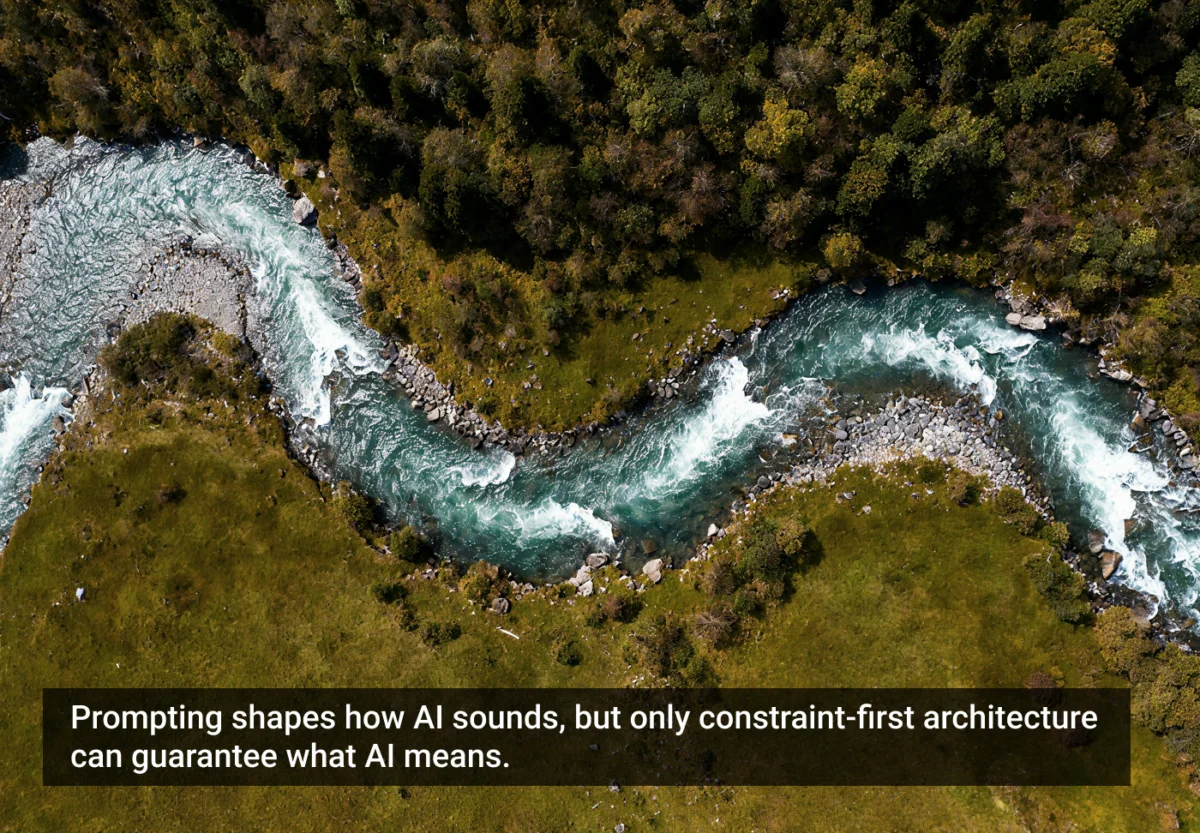
In the rapid evolution of artificial intelligence, we have reached a critical juncture. For the past two years, the industry has been intoxicated by the sheer fluency of Large Language Models (LLMs). We have treated "prompting"—the act of coaxing natural language output from a probabilistic machine—as the primary design language for the future of software. However, as AI transitions from creative toys to high-stakes infrastructure in healthcare, finance, and law, that paradigm is fracturing.
Yves Binda, a leading voice in AI architecture, argues that our reliance on prompting is not just a technical bottleneck; it is a fundamental design flaw. The industry is discovering that prompting shapes tone, but it cannot guarantee truth. As we move toward a future where AI must be auditable, we are entering the era of "constraint-first" design—a shift that prioritizes architectural verifiability over linguistic performance.
The Illusion of Competence: Why Prompting Is Not Engineering
The Genesis of the "Prompting" Workaround
History shows that every major technology cycle begins with a stopgap that eventually solidifies into a standard. Spreadsheets were once viewed as mere digital calculators before they became the backbone of global financial planning. Email was initially a novelty before it became the primary management layer of the modern workforce.
Prompting is currently in this "workaround" phase. It was designed to bridge the gap between human intent and machine-token prediction. Yet, somewhere along the way, the industry mistook the bridge for the destination. We began treating "system prompts"—long, complex strings of instructions like "You are a senior analyst who must always cite sources"—as a robust architectural framework.
The Failure of Persuasion
The core problem, which many in the AI experience community are hesitant to address, is that language models are not databases. They are, at their core, sophisticated pattern-matching engines. When a user asks an AI to "respond only with verified information," they are not compelling the system to check a source; they are simply nudging the model toward a tone that sounds "verified."
The model does not possess a truth table. It does not check a secondary source of truth. It merely optimizes for the next most probable token based on the stylistic cues provided in the prompt. This works perfectly for brainstorming or creative drafting, where the "truth" is subjective. It is a catastrophic failure mode in regulated environments where "truth" is a binary state of compliance.
Chronology: From Creative Novelty to Industrial Liability
The trajectory of AI adoption has moved through three distinct phases, each exposing the limitations of our current design philosophies:
- The Generative Infancy (2022–2023): The focus was on "wow factor." Fluency was the metric of success. The "hallucinations" of LLMs were viewed as quirky artifacts or manageable errors.
- The Integration Phase (2023–2024): Enterprises began bolting AI onto existing workflows. This is where the "guardrail" era began. Developers attempted to solve reliability by wrapping models in safety filters and post-hoc verification layers, essentially trying to catch errors after they had already been generated.
- The Constraint-First Reality (2025–Present): The current shift. Organizations are realizing that bolting on safety is reactive and insufficient. The industry is moving toward architectural systems where the constraints are "compiled" into the logic, rendering certain classes of errors structurally impossible.
Supporting Data: The Architecture of Failure
The current approach to AI safety relies on "guardrails"—a reactive strategy that functions like a fence at the edge of a cliff. If the model drifts toward a hallucination, the guardrail is intended to stop it.
However, data from early adopters in the insurance and legal sectors suggests that this "reactive" model is fundamentally flawed. According to recent white papers on Propositional Reasoning AI, guardrails often fail because they operate on the output of the model rather than the process of the model.
The Math of Constraint
David Epstein, in his exploration of performance boundaries, posits that constraints do not limit performance; they enable it. In a "blank canvas" environment, AI is prone to unfocused, mediocre, and often inaccurate output. When constrained, the system’s behavior becomes predictable and auditable.
- Prompt-Engineered Systems: Rely on the model "remembering" its instructions across a long context window. Accuracy is probabilistic, not deterministic.
- Constraint-First Systems: Rely on a "verification layer." If the model cannot prove the assertion against an underlying dataset (like a SQL database or a verified document repository), the system refuses to output the answer. It does not "try to guess." It triggers an escalation path.
Official Perspectives: Shifting the Paradigm
Industry experts, including those associated with the Reliath.AI framework, emphasize that we must distinguish between stylistic control and behavioral assurance.
"You might instruct an AI to sound compliant," says Binda. "But you cannot force it to comply through a prompt. The distinction becomes visible only when the system is wrong and the user is unaware of the error."
The consensus among high-stakes AI architects is that we must move away from "black box" models that are prompted into obedience and toward "modular" architectures where the language model is merely a user interface for a underlying verified engine. In this view, the LLM’s role is relegated to translating user intent into structured queries, and then translating the verified output of those queries back into natural language.
Implications: The Future of AI Experience Design
The move toward constraint-first architecture has profound implications for how we design the software of tomorrow.
1. The Death of the "Generalist" Persona
The era of the "all-knowing assistant" is likely coming to an end in professional settings. Designers will instead build "specialized truth-engines" that operate within strictly defined boundaries. These systems will not be judged by their conversational wit, but by their "proof-to-utterance" ratio.
2. Escalation as a Feature
In current UI/UX, we treat "I don’t know" as an error state. In a constraint-first architecture, "I cannot verify this" is a primary function. When a system is unable to confirm a fact, it should immediately escalate to a human expert or a more rigid verification protocol. This is not a failure of the design; it is the design working exactly as it should.
3. The New Primitives
Designers must adopt three core primitives to replace the "prompt-only" workflow:
- The Proposition: Every claim made by the AI must be backed by a verified source. The AI is no longer a generator of text; it is an orator for a database.
- The Constraint Boundary: Scope must be explicitly defined in the code, not just the prompt. If a system is not authorized to give financial advice, it should be structurally incapable of accessing the tokens required to construct such advice.
- The Escalation Path: Defined pathways for when the system hits the edge of its knowledge.
Conclusion: Meaning What We Say
The uncomfortable truth about the current "prompting culture" is that it favors engineers who enjoy the cleverness of system prompts and product managers who like the control of editing text. But for the end user—the patient waiting for a medical diagnosis, the client waiting for financial guidance—"sounding right" is a liability.
The transition to constraint-first design is the final step in the maturation of AI. By moving from systems that are merely fluent to systems that are demonstrably accurate, we are finally moving past the experimental phase of artificial intelligence. The end of prompting is not the end of language as an interface; it is the beginning of a future where we can finally trust that the machine means what it says.
As we look toward the next generation of enterprise AI, the winning products will not be the ones that are the most conversational or the most "human-like." They will be the ones that can prove their assertions, respect their boundaries, and know exactly when to defer to human judgment. The future of AI is not in the prompt—it is in the constraint.
 Ammar Sabilarrohman
  Neng Nana
  Sagoh
Sagoh 