
 By Sagoh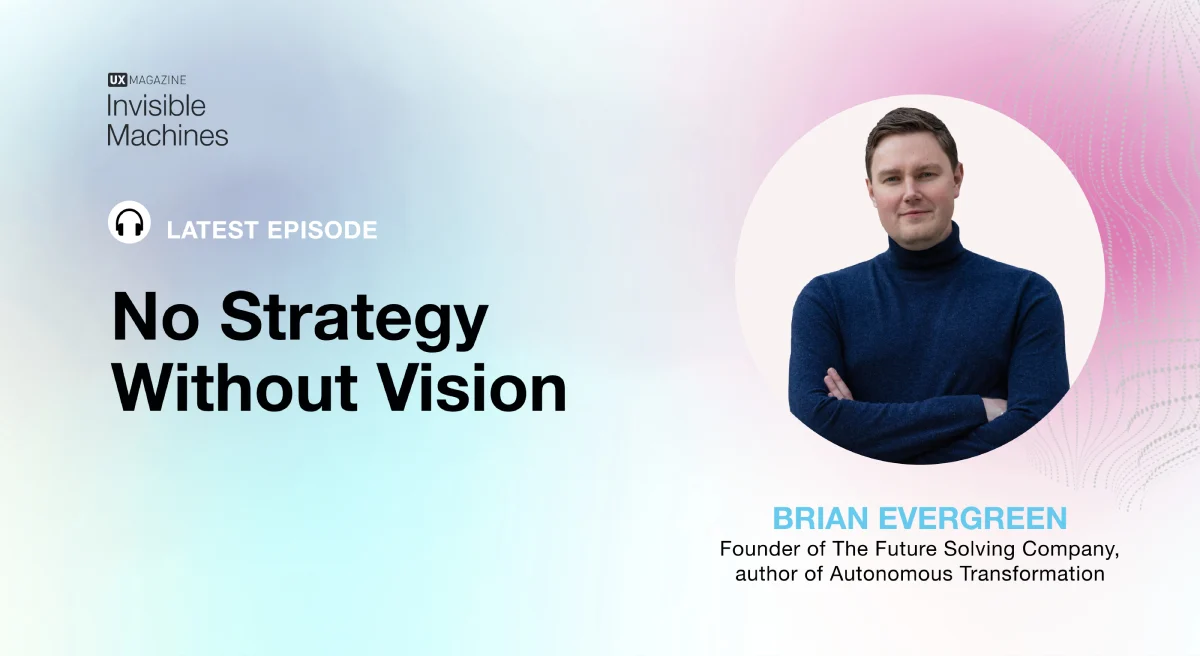
In the executive suites of the Fortune 500, a familiar, performative ritual is playing out. Boards are demanding an “AI strategy,” and leadership is responding with the only tools they have: RFPs, vendor shortlists, and feature matrices. They are building a plane while trying to fly it, but they are using a manual written for the age of fixed-cost software.
According to Brian Evergreen, founder of The Future Solving Company and author of Autonomous Transformation, this frantic motion is not strategy—it is an “agentic AI plan,” busy, intelligent, and profoundly hollow at its center. In a recent appearance on the Invisible Machines podcast, Evergreen argued that the modern corporate approach to AI is built for a world that no longer exists, and that until executives pivot from "problem solving" to "future solving," they are merely optimizing their own obsolescence.
The Ritual of the RFP: A Strategy for Yesterday
The misalignment begins with the definition of the work. When executives ask for an AI strategy, they are often performing a two-step: first, building enough technical literacy to sound credible in a board presentation; second, racing toward a list of use cases and a vendor bake-off.
Evergreen is sympathetic to the need for literacy. Just as a painter must understand the chemistry of pigments and the texture of the canvas, an executive must understand the distinction between generative AI, classical machine learning, and autonomous agentic systems. However, the trouble starts when literacy is mistaken for permission to sprint.
Current procurement motions—analyst quadrants, feature matrices, and oral defenses—are designed for a world of static products. They work beautifully when the problem is a SKU (Stock Keeping Unit). They fail spectacularly when the work is exploration. In the realm of agentic AI, there is no historical dataset for next year’s market structure, nor is there a replicated experiment for a business category that does not exist yet.
Trend lines are not physics. A common feature set across vendors is not an indicator of capability; in the era of rapid model iteration, a "missing" capability might be shipped as a side effect of an API update before the procurement cycle even concludes. By relying on static checklists, organizations are not buying innovation; they are buying legacy at a premium.
Chronology of a Misguided Shift: From Bell Labs to Blockbuster
To understand why the current approach is failing, one must look at the historical precedents of organizational transformation. Evergreen and podcast co-host Robb Wilson, CEO of OneReach.ai, highlight two pivotal case studies that illustrate the difference between tactical survival and visionary architecture.
The Blockbuster Trap
The story of Blockbuster is often cited as a failure of technology, but Evergreen insists it was a failure of alignment. Years before streaming became the industry standard, Blockbuster had a credible, streaming-shaped pilot. It failed not because the tech didn’t work, but because the business model was anchored to late-fee economics and a franchise-based customer-of-record. The streaming initiative was viewed as a threat to the balance sheet, cannibalizing the very structure that sustained the company. The lesson for today’s AI adopters: If you don’t "future-solve" a new model that aligns with your incentives, your organization will kill its own innovation to protect its existing P&L.
The Bell Labs Reset
In 1952, Bell Labs faced a crisis of stagnation. Despite being the birthplace of some of the most significant inventions in history, the organization was mired in the "embarrassing age" of its own legacy. Leadership initiated an unnatural, radical exercise: they forced teams to assume the entire telephone network was destroyed and irreparable. They then demanded that the engineers rebuild it from scratch, using only the science, economics, and regulations of 1952.
The goal wasn’t nostalgia for a monopoly; it was the creation of a "breakthrough cadence." They proved that innovation can be convened through a deliberate, structural reset rather than by hoping creativity strikes between calendar holds.
The Core Thesis: No Strategy Without Vision
Evergreen’s mantra is blunt: "No strategy without vision."
Most organizations begin with the current org chart and ask how they can make it 10% more efficient. This approach inherits every existing constraint as destiny. The alternative, while significantly harder, is to set the current system aside and articulate what the "most amazing version" of the organization’s work would look like.
This is not a mood board; it is a "visible map of necessary conditions." If you want to achieve a specific future, what must be true for that future to exist? You must map out the tools, data contracts, incentives, policies, and partnerships required to sustain it. Once that map is visible, the procurement process shifts from "checking boxes" to "securing necessary conditions."
Supporting Data: Why "Adoption" is a Vanity Metric
Josh Tyson, referencing Morgan Stanley’s work on a governed knowledge layer, points out that the real work of AI isn’t the model—it’s the ownership, freshness, and accountability of the data.
Evergreen suggests that if a vision isn’t visceral, it isn’t a vision; it’s just a goal. "We will be more profitable" is a scoreboard, not a strategy. A real vision is something you can picture: an advisor answering a complex inquiry in real-time, a clinician remaining present with a patient while the system handles the documentation, or a partner who trusts the AI because the relationship is governed by accountability.
This highlights a dangerous trend in modern digital transformation: using "adoption" as a proxy for success. If you force an organization to use an AI tool that doesn’t serve a clear, visionary purpose, you are merely achieving "wide usage of the wrong future." Friction, in this context, is infinite. Without a north star to act as a steamroller, the organization will spend all its energy navigating the bureaucracy of AI implementation rather than leveraging the technology to change the outcome.
Official Responses and Implications for the Future
The implications for the C-suite are severe. If an organization does not author its own future, a platform company will do it for them. We are moving toward a world where interfaces collapse and "intent" is handled end-to-end. In this environment, the winners will be those who move beyond transactions and focus on relationships.
Key Implications for Leadership:
- Stop Problem Solving, Start Future Solving: Problem solving is an elimination exercise—trimming waste and curating what you already have. Future solving is an exercise in appetite—deciding what you want to exist and working backward to build the necessary conditions.
- Redefine "Parity": In an age where software gains capabilities mid-flight, a vendor’s current feature list is a lagging indicator. Focus on the vendor’s capacity for evolution and alignment with your architectural goals.
- Map the Necessary Truths: Before issuing an RFP, build a map of what must be true for your vision to work. Use this map as the primary filter for your technology partners.
- Embrace the Emotional Work: Innovation is as much about human alignment as it is about technology. Leaders must be willing to address the "cannibalization" of existing roles and business models head-on, or they will face the same internal resistance that doomed Blockbuster.
Conclusion: The Architecture of Authorship
The future of AI is not discovered by measuring today’s processes with greater intensity. It is authored by those who are willing to define a future in language humans can carry, make the map of necessary truths visible, and only then negotiate the procurement of agents and models.
Real AI strategy is not a vendor bake-off on the deck of a ship whose heading has not been agreed upon. It is the courageous act of defining the destination, accepting the structural changes required to get there, and building a system that serves that vision—rather than one that merely replicates the status quo with better algorithms. In the coming years, the divide between the companies that simply "use AI" and those that "are AI" will be defined by one thing: the clarity of their vision.
 Ammar Sabilarrohman
  Neng Nana