
 By Dwi Wanna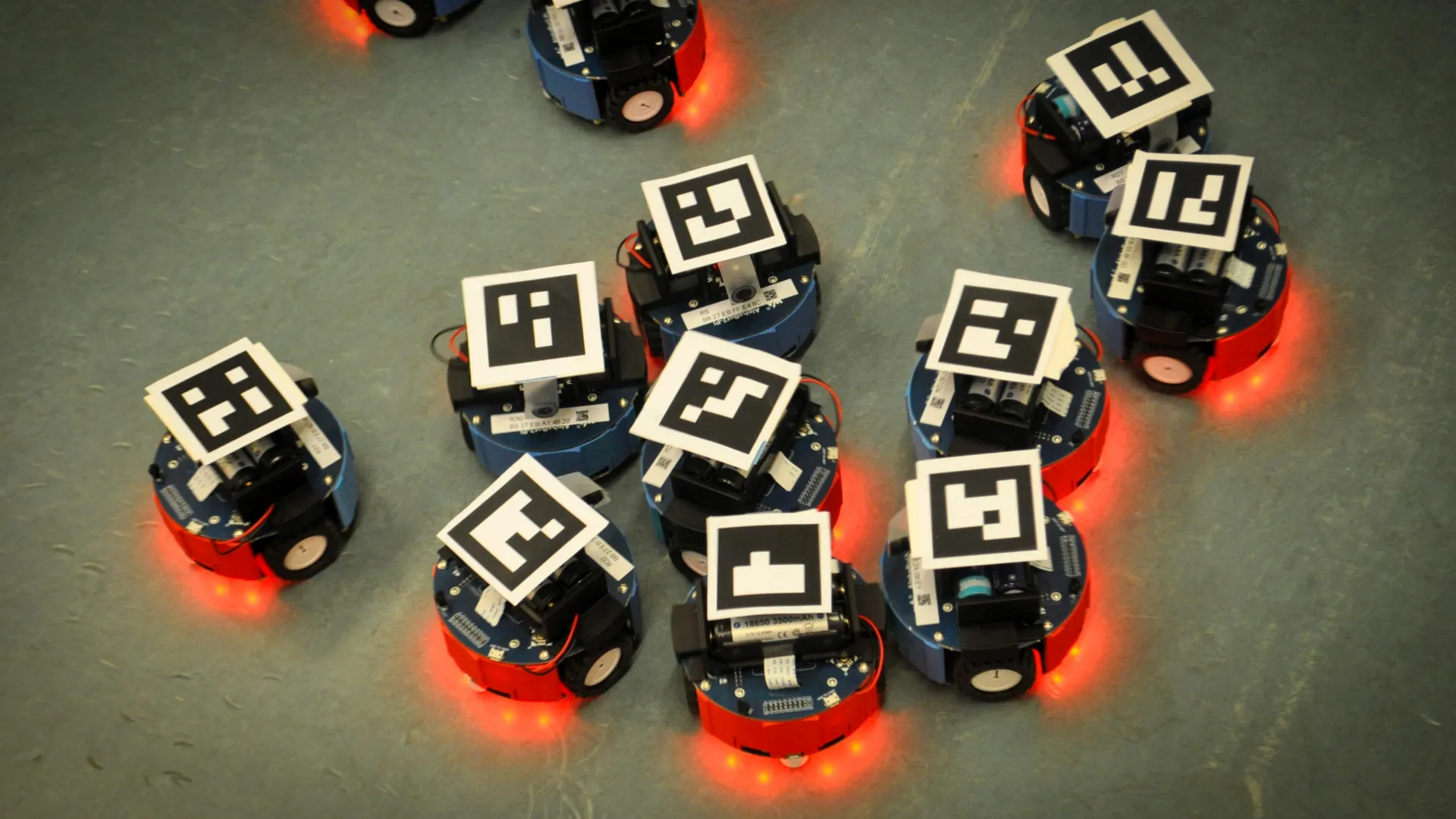
In the high-stakes world of autonomous robotics, bigger is not always better. When a fleet of robots is tasked with critical operations—such as decontaminating an oil spill, constructing complex infrastructure, or navigating a disaster zone—the immediate instinct is to scale up. Add more robots, the logic suggests, and the job will be finished faster. However, researchers have long grappled with the "crowding paradox": past a certain threshold, the addition of more units leads to a catastrophic decline in performance. As robots jostle for space and collide, the swarm descends into a gridlock of inefficiency.
Now, a team of researchers at Harvard University, led by applied mathematics Ph.D. student Lucy Liu and supervised by L. Mahadevan, the Lola England de Valpine Professor of Applied Mathematics, Organismic and Evolutionary Biology, and Physics, has identified a surprising solution. By introducing a "Goldilocks zone" of controlled randomness into robot movement, the team has discovered how to keep swarms moving fluidly, even in tightly constrained environments.
The Chronology of Discovery: From Theory to Laboratory
The research, recently published in the Proceedings of the National Academy of Sciences, did not happen in a vacuum. It was a multi-stage endeavor that bridged the gap between abstract mathematical modeling and tangible, physical hardware.
Phase 1: The Conceptual Framework
The project began with a fundamental question: How can we mathematically define the tipping point at which a productive swarm becomes a stagnant traffic jam? Liu and her colleagues, including SEAS Senior Research Fellow Justin Werfel, began by treating each robot as an "agent" within a dynamic system. They moved away from the complex programming of individual robotic "brains," instead viewing the swarm as an entity of "active matter."
Phase 2: Simulation and the "Noise" Variable
Before touching a physical robot, the team developed sophisticated computer simulations. They programmed these agents to move toward random destinations, which were reassigned the moment a robot reached its target. This mimicked the continuous, iterative nature of real-world labor.
The team introduced a variable they called "noise"—a degree of randomness in the robot’s trajectory. At zero noise, robots moved in perfect, rigid straight lines. At high noise, their paths became erratic and meandering. The simulations allowed the researchers to observe millions of iterations, providing the data necessary to identify exactly when and why gridlock occurred.
Phase 3: Experimental Validation
To prove the simulation held water, the team partnered with physicist Federico Toschi at the Eindhoven University of Technology in the Netherlands. They transitioned from pixels to physical hardware, using a fleet of small, wheeled robots confined to a lab floor. Equipped with QR codes, the robots were tracked by overhead cameras that fed real-time data back into the system. Despite the physical limitations of friction and motor precision, the robots mirrored the simulated patterns with startling accuracy, confirming that the "noise" variable was a universal lever for managing crowd flow.
Supporting Data: Finding the "Goldilocks Zone"
The core finding of the Harvard study is that efficiency is a function of the balance between order and chaos.
When robots followed perfectly straight paths, they frequently encountered one another head-on. Because they lacked the "wiggle room" to deviate, they would stop or cluster, creating traffic jams that cascaded through the entire swarm. Conversely, when the movement was too random, the robots spent more time wandering aimlessly than reaching their goals, leading to a precipitous drop in productivity.
The "Goldilocks zone" lies in the middle. In this range, the robots maintain enough directional intent to make progress toward their goals, but possess just enough "noise" to occasionally deviate from their paths. This deviation acts as a natural pressure-relief valve; when two robots are on a collision course, a slight, random adjustment allows one to slip past the other, preventing the formation of a cluster.
The mathematical modeling developed by Liu’s team allows operators to calculate the "goal attainment rate" based on two variables: the density of the swarm and the level of noise. For any given space, there is now a predictive formula to determine the exact amount of randomness required to maximize the throughput of the system.
Official Responses: Insights from the Lab
The implications of this study are profound, particularly regarding the philosophy of robotic control. For decades, the industry has focused on centralized coordination—systems where a master controller dictates the path of every robot to avoid collisions. This approach is computationally expensive and prone to failure if the central system loses communication.
"This might be counterintuitive, because how could randomness make things easier to work with?" says Lucy Liu. "But in this case, when you have a lot of randomness, it becomes possible to take averages—average distances, average times, average behaviors. This makes it a lot easier to make predictions."
Professor Mahadevan emphasizes the broader scientific significance, noting that the study challenges our understanding of self-organization. "Understanding how active matter, whether it is a swarm of ants, a herd of animals, or a group of robots, becomes functional and executes tasks in crowded environments using the principles of self-organization, is relevant to many questions in behavioral ecology," he explains.
By proving that simple, local rules—rather than complex, global directives—can optimize group behavior, the Harvard team has provided a blueprint for more resilient and scalable robotic fleets.
Implications: From Factory Floors to Urban Planning
While the study focused on robots, the potential applications for this research extend far beyond the laboratory. The mathematical tools developed by the team are applicable to any system where "agents" navigate a confined space.
1. Advanced Robotics and Logistics
In modern "dark warehouses" (automated distribution centers), thousands of robots retrieve goods for human packers. As companies push for faster shipping, these warehouses are becoming increasingly dense. Implementing the "noise" principle could allow these warehouses to operate at higher densities without the need for costly upgrades to traffic-control software.
2. Autonomous Vehicle Traffic
Traffic congestion is essentially a swarm problem. If autonomous vehicles are programmed to adopt a degree of "stochastic movement"—essentially mimicking the controlled randomness found in the Harvard study—they could potentially navigate dense intersections more effectively than human drivers, who are often prone to panicked or rigid reactions.
3. Human Crowd Management
The findings also offer potential insights for architecture and civil engineering. By understanding the "noise" thresholds of human pedestrians, city planners could design public spaces, stadium exits, and transit hubs that naturally encourage better flow, reducing the risk of dangerous crowd crushes and improving the efficiency of public movement.
4. Biological Research
As Mahadevan noted, the study provides a new lens through which to view behavioral ecology. By applying these mathematical models to natural swarms, biologists may be able to better understand how schools of fish or flocks of birds maintain their structure without a central "leader." It suggests that nature may have already "solved" the congestion problem using the same principle of controlled variability.
Conclusion: Embracing the "Noise"
The Harvard study serves as a poignant reminder that in complex systems, the drive for perfect efficiency can often be the very thing that destroys it. By embracing a degree of unpredictability, the researchers have managed to unlock a more stable, productive, and scalable method of swarm management.
As we move toward a future populated by autonomous fleets, the lesson is clear: sometimes, to get where we are going faster, we need to allow ourselves—and our robots—a little bit of room to wander.
Funding for this research was provided by the National Science Foundation Graduate Research Fellowship Program (Grant No. DGE 2140743), the Simons Foundation, and the Henri Seydoux Fund.
 Sagoh
Sagoh  Asro
Asro  Siti Muinah