
 By rifanmuazin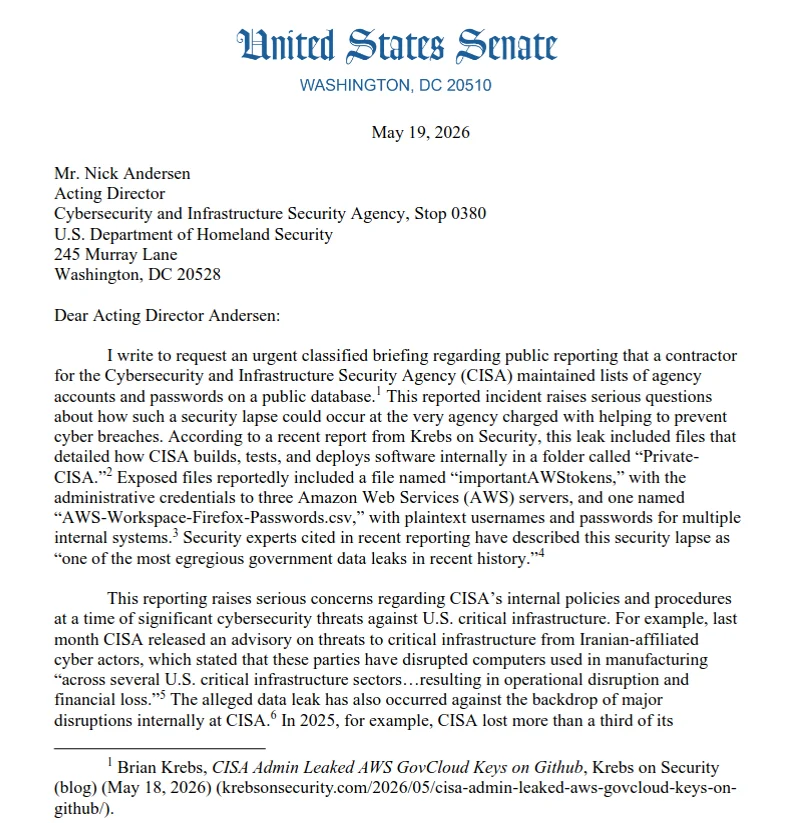
The Cybersecurity and Infrastructure Security Agency (CISA)—the very entity tasked with safeguarding the digital architecture of the United States—is currently grappling with a self-inflicted security crisis of profound proportions. Following an investigation by KrebsOnSecurity, it has been revealed that a CISA contractor inadvertently, yet intentionally, published a trove of highly sensitive internal credentials and AWS GovCloud keys onto a public GitHub repository.
This lapse has not only compromised the agency’s internal security posture but has triggered an immediate and aggressive inquiry from Congress. As federal lawmakers demand accountability, the incident serves as a stark reminder of the vulnerability inherent in modern, decentralized digital workflows and the difficulty of maintaining perimeter security in an era of remote work and third-party reliance.
The Breach: A "Private" Repository Made Public
The core of the incident centers on a public GitHub profile titled "Private-CISA." Created by a contractor with administrative access to the agency’s internal code development platforms, the repository functioned less like a managed project and more like a digital "scratchpad."
Evidence reviewed by security researchers suggests that the contractor deliberately bypassed GitHub’s built-in security features, which are specifically designed to detect and block the uploading of plaintext credentials. By disabling these safety protocols, the contractor effectively opened the front door to some of the agency’s most sensitive systems. The repository, which sat publicly accessible for an indeterminate period, contained dozens of plaintext files, including AWS GovCloud access tokens, configuration files (kube-config.txt), and saved browser credentials, effectively providing a roadmap for any malicious actor capable of scraping public GitHub activity.
A Chronology of the Exposure
The timeline of the exposure highlights a dangerous lag between the creation of the vulnerability and the agency’s remedial response.
- November 2025: The "Private-CISA" repository is initially established. Security experts analyzing the commit logs suggest that the user utilized the repository as a synchronization tool to move files between professional and personal workstations.
- Late April 2026: The repository receives a significant influx of high-value, sensitive data, including critical AWS GovCloud tokens. This is identified by researchers as the point of highest risk.
- May 18, 2026: KrebsOnSecurity publicly reports the breach, bringing the "Private-CISA" profile to national attention.
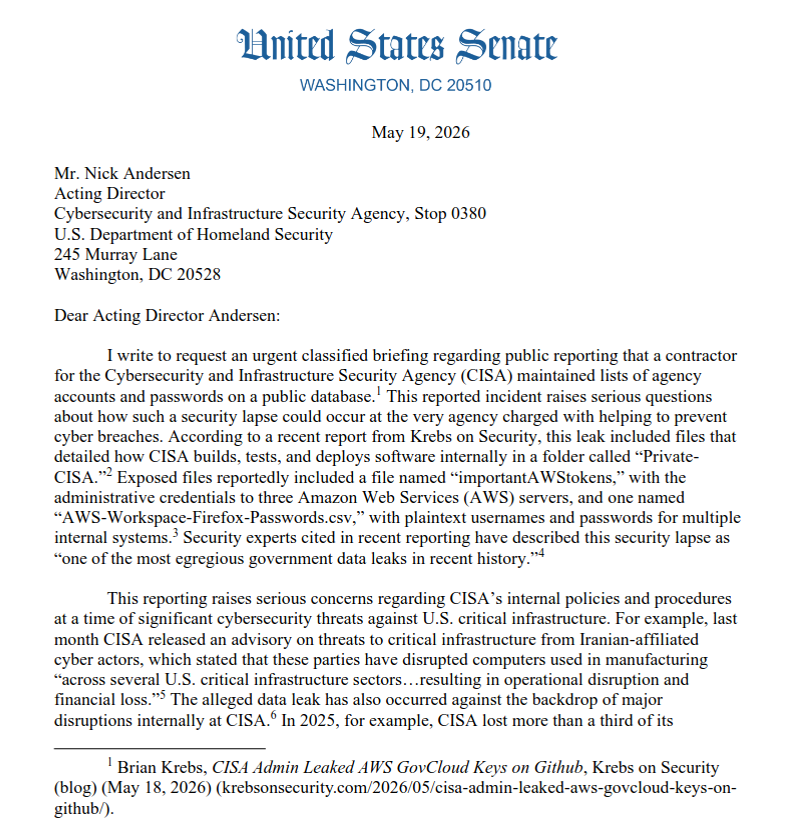
- May 19, 2026: Congressional leadership, including Senator Maggie Hassan (D-NH) and Representative Bennie Thompson (D-MS), issue formal letters of inquiry to CISA’s acting leadership, demanding a full accounting of the breach.
- May 20, 2026: Dylan Ayrey, founder of Truffle Security, identifies that a critical RSA private key—which granted full access to CISA’s enterprise GitHub account—remained live and unrevoked despite the initial reports.
- Post-May 20, 2026: Following direct notification, CISA begins the painstaking process of invalidating specific tokens. However, reports persist that numerous other credentials remain unrotated, leaving the agency’s infrastructure in a state of continued exposure.
The Technical Fallout: What Was at Stake?
The nature of the exposed data suggests a potential for total system compromise. According to Dylan Ayrey, the RSA key left active in the repository was not merely a password; it was a master key to CISA’s IT organization on GitHub.
"An attacker with this key could read source code from every repository in the CISA-IT organization, including private repos," Ayrey explained. Beyond simple data theft, such access allows for the injection of malicious code into the agency’s CI/CD (Continuous Integration and Continuous Delivery) pipelines. By hijacking these automated systems, an adversary could effectively weaponize the agency’s own update processes, pushing malicious software to other government agencies or critical infrastructure partners—the very nightmare scenario CISA is meant to prevent.

The exposure of "kube-config" files further suggests that the contractor had access to Kubernetes clusters, which manage large-scale containerized applications. Accessing these files would allow an attacker to gain administrative control over the underlying cloud infrastructure, potentially enabling them to move laterally through the agency’s network.
Institutional Fragility: A Diminished Agency
This security failure is occurring against a backdrop of significant institutional turbulence. CISA has recently undergone a massive reorganization following the transition of power, which resulted in the loss of over one-third of its total workforce. The departure of a vast majority of senior leadership—due to a combination of forced retirements, buyouts, and resignations—has raised concerns about the agency’s "institutional memory" and its ability to maintain rigorous security standards during a time of transition.
Senator Maggie Hassan emphasized this point in her May 19 letter to Acting Director Nick Andersen. "This reporting raises serious concerns regarding CISA’s internal policies and procedures at a time of significant cybersecurity threats against U.S. critical infrastructure," she wrote, questioning how an agency defined by its expertise could fall victim to such a fundamental lapse in basic cybersecurity hygiene.
The Congressional Response
The bipartisan outcry has been swift. Representative Bennie Thompson, alongside Representative Delia Ramirez, issued a scathing critique of CISA’s management. Their letter suggests that the leak is symptomatic of a broader decay in the agency’s security culture.
"It’s no secret that our adversaries—like China, Russia, and Iran—seek to gain access to and persistence on federal networks," the letter stated. "The files contained in the ‘Private-CISA’ repository provided the information, access, and roadmap to do just that."
Lawmakers are now pushing for answers on several fronts:
- How was a contractor able to bypass security protocols?
- Why did the internal monitoring systems fail to flag the exposure for over six months?
- What is the current status of all leaked credentials, and have they all been fully rotated?
- How does CISA intend to audit its existing contracts to ensure that no other "shadow" repositories exist?
The Human Factor: The Unsolvable Problem?
While CISA has stated that there is "no indication that any sensitive data was compromised," security experts remain skeptical. The reality of modern software development is that GitHub and similar platforms are constantly monitored by both security researchers and sophisticated state-sponsored threat actors.
"We monitor that firehose of data for keys," said Dylan Ayrey. "We have evidence attackers monitor that firehose as well. Anyone monitoring GitHub events could be sitting on this information."
The incident highlights a difficult reality: technical controls can only go so far. As noted by James Wilson and Adam Boileau of the Risky Business podcast, this breach is fundamentally a "human problem." When a contractor decides to synchronize sensitive work data to a personal account, they bypass the perimeter entirely. If that action is taken outside of CISA’s managed environment, traditional IT monitoring tools have no visibility into the activity.
This raises a vital question for federal agencies: How do you enforce security policy on a distributed, contractor-heavy workforce? The reliance on external vendors for high-level development tasks necessitates a level of trust that, as this incident proves, is frequently misplaced.
Conclusion: Implications for Federal Cybersecurity
The CISA breach is more than just a minor administrative error; it is a wake-up call for the entire federal cybersecurity apparatus. It demonstrates that even the "gold standard" agencies are susceptible to the same risks of credential leakage and insider negligence that plague the private sector.
As CISA continues the work of rotating compromised keys and conducting internal forensic audits, the pressure from Congress will only intensify. The agency must now work to restore its credibility, not only by fixing the immediate technical failures but by fundamentally re-evaluating how it manages contractors, monitors code repositories, and maintains its security culture in a post-reorganization environment.
For the present, the "Private-CISA" repository serves as a cautionary tale: in the digital age, security is not just about defending against external attacks, but about controlling the internal behaviors that make those attacks possible in the first place.
 Sagoh
Sagoh  Evan Lee Salim
  Ammar Sabilarrohman