
 By Nana Wu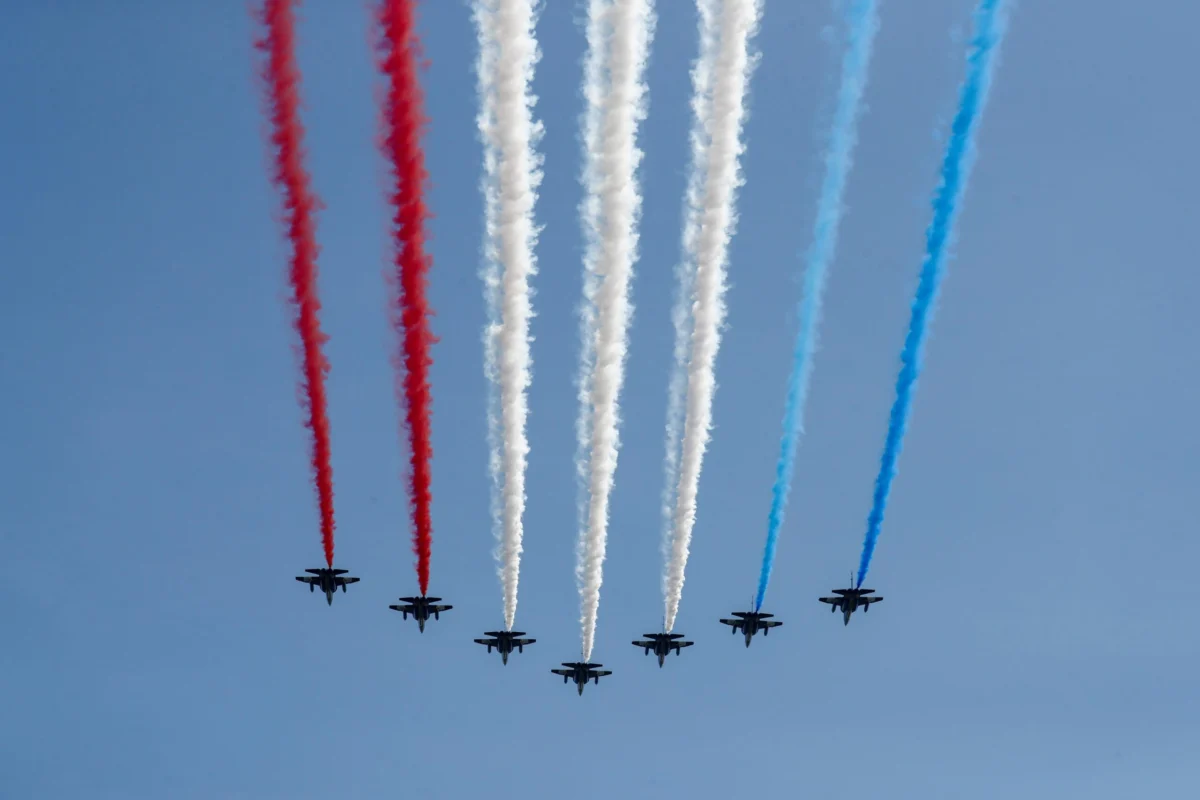
As the United States of America marked its semiquincentennial—a milestone 250 years in the making—the national atmosphere was defined by a stark, almost dizzying paradox. From the shimmering lights of the Eiffel Tower, illuminated in red, white, and blue, to the celebratory pyrotechnics over Tokyo, the global reach of the American experiment was on full display. In New York City, French fighter jets streaked the skyline with the tricolor, a poignant tribute from the nation’s first major ally. Yet, simultaneously, the heart of the American capital was marred by the sight of neo-fascist groups parading through the streets, casting a long, dark shadow over the festivities.
This duality is the defining characteristic of the United States. It is a nation built on radical, aspirational ideals that have frequently collided with the realities of its own fallibility. As we move further into 2026, the question is no longer just about celebrating history, but about the survival of the foundational document that makes the American project possible: the Constitution, and specifically, the First Amendment.
A Chronology of Constraint: From 1776 to the Present
The narrative of American freedom is not a steady upward climb; it is a jagged line of progress and regression. While the Declaration of Independence in 1776 provided the nation’s moral soul, the Constitution, ratified over a decade later, provided its functional anatomy.
The First Amendment was intended as a "day-one" safeguard for a society that the Framers knew would be forever imperfect. It was designed to allow for self-correction through the power of expression. However, the history of this amendment is a record of constant friction between government power and individual liberty.
The Adams Era and the Sedition Act
Hardly had the ink dried on the Constitution before its principles were tested. President John Adams, a man instrumental in the revolution against British tyranny, oversaw the passage of the Alien and Sedition Acts of 1798. These laws, which allowed for the deportation of foreigners and criminalized "scandalous and malicious" writings against the government, served as a grim precursor to modern authoritarian rhetoric. Adams, while ostensibly a patriot, succumbed to the fear of dissent, establishing a precedent that would haunt the American executive branch for centuries.
The World War I "Fire" Fallacy
In the early 20th century, the Supreme Court took up the mantle of restriction. The infamous phrase, "You can’t shout ‘fire’ in a crowded theater," originated from Justice Oliver Wendell Holmes during the 1919 Schenck v. United States decision. The case did not involve public safety, but rather the government’s desire to imprison an American socialist for distributing pamphlets opposing the military draft. Though the legal reasoning in Schenck was later undermined by subsequent rulings, the cultural myth of the "fire" in the theater persists as a tool to justify the suppression of political speech.
The Modern Crisis: Law Enforcement and Federal Overreach
In 2026, the threat to the First Amendment has taken on a more visceral, immediate form. Across the country, the interaction between citizens and law enforcement has become a flashpoint for constitutional litigation.
The "First Amendment Auditor" Phenomenon
The systemic failure of police departments to understand the boundaries of the First Amendment has birthed a cottage industry of "First Amendment auditors." These individuals—streamers and activists—deliberately test the limits of their right to record public servants in the performance of their duties. The viral nature of these confrontations on social media platforms like TikTok has laid bare a disturbing reality: many law enforcement agents view the simple act of recording as an act of non-compliance, leading to unnecessary escalations, unlawful detentions, and, in far too many cases, the physical assault of journalists and citizens alike.
The Federalization of Policing
The current administration has exacerbated this friction by flooding metropolitan areas with federal agents who operate with minimal local oversight. These agents, often poorly trained in the nuance of constitutional law, treat constitutionally protected protest as a security threat. The resulting incidents—deaths during protests, the harassment of news crews, and the chilling of public assembly—demonstrate a fundamental shift in how the state views the citizenry. The right to protest is not a nuisance; it is the fundamental mechanism by which a democracy ensures its government remains accountable.
Supporting Data: The Erosion of Free Expression
The assault on speech is not merely physical; it is institutional. The current political climate has seen a blurring of public and private interests that threatens the integrity of the information ecosystem.
- Broadcast Media and Patronage: The Federal Communications Commission (FCC), tasked with managing the airwaves, has increasingly become a site of political maneuvering. Reports indicate that broadcast networks, fearful of regulatory retaliation from the executive branch, have engaged in a pattern of self-censorship, removing hosts who express views critical of political allies of the current administration.
- The "Censorship" Paradox: We currently inhabit a "funhouse-mirror" reality. Political actors frequently decry "censorship" when private social media companies moderate content according to their terms of service. Simultaneously, these same actors support genuine, state-sponsored censorship, such as the removal of books from public school libraries.
- The Tech Industry’s Submission: Major technology CEOs, who command more capital and reach than most nation-states, have shown a profound willingness to capitulate to executive threats. The instance of a major social media CEO being publicly threatened with life imprisonment, only to later appear as a guest of the same administration at a state-sponsored event, illustrates a total collapse of corporate independence in the face of autocracy.
Official Responses and Administrative Logic
The administration maintains that its actions are necessary to maintain "national security" and "social order." In official briefings, spokespeople have repeatedly argued that the spread of information deemed "misleading" or "destabilizing" justifies the increased presence of federal agents and the monitoring of online discourse.
However, constitutional scholars argue that this logic is fundamentally circular. If the state determines what is "misleading," it effectively claims the power to define the truth—a power the First Amendment was explicitly designed to deny the government. The administration’s rhetoric frames dissent as a form of existential danger, effectively turning the constitutional protection of speech into a "privilege" that can be revoked based on the political climate.
Implications for the Future of American Democracy
The long-term implications of these trends are severe. When the government, the judiciary, and the corporate sector align to suppress or coerce speech, the "constitutional punchbowl" is effectively poisoned.
- The Death of the Public Square: As the barrier between the government and the platforms we use to speak to one another dissolves, the public square is becoming a place of surveillance rather than exchange.
- The Normalization of Authoritarianism: By labeling dissent as "un-American" or "dangerous," political leaders are conditioning the public to accept the restriction of rights as a necessary trade-off for security.
- The Erosion of Legal Recourse: As the judiciary becomes increasingly polarized, the ability of regular citizens to find protection from the courts is diminishing. When the law is no longer seen as a tool for protecting the vulnerable but as a weapon for the powerful, the rule of law itself begins to fail.
Conclusion: A Call to Action
The First Amendment is not a self-executing promise; it is a restraint on government power that requires constant vigilance. It is not violated when a private platform removes content; it is violated when the government forces that removal or retaliates against those who speak.
The current crisis is not a distant problem; it is a local one. The battle for the future of the First Amendment will be won or lost in school board meetings, city council sessions, and at the ballot box. Supporting local journalism, participating in the democratic process, and refusing to accept the "new normal" of government overreach are the only defenses against the further degradation of our liberties.
The United States has survived 250 years by acknowledging that it is a project in progress. To survive the next 250, it must rediscover the courage to protect the very speech that the powerful find most inconvenient. As we reflect on our history, we must realize that the "spectacle" of our anniversary will mean nothing if the foundations upon which it is built are allowed to crumble.
 Raul Delapena Setiawan
  Siti Muinah
  Asro
Asro 