
 By Asro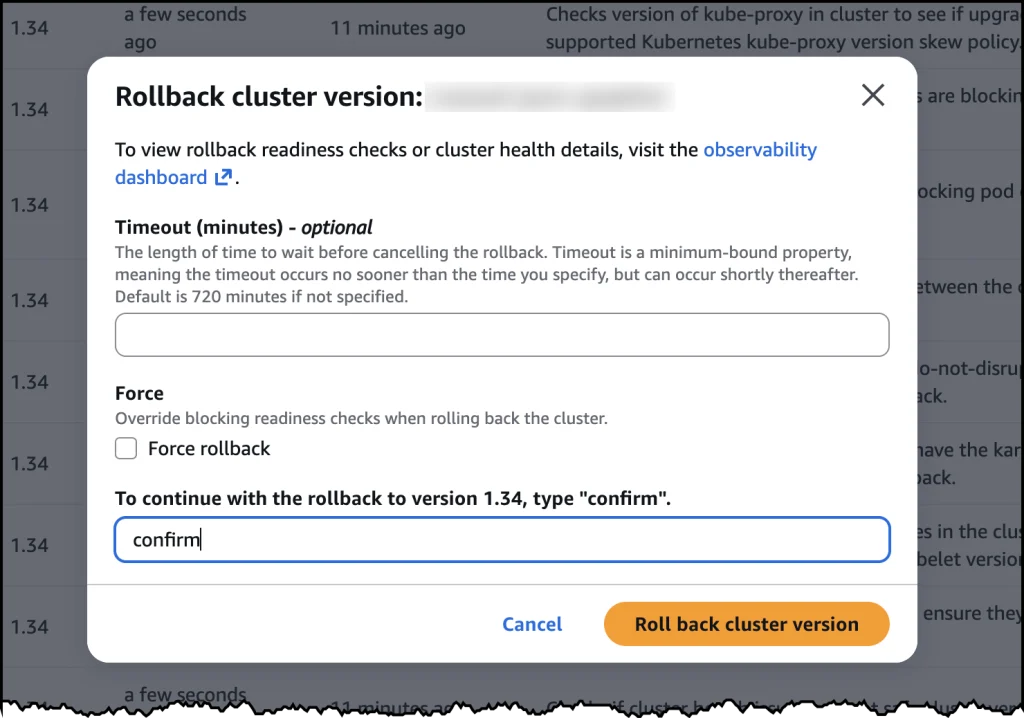
In the high-stakes world of cloud-native infrastructure, the Kubernetes control plane upgrade has long been viewed with a mixture of necessity and dread. For years, the open-source Kubernetes ecosystem has functioned on a "one-way door" philosophy: once an upgrade is initiated, there is no native mechanism to revert to a previous state. Today, Amazon Web Services (AWS) has fundamentally altered that landscape, announcing the immediate availability of native version rollbacks for Amazon Elastic Kubernetes Service (Amazon EKS). This development promises to transform how enterprise organizations manage their clusters, effectively providing an "undo button" for one of the most critical maintenance tasks in modern DevOps.
Main Facts: A New Paradigm for Cluster Lifecycle Management
The newly announced feature allows administrators to reverse a Kubernetes minor version upgrade within a seven-day window. Unlike experimental community efforts—such as those explored in KEP-4330, which relies on emulated versions that keep clusters in a transitional state—AWS has implemented a robust mechanism that returns the cluster to a fully validated, production-proven state.
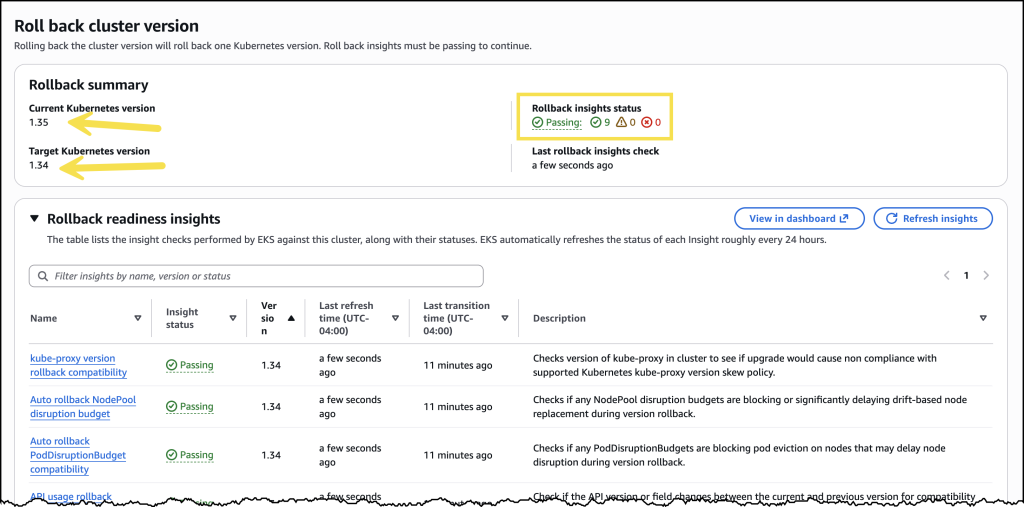
When a team upgrades a cluster from, for instance, Kubernetes 1.34 to 1.35 and encounters unforeseen compatibility issues, they no longer need to scramble to rebuild infrastructure or troubleshoot under the pressure of a broken production environment. The EKS rollback feature handles the heavy lifting, reverting the control plane to the previous version. Furthermore, the feature is deeply integrated with EKS’s existing ecosystem, including Cluster Insights, which provides automated, proactive assessments of rollback readiness, such as flagging potential conflicts with node versions or add-on dependencies.
Chronology: The Evolution of the "One-Way Door" Problem
To understand the magnitude of this release, one must look at the historical friction inherent in Kubernetes maintenance.
- The Early Days of Kubernetes: The platform was designed with a philosophy of constant forward momentum. Versioning was linear, and the complexity of state synchronization made the concept of a "rollback" technically daunting for the upstream community.
- The Rise of Compensating Mechanisms: As organizations scaled to hundreds of clusters, the lack of a rollback mechanism forced the industry to innovate around the problem. This gave birth to expensive, time-consuming strategies: months-long "bake periods," staggered upgrade groups, elaborate automated sign-off processes, and rigorous manual testing.
- The Versioning Crunch: With the Kubernetes community maintaining a cadence of three minor releases per year, many enterprises found themselves in a perpetual state of "upgrade debt." Fearing that an upgrade could lead to downtime without a recovery path, many teams opted to delay updates entirely, leaving their infrastructure vulnerable to security exploits and eventually forcing them into costly extended support cycles.
- The Turning Point: Recognizing this industry-wide pain point, AWS engineers began developing a native solution within EKS. By leveraging the specific way EKS manages the control plane and node lifecycle, they created a controlled environment where the previous configuration could be restored reliably.
Supporting Data: Why This Matters for Enterprise Stability
The data behind the necessity of this feature is clear: fear of failure is the primary driver of technical stagnation. For regulated industries, such as finance and healthcare, the inability to roll back a cluster upgrade has historically been a non-starter for high-frequency deployment cycles.
According to industry trends observed by AWS, the most common barriers to keeping clusters up-to-date include:

- Incompatibility Risk: Unexpected behavior between new API versions and existing third-party operators.
- Add-on Fragility: Dependencies on CNI (Container Network Interface) plugins or storage drivers that may not support the latest minor release.
- Operational Overhead: The massive labor cost of manual validation, which often exceeds the cost of the infrastructure itself.
By introducing this feature, AWS is not just adding a tool; they are reducing the risk profile of every EKS user. The capability is available in all commercial AWS Regions at no additional cost, reinforcing the platform’s value proposition for teams that require high availability without the anxiety of "point-of-no-return" maintenance.
EKS Auto Mode: Managing Complexity at Scale
While the rollback feature applies to all EKS clusters, the implementation is particularly sophisticated for those utilizing EKS Auto Mode. This managed service tier abstracts away compute, networking, and storage, effectively allowing users to treat their entire Kubernetes footprint as a single entity.
When an Auto Mode cluster is rolled back, the process is inherently more complex than a standard control plane revert. Because the managed nodes must also be brought back into sync with the previous version, the process must strictly adhere to Pod Disruption Budgets (PDBs).
AWS has introduced a new Cancel API specifically for this purpose. If a user realizes mid-rollback that the process is impacting traffic or taking longer than anticipated due to complex PDB configurations, they can pause the operation. This level of granular control is a departure from traditional "black box" management, putting the power of intervention back into the hands of the cluster operator.
Official Responses and Strategic Implications
The introduction of version rollbacks is being framed by the AWS team as a definitive shift in the "managed" experience. By providing this safety net, AWS is effectively encouraging faster adoption of new Kubernetes versions.
"We want to remove the fear factor from the upgrade process," an AWS representative stated during the announcement. "By ensuring that our customers have a reliable way to return to a known good state, we are empowering them to move faster, test more frequently, and keep their environments secure without the risk of extended downtime."
Implications for the DevOps Landscape
- Shift in Testing Strategies: Organizations can now move away from the "massive, once-a-year" upgrade cycle toward more frequent, incremental updates. The existence of the rollback feature serves as a form of insurance, allowing teams to test in production with significantly lower risk.
- Increased Compliance Confidence: For organizations in highly regulated environments, the ability to document a successful rollback procedure provides a tangible benefit during compliance audits. It proves that the organization has a robust disaster recovery plan for its primary orchestration layer.
- Standardization: As EKS becomes the standard for enterprise Kubernetes, this feature will likely become a benchmark against which other managed Kubernetes providers are measured. It sets a new standard for what it means to offer a "fully managed" service.
Getting Started: A Seamless Integration
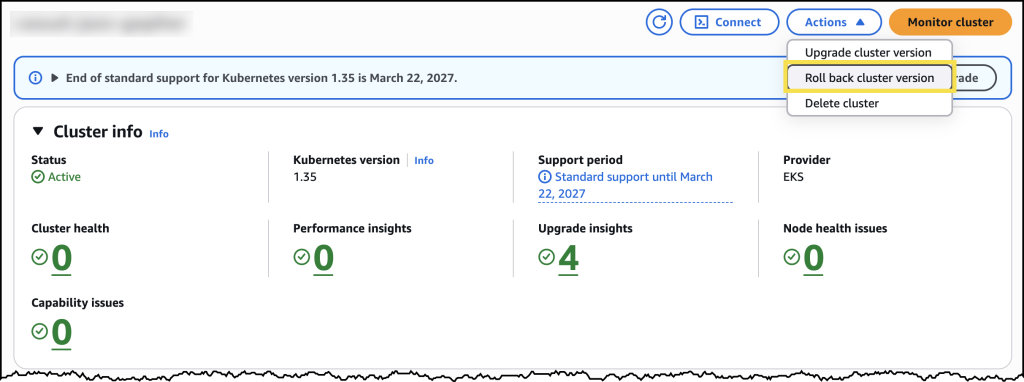
For administrators ready to utilize the feature, the process is intentionally integrated into the existing EKS Console experience. The workflow is as follows:
- Visibility: Users navigate to the cluster configuration page, where the rollback window is clearly displayed.
- Assessment: Before the rollback begins, the system automatically pulls data from "Cluster Insights." This identifies any potential blockers—such as deprecated APIs or incompatible add-ons—before the action is taken.
- Execution: Once the user initiates the process, the control plane rollback occurs, typically taking around 20 minutes.
- Node Reconciliation: For Auto Mode clusters, the system handles the orderly replacement of nodes, respecting pre-configured disruption budgets to ensure that application traffic remains uninterrupted.
Conclusion
The release of native version rollbacks for Amazon EKS represents a maturing of the Kubernetes ecosystem. It acknowledges the reality that, despite the best CI/CD practices and staging environments, the unpredictable nature of complex, distributed systems requires a fail-safe.
By removing the "one-way door," AWS is enabling a new era of confidence in cloud-native infrastructure. Teams that were previously paralyzed by the risks of upgrading are now equipped with the tools to maintain their clusters with agility and security. As the Kubernetes landscape continues to evolve at a rapid pace, features like this serve as the foundational bedrock upon which stable, scalable, and resilient enterprise applications are built. The "undo button" is no longer a luxury—it is the new baseline for professional cloud operations.
 Neng Nana
  Suro Senen
  Lina Hope