
 By Laily UPN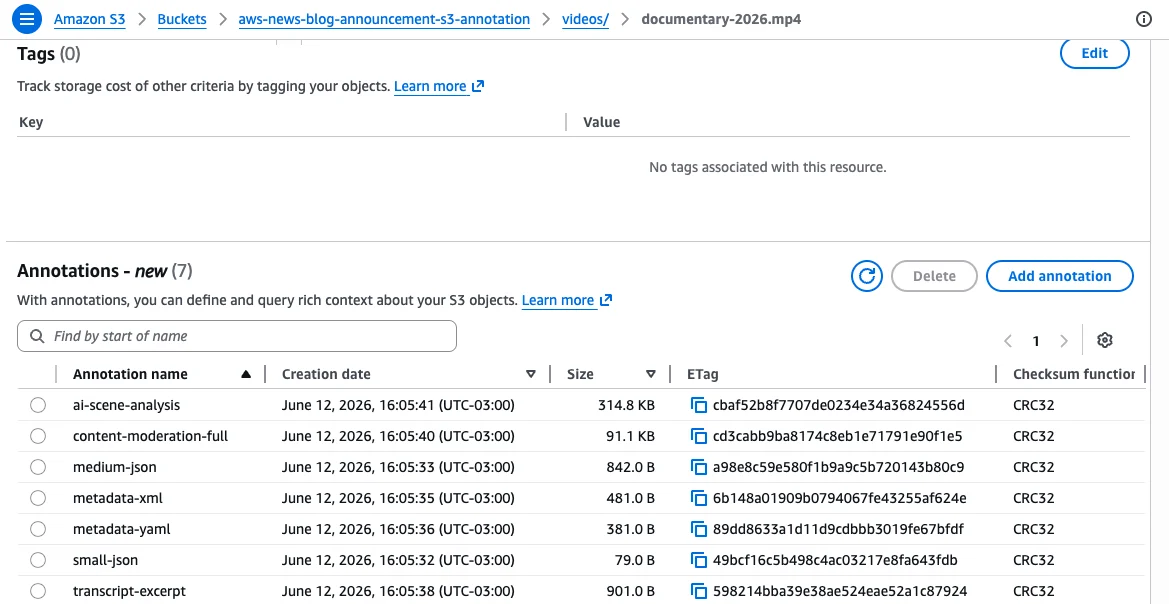
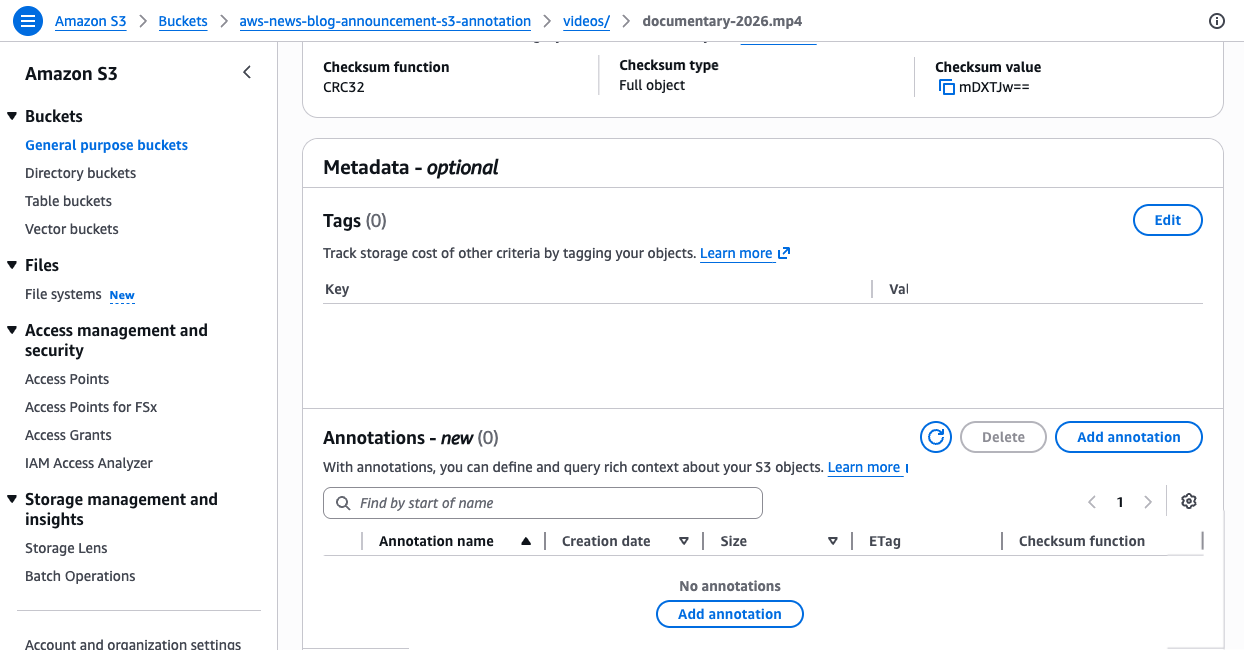
In a move set to transform how enterprises manage, query, and derive value from massive data estates, Amazon Web Services (AWS) has announced a groundbreaking metadata capability for Amazon Simple Storage Service (S3): S3 Annotations. This new feature allows organizations to attach rich, large-scale business context directly to their objects, effectively bridging the gap between raw data storage and intelligent, agentic AI workflows.
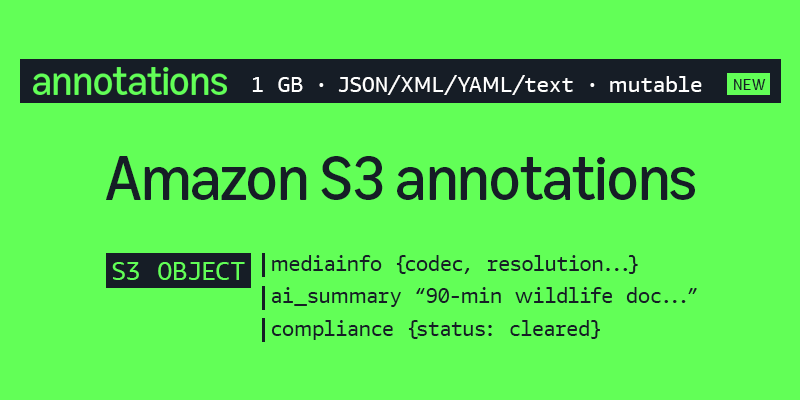
By moving away from the constraints of traditional, limited metadata headers, S3 Annotations enable the storage of up to 1,000 named annotations per object, with each annotation supporting up to 1 MB of data. With a total capacity of 1 GB of metadata per object, this capability is designed for the modern era of AI, where context is as valuable as the data itself.
Main Facts: A Paradigm Shift in Object Metadata
For years, the industry has relied on standard metadata—size, storage class, and basic user-defined headers—to categorize data. However, as organizations pivot toward building autonomous AI agents and complex, event-driven pipelines, these legacy methods have become a bottleneck.
S3 Annotations fundamentally change the storage landscape by providing:
- Scale: Support for up to 1 GB of metadata per object, allowing for rich JSON, XML, YAML, or plain text content.
- Mutability: Unlike standard object tags, which are often static or cumbersome to update, annotations can be modified or deleted at any time without requiring the parent object to be re-written.
- Portability: Context travels with the object during replication, copying, or cross-region transfers, ensuring consistency across the global data fabric.
- Queryability: Through integration with S3 Metadata tables and Amazon Athena, these annotations become instantly queryable, allowing businesses to derive insights without needing to build or maintain separate, expensive sidecar databases.
This release effectively eliminates the "metadata tax"—the cost and operational complexity of maintaining external synchronization workflows to keep object context aligned with the actual files.
Chronology of Metadata Evolution
To understand the magnitude of this announcement, one must look at the evolution of S3’s object management capabilities:
- The Foundational Era (System-Defined Metadata): At its inception, S3 provided essential system-level properties like creation time, file size, and storage class. This was sufficient for basic retrieval but lacked business-specific insights.
- The Operational Era (Object Tags): Recognizing the need for cost allocation and lifecycle management, AWS introduced object tagging. These allowed for granular control but were limited to 10 tags with small character counts, making them unsuitable for complex data schemas.
- The Custom Era (User-Defined Metadata): Users began adding small snippets of metadata at upload time, but these were largely static and immutable once the object was stored, creating "data silos" where the context could not evolve with the business logic.
- The Intelligent Era (S3 Annotations): Today’s announcement marks the arrival of dynamic, queryable, and high-capacity metadata. By providing a scalable framework that supports evolving AI needs, AWS is shifting the focus from simply storing bytes to understanding them in context.
Supporting Data: Why Annotations Outperform Existing Models
The following table illustrates the stark difference between previous metadata methods and the new S3 Annotations capability:
| Capability | Max Size | Mutable? | Best For |
|---|---|---|---|
| System Metadata | Fixed | No | Basic object properties |
| User Metadata | 2 KB | No | Small, static key-value pairs |
| Object Tags | 10 tags | Yes | Lifecycle/Access control |
| Annotations | 1 GB | Yes | Rich, evolving business context |
By offering a 1 GB capacity—a massive leap from the 2 KB limit of traditional user-defined metadata—AWS is enabling use cases previously impossible within S3, such as attaching AI-generated summaries, high-fidelity technical specs, or detailed compliance audit logs directly to the underlying object.
Implications for AI and Autonomous Agents
The most significant implication of this release is the empowerment of agentic workflows. As organizations deploy AI agents to autonomously crawl and act upon data, the ability to "discover" information without querying an external database is a game-changer.
Seamless Integration with AI Frameworks
When annotations are enabled via S3 Metadata tables, they are indexed into a fully managed Apache Iceberg table. This allows developers to use Amazon Athena to perform complex analytical queries across petabytes of metadata. For instance, an AI agent could search for "all video assets with more than 8 audio tracks" or "all documents containing specific sensitive PII labels" by simply querying the annotation table.
Furthermore, the integration with the S3 Tables MCP (Model Context Protocol) server allows AI models to interact with this data using natural language. This means developers can build agents that not only find data but understand its context, drastically reducing the time-to-insight for data science and machine learning teams.
Operational Efficiency
Previously, if a media company needed to store technical metadata for thousands of videos, they would have likely built a dedicated database (such as Amazon DynamoDB or an RDS instance) to map object keys to metadata. This required:

- Synchronizing data between S3 and the database.
- Handling latency when the two systems went out of sync.
- Paying for redundant storage and compute overhead.
With S3 Annotations, this process is internalized. The metadata lives in S3, is automatically backed up with the object, and is indexed automatically. This reduces the total cost of ownership (TCO) and simplifies the architectural footprint of data-heavy applications.
Official Perspective and Implementation Details
Daniel Abib, representing the AWS S3 team, emphasized that the goal of this feature is to allow data to remain "self-describing." By embedding context directly into the storage layer, organizations can ensure that their metadata remains as resilient and durable as their data itself.
Getting Started: A Developer-Centric Approach
Implementation is designed to be developer-friendly, utilizing standard AWS CLI or SDK calls. By ensuring that IAM permissions are correctly configured for s3:PutObjectAnnotation and s3:GetObjectAnnotation, developers can start enriching their existing data immediately.
For example, attaching a JSON-formatted technical specification is as straightforward as:
aws s3api put-object-annotation
  --bucket my-media-bucket
  --key data/record.json
  --annotation-name tech_specs
  --annotation-payload ./specs.json
The system is also built for scale. When enabled, S3 automatically backfills existing annotations into a queryable table, a process that happens in the background to ensure no impact on performance or availability.
Future Outlook: A New Standard for Data Management
The introduction of S3 Annotations is not merely a feature release; it is a fundamental shift in the definition of "object storage." By treating metadata as a first-class citizen with the same storage durability and availability as the object itself, AWS is setting a new standard for how cloud-native data should be managed.
As we look toward the future, the ability for AI agents to query, parse, and update this metadata in real-time will likely become the backbone of enterprise data strategy. Whether it is compliance teams tracking the lifecycle of sensitive documents, or media companies automating their archival processes, S3 Annotations provide the flexibility required to navigate the complexities of the modern digital landscape.
For organizations currently struggling with the "sidecar file" problem or the limitations of traditional tagging, this new capability offers a clear path forward. It is a reminder that in the age of AI, the value of data is locked within its context—and with S3 Annotations, that context is finally fully accessible, scalable, and secure.
For those ready to integrate this into their infrastructure, full documentation is available via the AWS S3 user guide, and the feature is currently available in all AWS Regions, including AWS China. The era of "blind storage" is over; the era of "intelligent storage" has begun.
 Neng Nana
  Suro Senen
  Lina Hope