
 By Iffa Jayyana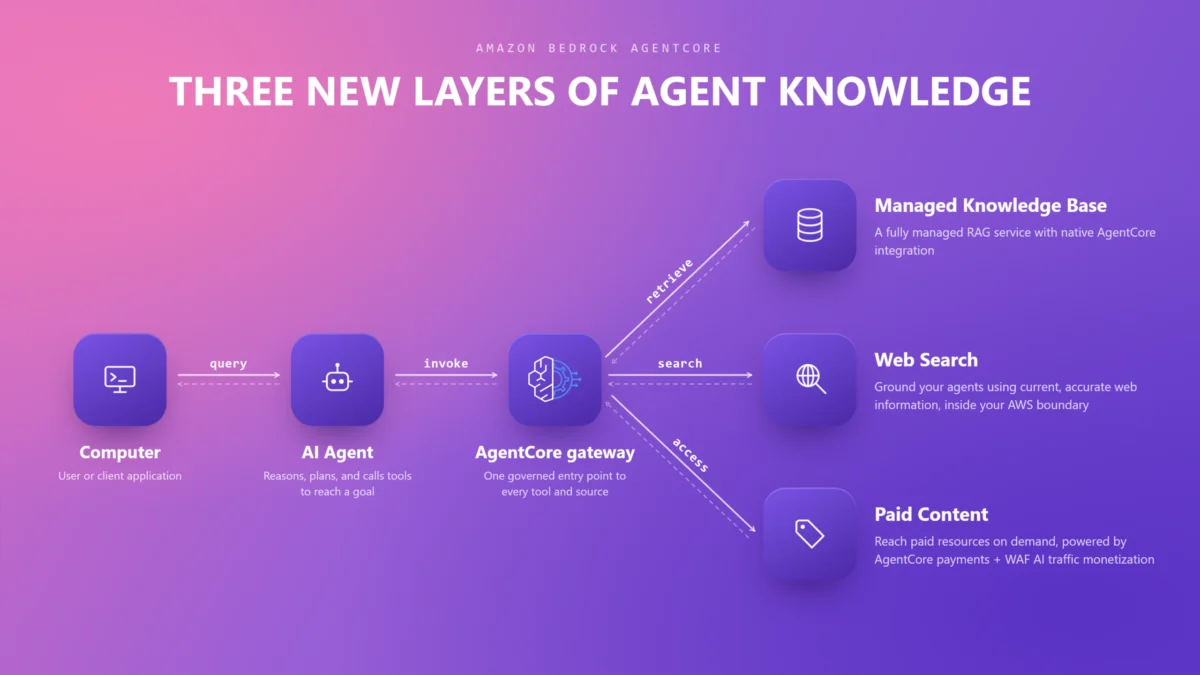
At the 2026 AWS Summit in New York City, Amazon Web Services (AWS) signaled a profound shift in the trajectory of generative AI. Moving beyond simple chatbots and text-generation models, the company has pivoted toward "Agentic AI"—systems capable of independent reasoning, tool execution, and complex multi-step workflows. Swami Sivasubramanian, AWS VP of Agentic AI, anchored the keynote by unveiling a suite of tools designed to transform AI from a passive assistant into an active, autonomous collaborator within the enterprise.
Main Facts: The Rise of Agentic Frameworks
The core theme of this year’s summit was the maturation of the Amazon Bedrock ecosystem. AWS is aggressively positioning itself as the infrastructure layer for developers who are tired of building fragmented AI prototypes and are ready to deploy scalable, production-grade agents.
The marquee announcement centered on Amazon Bedrock AgentCore. This new framework is designed to solve the "black box" problem that has plagued earlier iterations of AI agents. By allowing agents to interface directly with organizational, web, and paid knowledge bases, AWS is enabling businesses to ground their AI in real-time company data.
Furthermore, the introduction of Amazon Quick’s autonomous agents marks a significant departure from standard business intelligence. These are not merely data-visualization tools; they are functional, specialized agents capable of executing tasks in the background, such as order processing in finance or proactive lead nurturing in sales departments.
Chronology of the 2026 AWS Summit
The event, held in the heart of Manhattan, followed a high-energy rollout of technical capabilities:
- Morning Keynote (June 17, 2026): Swami Sivasubramanian opened the summit by defining the "Agentic Era." He argued that while LLMs (Large Language Models) have been the "eyes and ears" of AI, agents will serve as the "hands."
- Mid-Day Technical Deep Dives: Following the keynote, breakout sessions focused on the architecture of Bedrock AgentCore, specifically how it manages state and memory—the two biggest hurdles in keeping agents consistent over long-running tasks.
- The Launch of Amazon Quick Agents: During the afternoon session, the focus shifted to productivity. The announcement of the new activity feed, which uses machine learning to prioritize a user’s inbox and task list, demonstrated a move toward "AI-first" work environments.
- Follow-up Announcements (June 18, 2026): AWS expanded on the initial news, providing further technical documentation and partner integrations to ensure that the developer ecosystem could hit the ground running with the new Bedrock capabilities.
Supporting Data: Why Agentic AI Matters
The push toward autonomous agents is driven by the growing realization that "AI fatigue" is a real problem for modern workers. Data presented during the summit highlighted the inefficiency of current workflows:
- Context Switching: The average knowledge worker spends nearly 30% of their day navigating between email, Slack, CRM software, and calendar apps. The new "Activity Feed" within Amazon Quick aims to reduce this by 40% through intelligent consolidation.
- The Governance Gap: According to AWS internal research, 65% of enterprises are hesitant to deploy AI agents due to a lack of "guardrails." Bedrock AgentCore addresses this by providing native controls that scale, ensuring that as an agent learns, it does not bypass internal security protocols.
- Knowledge Latency: Companies often have data silos. By connecting agents to live organizational knowledge layers, AWS is reducing the latency between data generation and actionable insight.
Official Responses and Strategic Vision
In his keynote, Sivasubramanian emphasized that the goal of AWS is not to replace human decision-making, but to augment it through "agentic workflows."
"We are moving from a world where you ask a model for an answer to a world where you give an agent a goal," Sivasubramanian stated. "Whether it’s drafting a complex sales follow-up or reconciling a financial ledger, the agent is responsible for the execution, the audit trail, and the error correction."
The company’s strategy is clear: by embedding these capabilities directly into the AWS cloud, they are creating a "gravity well" for enterprise data. If a company’s CRM, email, and ERP systems are already hosted on AWS, the friction required to deploy a Quick Agent is virtually zero. This ecosystem play is designed to lock in enterprise customers who are seeking a unified, secure path to AI implementation.
Implications: The Future of Enterprise Operations
The announcements at the AWS Summit suggest several transformative shifts for the industry at large:

1. From "Chatbots" to "Workers"
The industry has spent the last two years perfecting the chatbot. The next two years will be defined by the "digital worker." Unlike a chatbot, which waits for a prompt, the new Amazon Quick agents are proactive. They monitor interactions in real-time, flag risks, and recommend steps without being prompted. This shift necessitates a change in how organizations structure their teams; management will increasingly focus on "managing agents" as much as managing people.
2. The Standardization of AI Governance
By introducing controls that scale within Bedrock, AWS is making it easier for highly regulated industries—such as banking, healthcare, and government—to adopt AI. The ability to audit an agent’s decision-making process is no longer a "nice to have," but a regulatory requirement. AWS is positioning itself as the leader in "governed autonomy."
3. The New Interface: The Activity Feed
The concept of the "desktop" or the "app" may soon become secondary to the "feed." If an AI agent can synthesize email, Slack, and calendar tasks into a single, prioritized view, the traditional way of navigating software becomes obsolete. We are moving toward a paradigm where the agent acts as the interface, filtering the noise of the digital world so the human can focus on the signal.
4. Continuous Learning as a Standard
One of the most critical aspects of the Bedrock AgentCore update is the focus on "continuous learning." Agents are no longer static; they are designed to improve based on which threads a user skips, which messages they answer quickly, and what topics dominate their work week. This creates a feedback loop where the software effectively "learns" the user’s specific role, becoming more valuable the longer it is deployed.
Conclusion: Preparing for the Agentic Shift
The 2026 AWS Summit served as a milestone for the maturation of generative AI. The excitement surrounding these announcements is not just about the novelty of the features, but the underlying promise that AI is finally ready to perform "real work."
For businesses, the implication is clear: the barrier to entry for building intelligent, autonomous agents has been lowered significantly. However, this ease of use brings a new responsibility. As agents become more capable, the burden of governance, security, and human oversight will grow.
AWS has provided the tools, the infrastructure, and the framework. The next phase—the actual integration of these agents into the daily life of the global workforce—will be the true test of the "Agentic Era." As organizations begin to pilot these new capabilities, the focus will undoubtedly shift from "what can AI do?" to "what can we build now that we have an army of digital agents at our disposal?"
The road ahead is complex, but one thing is certain: the era of the passive, text-generating model is ending, and the era of the autonomous, executing agent has officially begun. AWS is betting that by controlling the core of these agents, they will remain the backbone of the enterprise for years to come.
 Neng Nana
  Suro Senen
  Lina Hope