
 By Dwi Wanna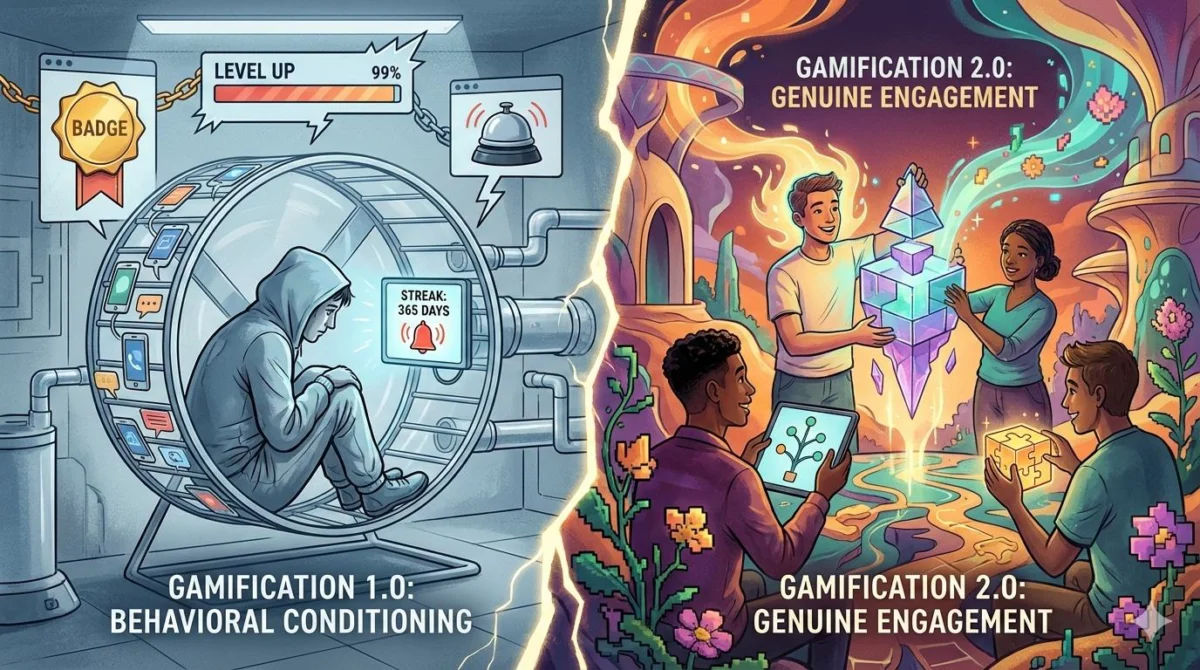
In the modern digital landscape, the term "gamification" has become a hollow buzzword—a corporate talisman brandished by product managers and growth teams in a desperate attempt to boost retention. Yet, beneath the veneer of progress bars, digital badges, and push notifications lies a hollow reality: we are witnessing a "cargo cult" of game design. Much like the indigenous Pacific islanders who, during World War II, built bamboo runways and wooden radio towers in hopes of summoning supply planes, today’s tech companies are mimicking the outward appearance of games while failing to grasp the underlying mechanics of human motivation.
The result is a landscape of apps that no actual gamer would tolerate for more than five minutes. From the guilt-tripping streak-counters on language learning apps to the arbitrary "All-Star" status labels on professional networking sites, these systems optimize for data collection rather than human enrichment.
The Anatomy of a Failed Paradigm
The pattern of modern gamification is remarkably consistent: an initial surge of curiosity, a phase of "gamification theater," and finally, the inevitable drift toward total user abandonment. This is not a failure of technology, but a failure of philosophy.
The Chronology of Digital Abandonment
- The Hook (Weeks 1-2): Users are incentivized by extrinsic rewards—points, levels, and badges—triggering a dopamine response to simple task completion.
- The Optimization Phase (Weeks 3-6): As the novelty wears off, users begin to "game the system." They learn the most efficient path to the reward, often bypassing the actual utility of the application to secure the digital bauble.
- The Fatigue Point (Weeks 7-12): The extrinsic rewards cease to provide satisfaction. The app becomes a chore, not a tool.
- The Abandonment: The user realizes the "game" has no depth, no agency, and no soul. The device is shelved, the notification alerts are muted, and the subscription is canceled.
The Experts Weigh In: A Career in Game Design
To understand why these systems fail, one must look to those who have spent decades building environments that captivate, rather than coerce.
For 39 years, the veterans of the gaming industry—those who programmed classics like John Madden Football in 1991 or produced the Street Fighter series at Capcom—have observed a fundamental disconnect. These architects of play have generated billions in revenue not by bribing players with digital trinkets, but by mastering the science of human motivation.
"If your gamification strategy can be specified in a single $5 Fiverr gig—’Add points, badges, and a leaderboard to my app’—you are not building a game," says one industry veteran. "You are building a psychological Skinner box."
The critique is sharp: the modern "gamification expert" is often a professional who has never actually shipped a game. They treat users like laboratory rats, assuming that if you push a button and provide a pellet, the subject will be engaged. This is a fatal miscalculation.
The Extrinsic Trap: Why Current Methods Fail
Walk into a product meeting today, and you will hear a familiar, shallow toolkit being deployed. These are the pillars of the "Cargo Cult" methodology:
- Pointification: The belief that assigning an arbitrary number to a behavior makes it inherently more valuable.
- Badging: Creating digital "achievements" for tasks that require no skill, thereby cheapening the concept of accomplishment.
- Leaderboards: Forcing users into competition they never asked for, often demoralizing the bottom 90% of the user base.
- Streaks: Guilt-tripping users into returning, transforming a hobby or a learning tool into a source of anxiety.
These tactics share a fatal flaw: they assume all humans are motivated by the same extrinsic stimuli. However, the most successful games in history—from Elden Ring to World of Warcraft—succeed because they leverage intrinsic motivation.
The Intrinsic Difference
Intrinsic motivation is the "why" behind the player. It is the drive to master a complex system, the desire for social connection within a virtual world, and the joy of solving a difficult problem.
- Autonomy: Players stay because they have choices.
- Competence: Players stay because they see themselves getting better at something that matters.
- Relatedness: Players stay because they are part of a community that transcends the app itself.
Real games do not bribe players to show up. They make the experience so intrinsically satisfying that the player chooses to return, even when the task is difficult, repetitive, or punishing.
Implications for the Future of Product Design
The current model of gamification is not just ineffective; it is unsustainable. When a user realizes they are being manipulated by a "streak" notification, they don’t feel encouraged; they feel patronized.
The Path to Gamification 2.0
To move forward, the tech industry must undergo a fundamental shift. We must move from extrinsic rewards to intrinsic satisfaction. This requires a radical redesign of how we view our users:
- Stop Treating Users as Metrics: Shift the focus from "Daily Active Users" (DAU) to "Daily Engaged Humans."
- Design for Agency: Give users meaningful choices that change the outcome of their experience within the app.
- Respect the User’s Time: If the user feels the need to "game" the system to get the reward, the reward is worthless. Remove the friction and focus on the value.
- Incorporate Mastery: Build systems that allow for genuine skill progression. Whether it’s learning a language or tracking fitness, the feeling of "I am better today than I was yesterday" is the most powerful retention tool in existence.
Conclusion: A Rescue Mission
This analysis is not a dismissal of gamification as a discipline; it is a rescue mission. Done correctly—designed by people who understand the psychology of play, not just the mechanics of marketing—gamification could be a transformative tool for education, health, and productivity.
The bamboo control towers must come down. We need to stop building the appearance of engagement and start designing for the substance of human satisfaction. The era of the cargo cult is nearing its end. The era of Gamification 2.0—the era of treating users like players—must begin.
Up next in this series: Gamification 2.0. Beyond Points and Badges: Designing for Players, Not Metrics. Chapter 2: The Solution.
 Ammar Sabilarrohman
  Neng Nana
  Sagoh
Sagoh 