
 By Neng Nana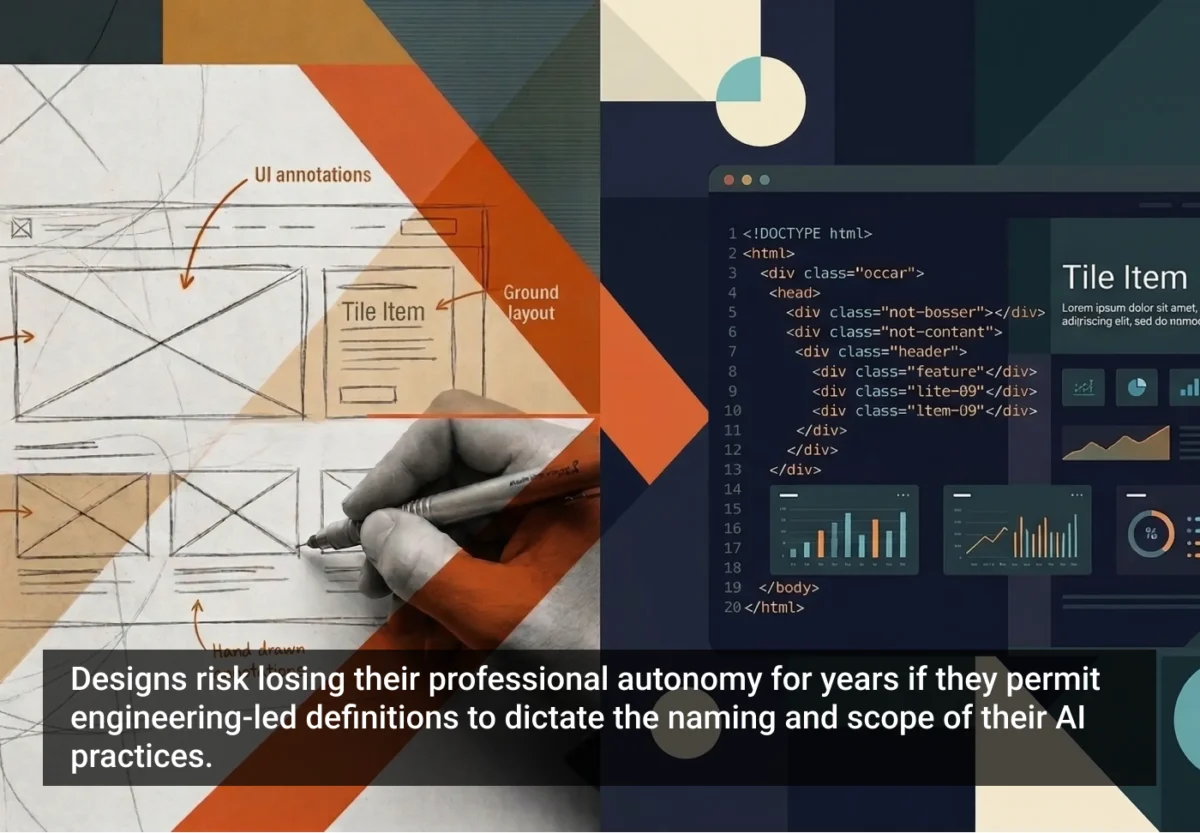
The rise of generative AI has introduced a peculiar vernacular into the design industry. Among the most pervasive and reductive labels to emerge is "vibe coding"—a term that, while catchy, threatens to erode the professional standing of designers who have begun to integrate AI into their core workflows. As the industry grapples with the transition from traditional, deterministic design systems to AI-augmented methodologies, a critical question of authority has emerged: Is the human designer the architect of the system, or merely a curator of machine-generated output?
Design leaders argue that by adopting labels like "vibe coding," designers are inadvertently surrendering their agency. While the term may accurately describe low-accountability experimentation, it fails to capture the rigor, judgment, and intentionality required to build scalable, high-fidelity products. As we stand at this technological inflection point, the need for a precise, authoritative vocabulary has never been more urgent.
The Genesis of a Misnomer: Chronology of the "Vibe"
The term "vibe coding" gained prominence in early 2025, largely championed by figures like Andrej Karpathy. In its original context, it served as a functional description of a specific, low-friction interaction with AI: providing a loose, high-level prompt, accepting the model’s output, and moving on without deep interrogation of the underlying mechanics.
Initially, it was a niche descriptor for casual prototyping. However, as the industry’s vocabulary around AI-assisted design remains in its infancy, the term began to "colonize" broader professional practices. Designers who engage in complex, reference-heavy, and highly iterative AI workflows have found their work similarly labeled.
This linguistic migration is problematic. George Orwell famously noted that the slovenliness of language facilitates foolish thoughts; when imprecise terminology defines a professional practice, it pre-shapes how that practice is perceived, hired, and valued. By allowing "vibe coding" to serve as a blanket term, the design community risks delegating its expertise to engineering-centric definitions that view the human role as purely supervisory or passive.
The Architecture of Authority: Directed Generation
The real division in the design world today is not between those who use AI and those who do not; it is between those who view AI as a generator of decisions and those who view it as a respondent to human judgment.
In the "vibe coding" paradigm, generation drives the process: the user prompts, the model outputs, and the designer adjusts at the margins. Conversely, in the emerging practice of Directed Generation, judgment arrives first. Here, the AI acts as an instrument—a high-fidelity engine that operates under strict, human-defined constraints.
The Role of the Curated Input
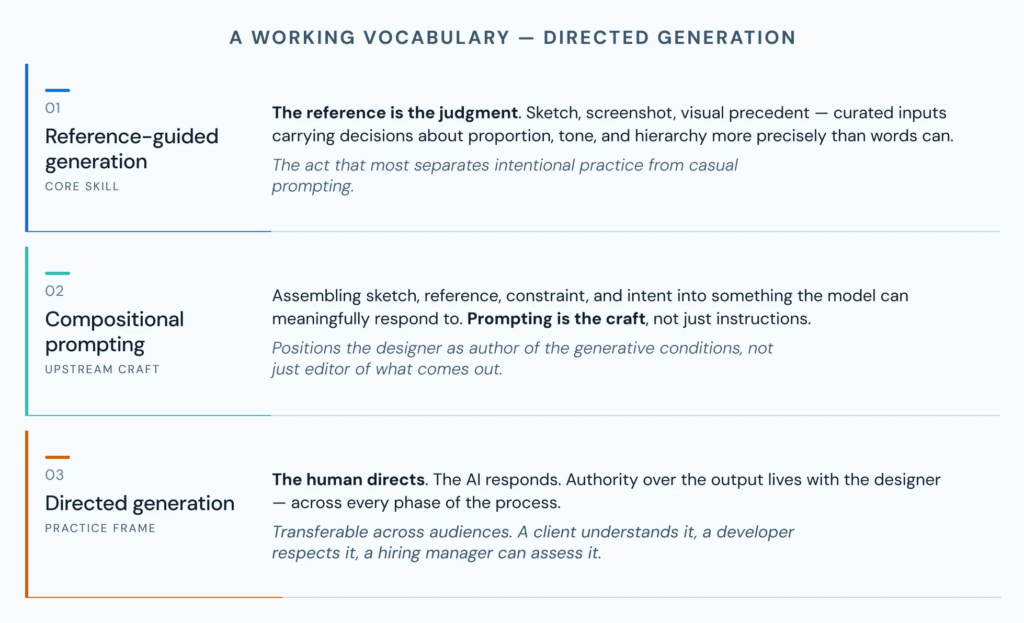
Directed generation starts with a "reference"—a curated input that might take the form of a sketch, a screenshot, or a specific visual precedent. This reference is not merely a prompt; it is a manifestation of the designer’s expertise. It embodies decisions regarding proportion, tone, hierarchy, and intent—nuances that would take paragraphs of text to articulate but are captured instantly in a visual frame.
This shift represents a fundamental change in the design process:
- Input Phase: The designer provides high-intent visual or structural primitives.
- Constraint Phase: The designer defines the "rules of engagement," establishing boundaries within which the AI must operate.
- Execution Phase: The AI interprets these constraints to produce outputs across various surfaces, devices, and contexts.
- Judgment Phase: The designer evaluates the output against the original intent, refining the primitives rather than the pixels.
Scaling Without Freezing: The New Design System
The implications for design systems are profound. Traditionally, design systems have treated patterns as fixed, immutable artifacts. Consistency is achieved through replication, but this often comes at the cost of flexibility.
Directed generation breaks this constraint. When a machine understands a design pattern abstractly—rather than treating it as a static component—it can recompose that pattern contextually. The system no longer copies; it interprets. This allows for the creation of "non-deterministic design," where the output is not fully predicted, but is guaranteed to adhere to the core grammar defined by the designer.
In this model, the designer’s role shifts from specifying every instance of a button or card to defining the conditions under which high-quality instances reliably emerge. The craft moves upstream, focusing on the quality of the primitives and the rigor of the constraints. This is the path to "agentic delivery," where systems do not just respond to design direction but autonomously carry it forward, maintaining authorial intent across scale.
Industry Implications and Professional Identity
The debate over terminology is not a pedantic exercise; it is a matter of professional survival. When designers participate in portfolio reviews, client kickoffs, or internal team debates, the language they use defines their value proposition.
The Lessons of History
The emergence of User Experience (UX) design as a discipline serves as a vital case study. The practitioners who gained the most influence were those who defined their work with precision—articulating exactly what interaction design and information architecture were and why they mattered. Those who waited for adjacent fields to define them spent years playing catch-up.
Today, AI-assisted design is at a similar juncture. The technology is already normalized, but the practice is still being codified. If designers do not lead the naming of this practice, the definitions will be written by engineers who focus on shipping, or journalists who focus on surface-level outputs.
Embracing a Hybrid Methodology
It is essential to acknowledge that "directed generation" is not a panacea that replaces all traditional methods. In many production environments, deterministic outputs—fixed, documented, and predictable—remain the gold standard.
A mature design practice is one that recognizes different risk tolerances:
- Deterministic Design: Best for core components, established design systems, and high-stakes production environments where pixel-perfect precision is non-negotiable.
- Non-Deterministic Design: Best for rapid concept exploration, cross-surface pattern interpretation, and generative wireframing where speed and broad adaptability provide outsized returns.
The most successful designers of the coming decade will be "bilingual," capable of toggling between these modes based on the requirements of the project.
Conclusion: Claiming the Narrative
"Vibe coding" may have its place in the sandbox of low-stakes experimentation, but it is not a term for design leadership. As the industry moves forward, we must reject the passive implications of that label.
Whether we choose to call our practice Directed Generation, Reference-Guided Design, or Compositional Prompting, the act of naming is an act of claiming authorship. We are no longer just manipulating tools; we are authoring the grammar that these tools speak.
By grounding our work in intentionality, rigor, and professional clarity, we ensure that as AI becomes more powerful, the designer’s role becomes more—not less—essential. The tools will continue to evolve, but the authority to define what "good" looks like must remain firmly in the hands of the designer. It is time to stop accepting the shorthand of others and start articulating the sophisticated, intentional reality of our own work.
 Ammar Sabilarrohman
  Sagoh
Sagoh 