
 By Neng Nana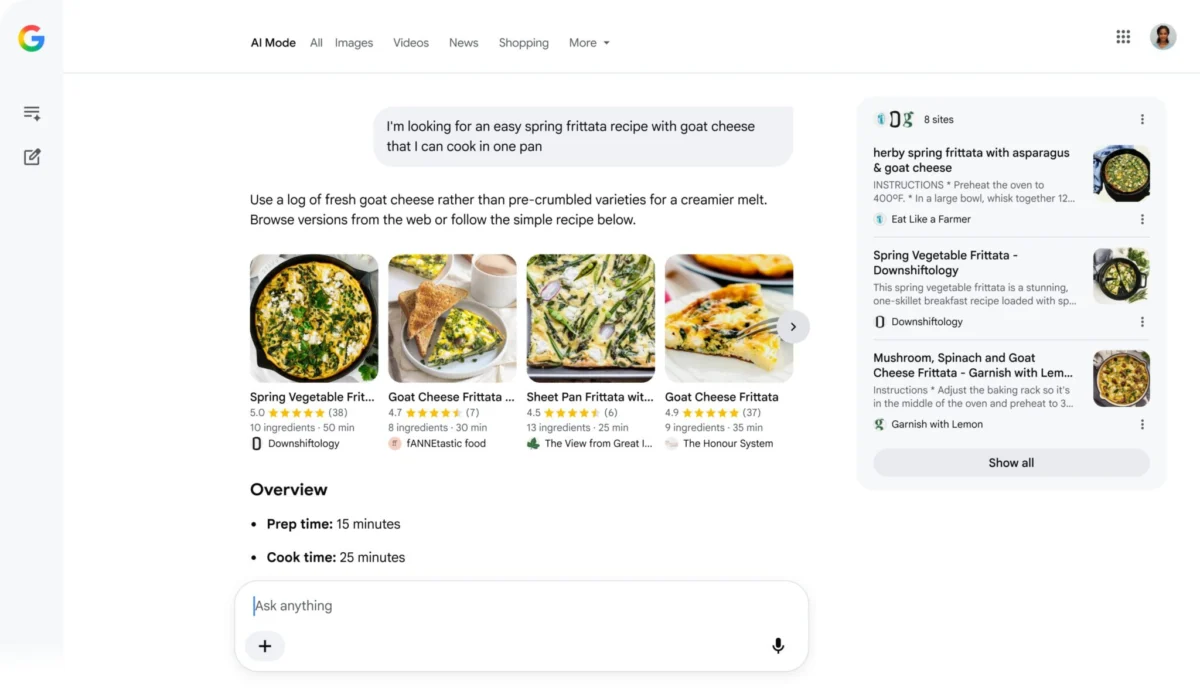
In an effort to mend its increasingly strained relationship with independent content creators and publishers, Google has rolled out a significant design and algorithmic update to its AI-driven recipe search results. Operating within its conversational search interfaces—often referred to as "AI Mode"—the search giant has introduced visual elements designed to attribute credit and drive user traffic back to original content creators.
The update integrates highly visible attribution metrics, including the recipe creator’s name, user ratings, and ingredient counts, directly into the AI-generated responses. This move follows months of escalating tension between the SEO community, digital publishers, and search engines over the rise of "zero-click" searches powered by generative artificial intelligence.
Main Facts of the Update
Google’s latest update fundamentally alters how culinary and recipe queries are handled within its AI Mode. Instead of presenting a synthesized, text-only block of cooking instructions that keeps users on the search engine results page (SERP), the AI interface now prioritizes structured link cards.
Key Visual and Functional Enhancements
- Creator Attribution: The name of the original blogger, chef, or publishing website is prominently displayed alongside the recipe title.
- Rich Snippet Data: Essential metadata—specifically aggregate user ratings (e.g., star ratings) and the total number of ingredients required—is pulled directly from the publisher’s structured data and displayed in the AI response.
- High-Visibility Link Cards: Prominent, clickable image cards are positioned at the very top of the AI-generated response, rather than being relegated to small, easily overlooked footnote citations at the bottom.
- Enhanced User Experience: By displaying critical decision-making factors (ratings, complexity, and brand familiarity) immediately, the interface seeks to encourage users to click through to the source website to view the full cooking instructions.
This feature is currently live for a wide selection of recipe-based queries in regions where Google’s advanced conversational search and AI Mode are active. The rollout represents one of the most direct UI modifications Google has made to date specifically aimed at addressing publisher concerns regarding AI-driven traffic loss.
Chronology of Google’s AI Search and the Recipe Publisher Tension
The conflict between search engines utilizing generative AI and the publishing ecosystem has been brewing for over a year. The timeline of this friction, culminating in the recent AI Mode recipe update, highlights a cycle of rapid technology deployment followed by publisher backlash and subsequent UI adjustments.
[May 2023] Google introduces SGE (Search Generative Experience)
   │
[Late 2023] Proliferation of "AI Recipe Slop" and zero-click search anxieties
   │
[March 2024] Robby Stein announces first wave of publisher-focused AI recipe updates
   │
[May 2024] Google rebrands SGE to "AI Overviews" at Google I/O
   │
[June 2024] Launch of the new AI Mode recipe cards with ratings, creators, and ingredient counts
May 2023: The Debut of SGE
At its annual I/O developer conference, Google introduced the Search Generative Experience (SGE). This early iteration of AI-powered search synthesized information from across the web to answer complex queries directly. Almost immediately, food bloggers and lifestyle publishers raised alarms, noting that culinary queries—which traditionally relied on step-by-step traffic—were highly susceptible to being entirely answered by AI, leaving no incentive for users to visit the actual blogs.
Late 2023: The Proliferation of "AI Recipe Slop"
As SGE and other conversational search tools grew in popularity, the web saw an influx of what critics termed "AI recipe slop." Automated scrapers and low-quality AI models generated thousands of nonsensical or untested recipes, which occasionally ranked highly or were synthesized by search engines. Simultaneously, legitimate food bloggers reported that Google’s AI models were extracting their proprietary ingredient lists and instructions, presenting them as native search answers without sending corresponding traffic.
March 2024: Google Promises Better Connections
Acknowledging the growing discontent, Robby Stein, a product lead at Google, announced a preliminary round of updates aimed at recipe queries. At the time, Stein stated that Google had "heard feedback on recipe results in AI Mode" and was actively working on updates "to better connect people with recipe creators on the web." While this initial change adjusted how links were grouped, publishers argued it did not go far enough to restore lost click-through rates (CTR).
May 2024: The Launch of AI Overviews
Google officially rebranded SGE to "AI Overviews" and began rolling it out to hundreds of millions of users in the United States. The widespread rollout amplified anxieties among web publishers, who projected devastating losses in ad and affiliate revenue if AI summaries continued to dominate the top of the search page.
June 2024: The Rollout of Rich AI Mode Recipe Cards
Building on the foundation laid in March, Google deployed the current visual update. Robby Stein confirmed the release, pointing to "prominent links at the top of responses with useful details and images." Concurrently, industry observers noted Google testing other traffic-preservation features, such as "Top Stories" carousels embedded directly within AI Overviews, though those features remain in the testing phase.
Supporting Data and the Economics of Food Blogging
To understand why this update is critical, it is necessary to examine the underlying economics of the digital publishing industry, particularly the food and culinary niche.

The Threat of Zero-Click Searches
According to data from search behavior researchers, "zero-click" searches—queries that resolve on the search page without the user clicking on any external links—have risen steadily. With the integration of AI Overviews, SEO agencies project that informational niches, including food blogging, could see organic click-through rates decline by 20% to 40% if the search engine provides the entire recipe natively.
| Metric | Traditional Search | Unoptimized AI Summary | Updated AI Mode (With Rich Cards) |
|---|---|---|---|
| Visibility | High (Page 1 Organic) | Low (Burying source links) | High (Top-of-page visual cards) |
| Information Provided | Snippet only | Complete recipe details | Metadata (Ratings, Ingredients, Brand) |
| Publisher CTR Potential | High | Extremely Low | Moderate to High (Encourages brand clicks) |
The Financial Impact on Independent Creators
Unlike large media conglomerates, the vast majority of food blogs are run by independent creators, solopreneurs, and small teams. These businesses monetize through three primary channels:
- Programmatic Display Advertising: Monetized via ad networks like Raptive and Mediavine, which pay publishers based on pageviews and ad impressions (RPMs).
- Affiliate Marketing: Income generated when readers purchase specific kitchen tools or ingredients linked within a post.
- Sponsored Content: Brand partnerships that require proof of high organic traffic and active reader engagement.
When an AI engine displays a recipe’s ingredients and instructions directly on the SERP, the user has no reason to load the publisher’s website. Consequently, the publisher loses the pageview, the ad impression, the potential affiliate click, and the cookie data required for retargeting, threatening the financial viability of independent culinary journalism.
The Role of Schema Markup
The data Google displays in these new AI Mode cards does not appear by magic. It relies entirely on structured data, specifically Schema.org vocabulary. Food bloggers meticulously implement Recipe schema markup, providing search engines with explicit details regarding:
recipeIngredient(the list of ingredients)aggregateRating(user-submitted reviews)author(the creator’s name)image(high-quality step-by-step photography)
This creates a paradoxical dynamic: publishers must provide highly structured, machine-readable data to rank in search engines, but that very data allows Google’s AI models to easily parse, synthesize, and display the content, potentially bypassing the publisher entirely. The June 2024 update represents an attempt to use this schema data to benefit the publisher rather than replace them.
Official Responses and Industry Reaction
The reaction to the update has been a mixture of cautious optimism from SEO professionals and continued skepticism from the broader publishing community.
Google’s Perspective
In announcing the update on X (formerly Twitter), Google’s Robby Stein framed the changes as a win-win for both users and content creators:
"We’ve added prominent links at the top of responses with useful details and images—like the creator name, recipe ratings and number of ingredients. This should make it even easier to discover and visit recipe pages with AI Mode."
Google’s official stance remains that its AI experiences are designed to act as a jumping-off point for deeper web exploration, rather than a destination that replaces the open web.
Industry Skepticism
Despite the visual improvements, many digital publishers remain wary. Industry advocates point out that while displaying the creator’s name and ratings is a step in the right direction, it still requires the user to take an active step to click through, whereas the AI summary still provides a highly detailed answer that may satisfy casual searchers.
Barry Schwartz, a prominent search engine roundtable editor and technologist, observed:

"Recipe bloggers, well, content creators in general, have not been happy with how traffic from Google’s AI experiences did not send as much traffic as the traditional search results. Here we see Google trying to make changes to encourage more searchers to click from those AI experiences to the bloggers’ websites."
Schwartz added that if Google continues to add highly clickable link units to its AI interfaces, it could go a long way toward repairing the fragile publisher-Google relationship.
Implications for SEO and Content Strategy
The update to AI Mode recipe results has immediate and long-term implications for how digital marketers, content creators, and SEO strategists approach search engine optimization.
1. The Critical Importance of Schema Markup
With Google utilizing structured data to populate the new rich AI cards, publishers can no longer afford to treat schema markup as an afterthought. To be eligible for these highly visible spots at the top of AI Mode responses, websites must maintain flawless, error-free schema implementations.
Publishers should regularly audit their Recipe schema, ensuring that the author field accurately reflects their brand or creator name, and that aggregateRating properties are correctly configured to pass user reviews to search crawlers.
2. Double Down on Brand Building and E-E-A-T
Because the creator’s name is now prominently featured in the AI interface, brand recognition has become a powerful ranking and click-through factor. Users are more likely to click on an AI card if they recognize the creator’s name (e.g., "Sally’s Baking Addiction" or "Serious Eats").
Publishers must focus on building strong, direct relationships with their audiences through email newsletters, social media, and community engagement. Establishing high Experience, Expertise, Authoritativeness, and Trustworthiness (E-E-A-T) will ensure that when a brand name appears in an AI Overview, it carries enough weight to command a click.
3. Adapting to the Shifting Social Contract
For decades, the implicit social contract of the web was simple: publishers allowed search engines to crawl their proprietary content for free, and in exchange, search engines sent targeted traffic to those publishers. Generative AI threatened to dissolve this contract by keeping users within the search ecosystem.
Google’s UI adjustments indicate that the company recognizes the danger of starving its own data sources. If independent publishers go out of business due to a lack of traffic, Google’s AI models will eventually run out of fresh, high-quality, human-created data to crawl. The introduction of prominent creator links and metadata is a clear acknowledgement that search engines must preserve the economic viability of the open web to sustain their own AI-driven products.
As Google continues to test features like Top Stories carousels in AI Overviews, publishers must remain agile, monitoring their analytics closely to see if these new rich visual cards succeed in stabilizing organic traffic in an AI-dominated landscape.
 Jia Lissa
  Nana Muazin
  Layla Zulfa