
 By Ammar Sabilarrohman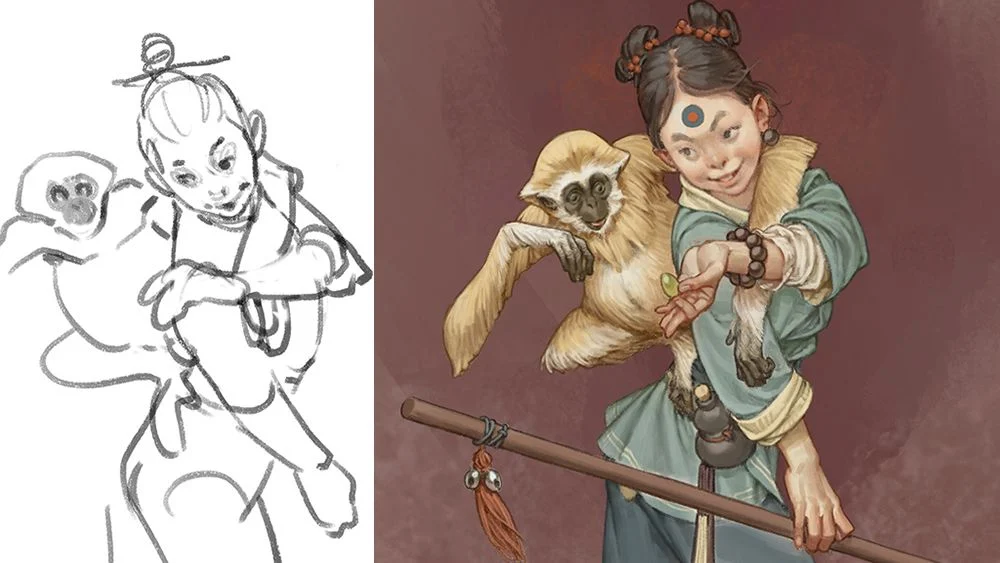
Connecting with an audience, immersing them in a fantastical world, and making them invest in a story begins long before a single line of dialogue is spoken or an animation frame rendered. It starts with compelling character design. Far from being a mere aesthetic exercise, character design is a sophisticated craft, a visual language capable of communicating profound narrative aspects, personality, and even gameplay roles, all at a glance.
At its core, character design is about establishing a connection, pulling viewers into a meticulously crafted universe. This intricate process, often underestimated in its complexity, relies heavily on a designer’s ability to imbue static images with dynamic life. Through the careful manipulation of elements such as pose, gesture, and facial expressions, designers forge characters that are not only visually appealing but also resonant storytellers.
This article explores the nuanced methodology behind creating characters that transcend mere illustration, drawing insights from the detailed process of a seasoned character designer, Riccardo Moscatello, as he unveils his techniques for communicating narrative through design. His approach underscores the paramount importance of the "first read"—that instantaneous impression a character makes—and how mastering it is crucial for captivating an audience.
The Immutable Power of the First Impression: The Silhouette as Narrative Blueprint
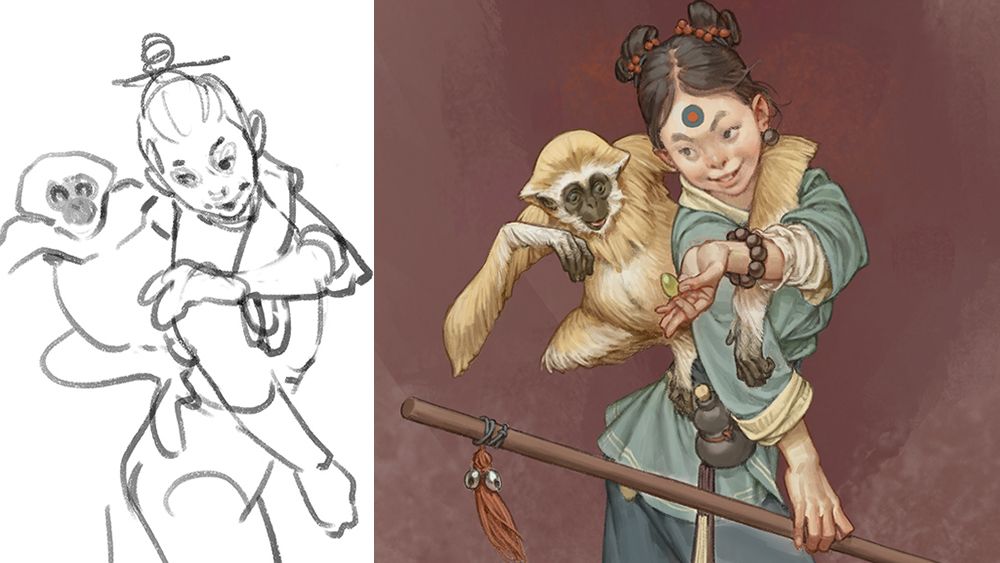
In the realm of visual storytelling, the silhouette stands as one of the most impactful, yet often overlooked, aspects of a character’s design. Much like the compelling cover of a book that beckons a reader to delve within, the silhouette is the primary element designed to arrest a viewer’s attention, preventing their gaze from drifting elsewhere. It is the character’s primal scream, conveying essence before detail.
The concept of the "first read" is foundational here. This initial visual scan dictates the most fundamental assumptions a viewer will make about a character’s backstory, their personality, or their functional role within a video game or narrative. A powerful, well-defined silhouette, in many instances, is the very feature that articulates these assumptions. It offers immediate clues: Is the character strong or agile? Heroic or villainous? Playful or menacing? This instantaneous recognition is vital for engagement.
Therefore, for character designers, harnessing the silhouette as a potent tool is not merely advantageous; it is imperative. It empowers images, allowing them to create characters that are not only instantly readable and aesthetically pleasing but also profoundly convey a specific narrative. Ultimately, this mastery is what compels viewers to become emotionally invested and drawn into the unfolding story. It is the silent, yet eloquent, promise of adventure, mystery, or delight.
A Journey of Creation: From Concept to Compelling Character
The creation of a truly engaging character is an iterative journey, a dialogue between concept and execution. Riccardo Moscatello’s process exemplifies this, moving systematically from broad narrative strokes to intricate details, always with the goal of communicating a living personality.
01. Establishing the Narrative Core: Exploring Poses
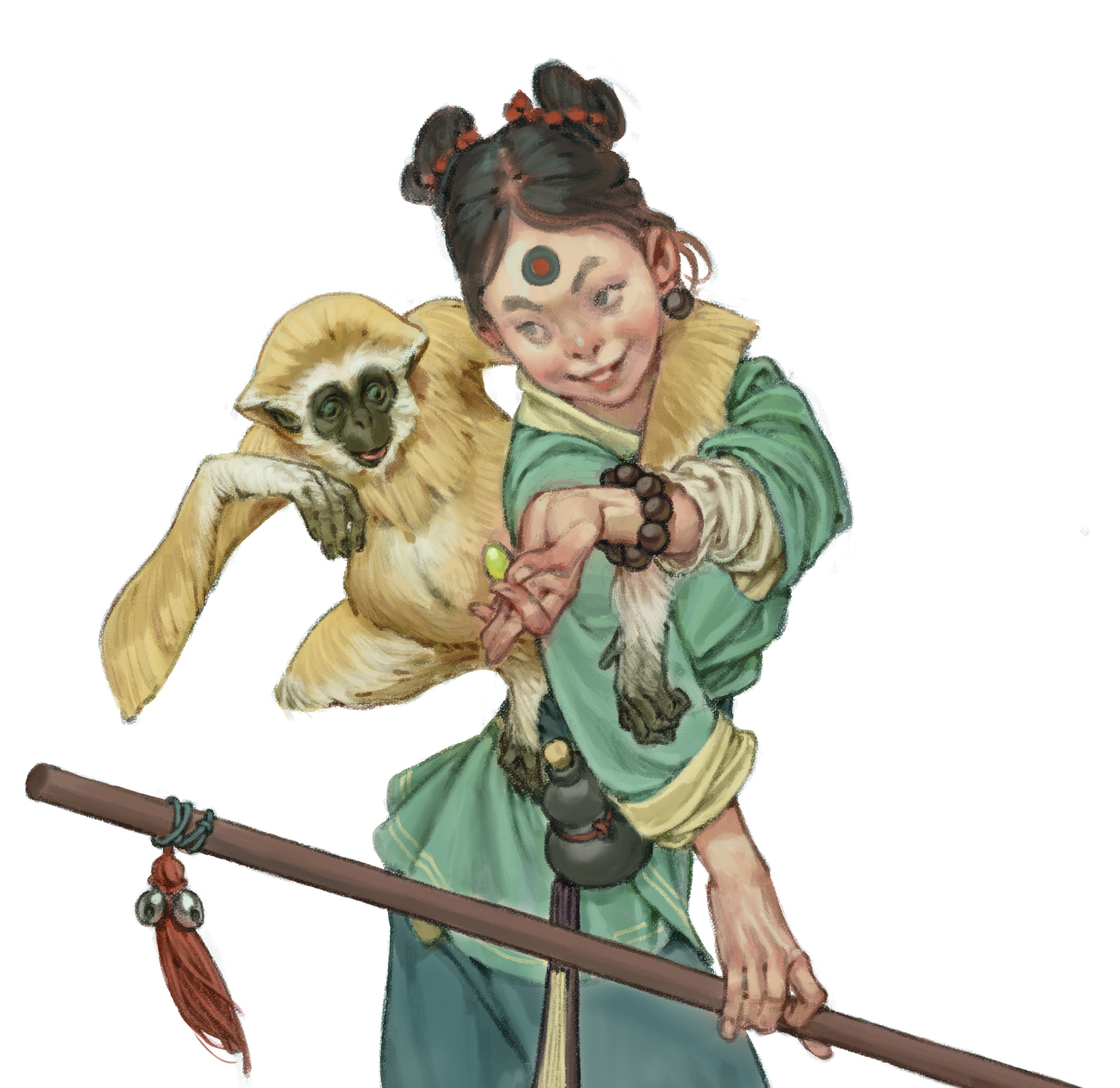
The initial phase of character design is rooted in defining the overarching narrative. Before any lines are committed, the designer must articulate the core story the character embodies. In the illustrative example, the focal point was an interaction between a young girl and her monkey. The desired narrative conveyed dynamism, playfulness, and a palpable bond between the two figures. This foundational narrative serves as the compass for all subsequent design decisions.
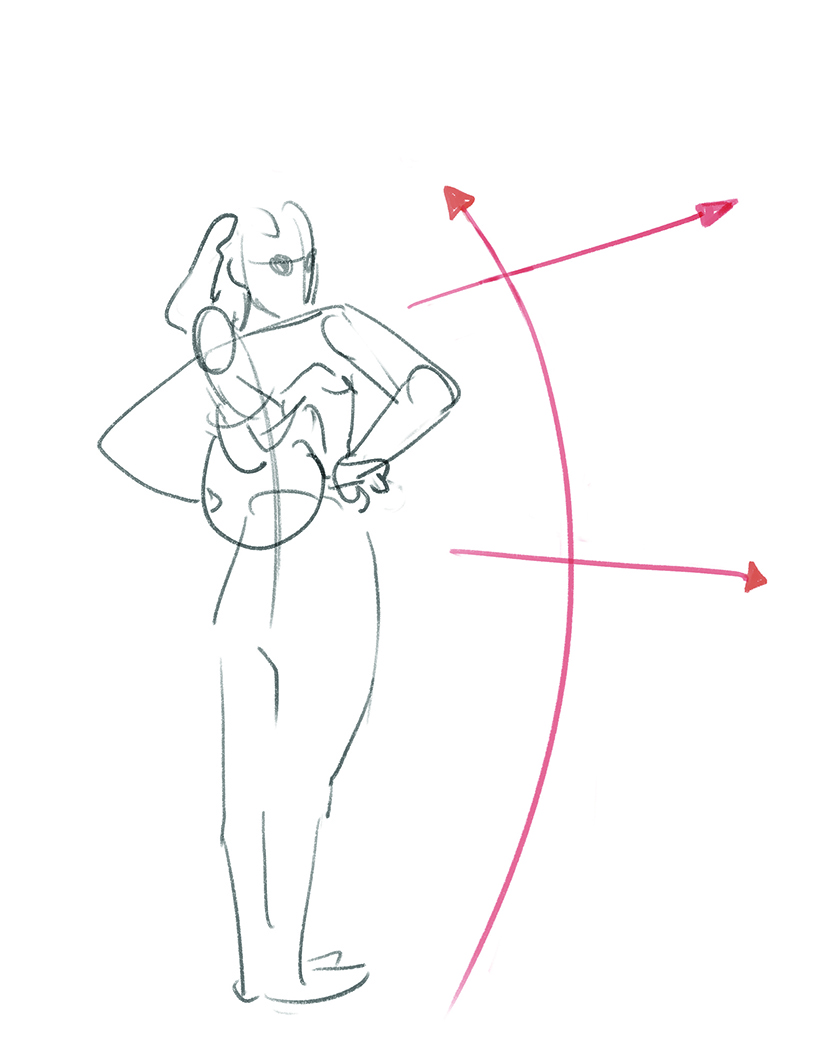
Once this clear narrative direction is established, the designer begins with broad, gestural scribbles. These aren’t meant to be precise drawings but rather an exploration of "lines of action" – the invisible forces that give a pose its energy and direction. Crucial to this stage are the axes of the shoulders and hips, along with the curvature of the spine. These anatomical guidelines are manipulated to express movement, emotion, and the underlying personality. It’s a foundational sketch, capturing the raw energy before details are considered.
02. Injecting Dynamism: Second Iteration and Story Integration
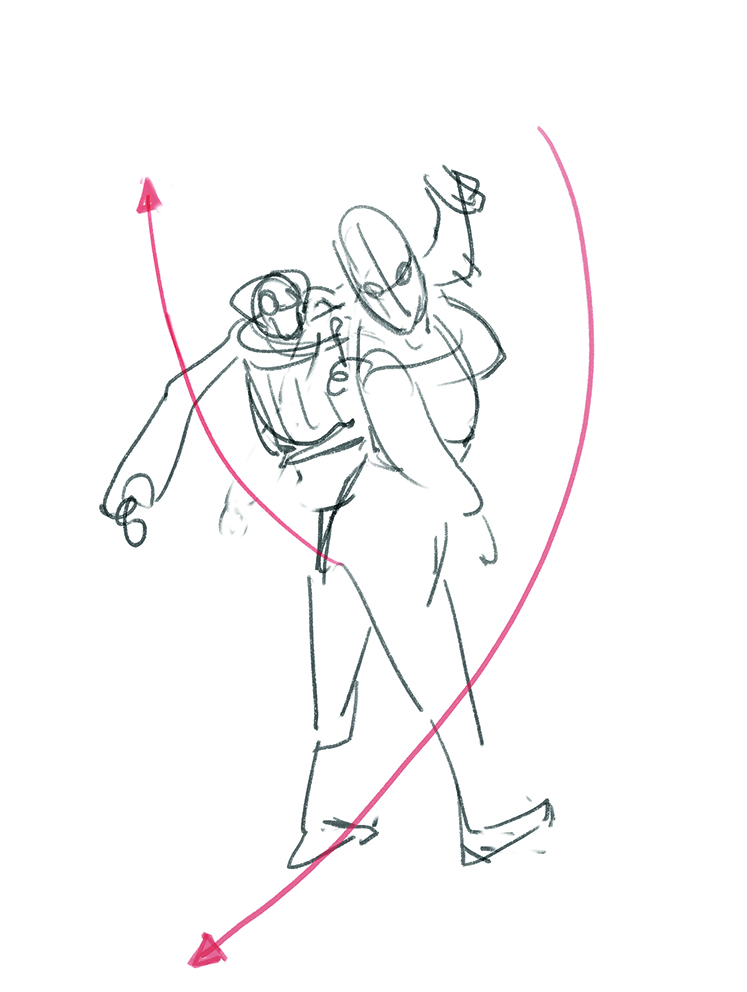
Building upon the initial explorations, the second iteration refines the gesture, pushing the boundaries of dynamism and narrative expression. In this specific case, the designer considered the girl twisting her body to face her primate companion, a subtle yet powerful addition that amplifies the overall gesture. This twist not only enhances the visual dynamism but also deepens the narrative.
This particular character’s backstory—a travelling circus performer—provides a rich vein of inspiration. Such a background naturally suggests an individual who is highly active, cheerful, and accustomed to constant movement, whether hopping around a stage or interacting playfully with her animal partner. The twisting pose becomes a visual echo of her profession and personality, subtly informing the viewer about her life and energy. This stage highlights how even minor adjustments to a pose can significantly enrich the character’s story and emotional impact.
03. Sculpting Form and Refining Interaction: Fleshing Out Volumes
As the primary gesture solidifies, the design progresses to fleshing out the characters’ volumes, transitioning from abstract lines to more three-dimensional forms. A key focus at this stage is the interaction between the two figures. The designer meticulously establishes the overlaps of all elements, ensuring that forms clearly distinguish themselves from one another.
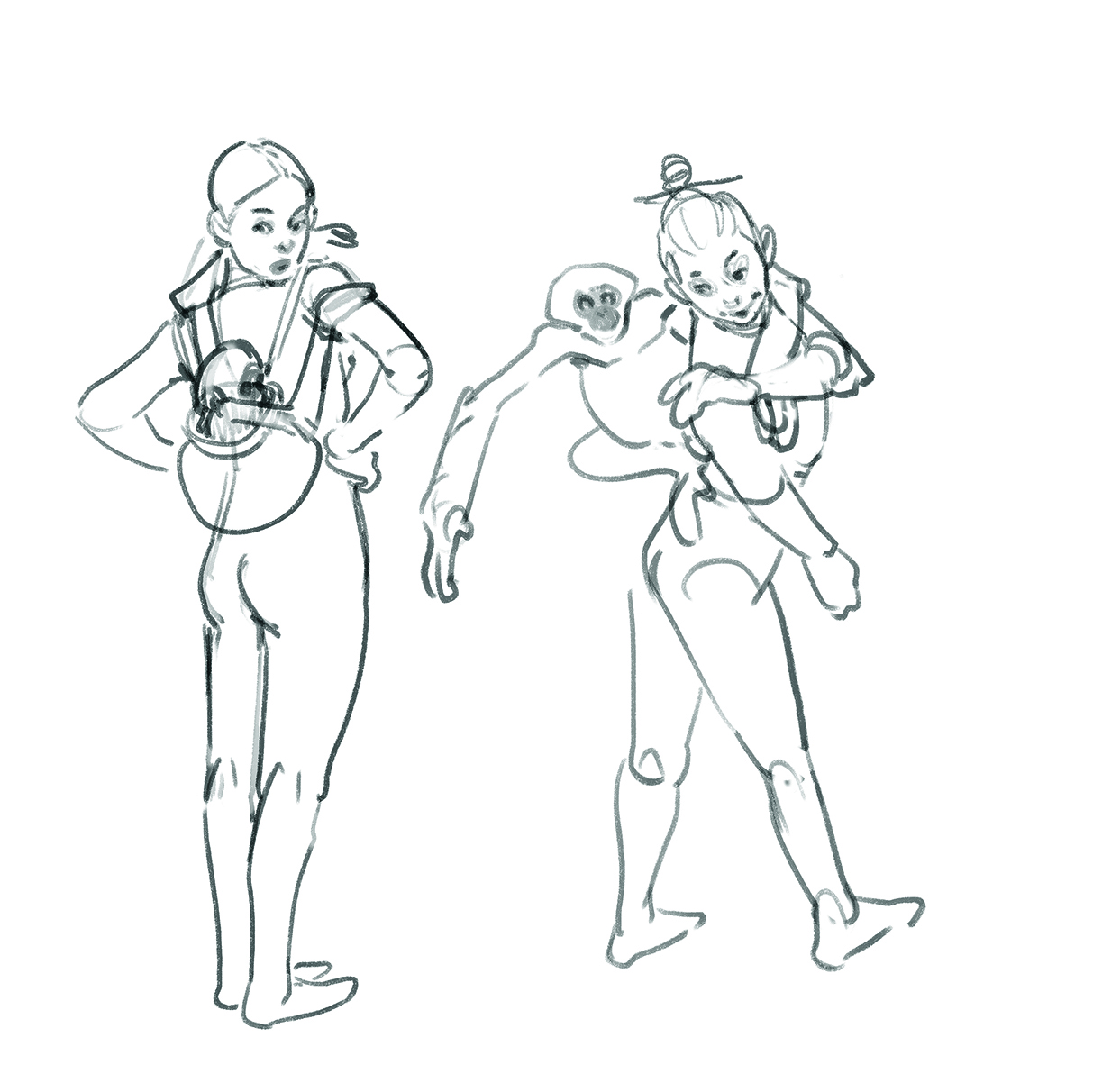
This attention to overlaps is critical for maintaining visual clarity and preventing "tangents"—instances where lines or forms appear to touch awkwardly, flattening the drawing and making it difficult to read. By carefully defining how the girl and monkey intersect and relate in space, the designer ensures that their bond and dynamic interplay are visually coherent and believable, reinforcing the narrative established in earlier stages.
04. Weaving Story into Attire: Costume and Props (Part 1)
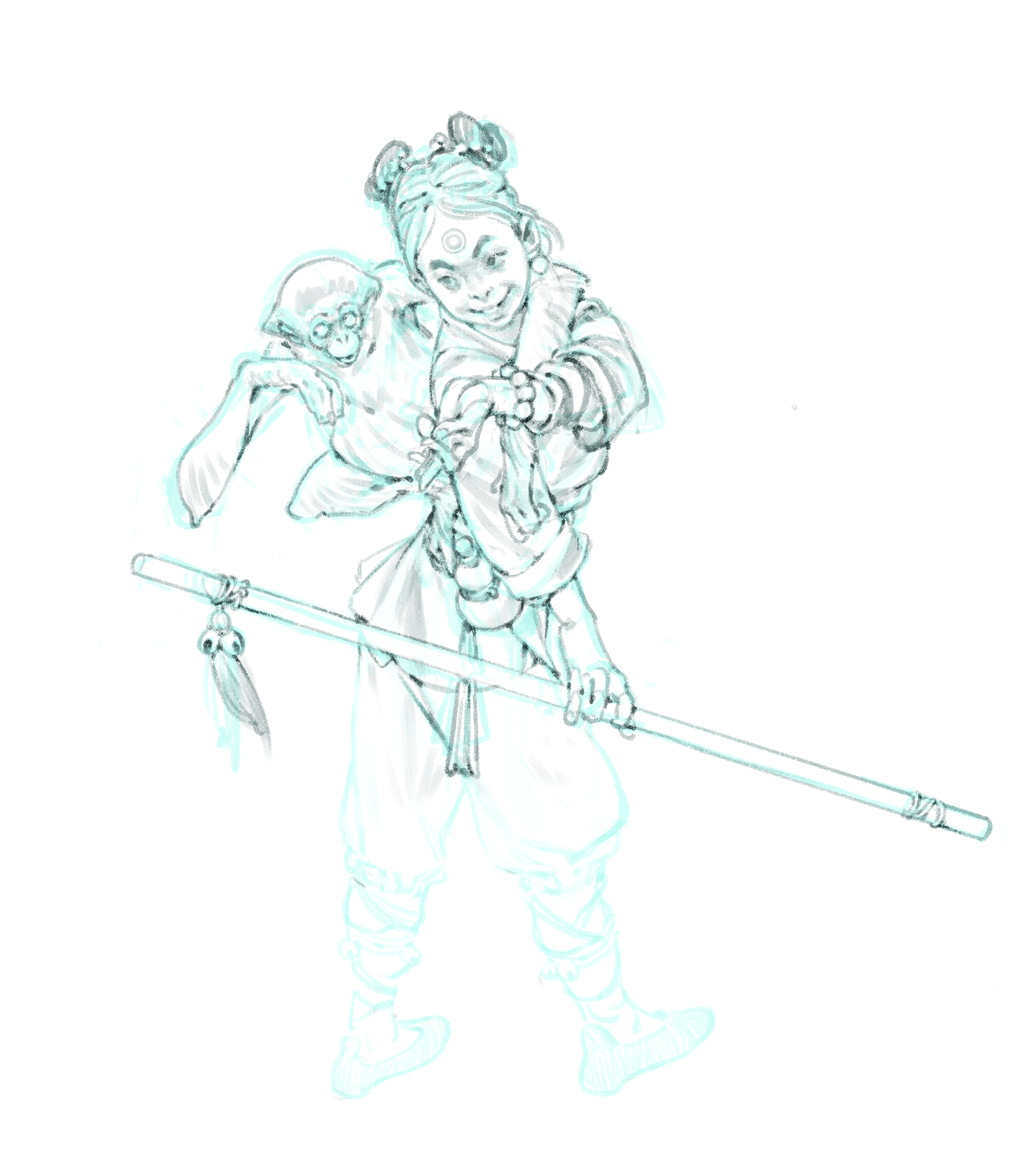
With the general structure and pose firmly established through the thumbnails, the designer can then proceed to redraw the character with a focus on details. This involves adding elements such as costumes, props, and initial facial expressions. The underlying thumbnail sketch is maintained, but its opacity is reduced and often shifted to a cyan color. This technique allows the original gesture to serve as a guide without creating visual clutter or interfering with the new, darker lines being laid down for the detailed design. This method ensures that the essence of the initial dynamic pose is preserved while the intricacies of the character’s appearance are developed.
05. Refining Nuance: Costume and Props (Part 2)
This stage emphasizes the iterative nature of design. While the initial thumbnail provides a strong foundation, it’s crucial not to adhere to it too rigidly. The designer approaches this step almost as if redoing the drawing from scratch, allowing for spontaneous refinements and improvements. The goal is efficient communication of the design, acknowledging that all elements remain subject to further modification.
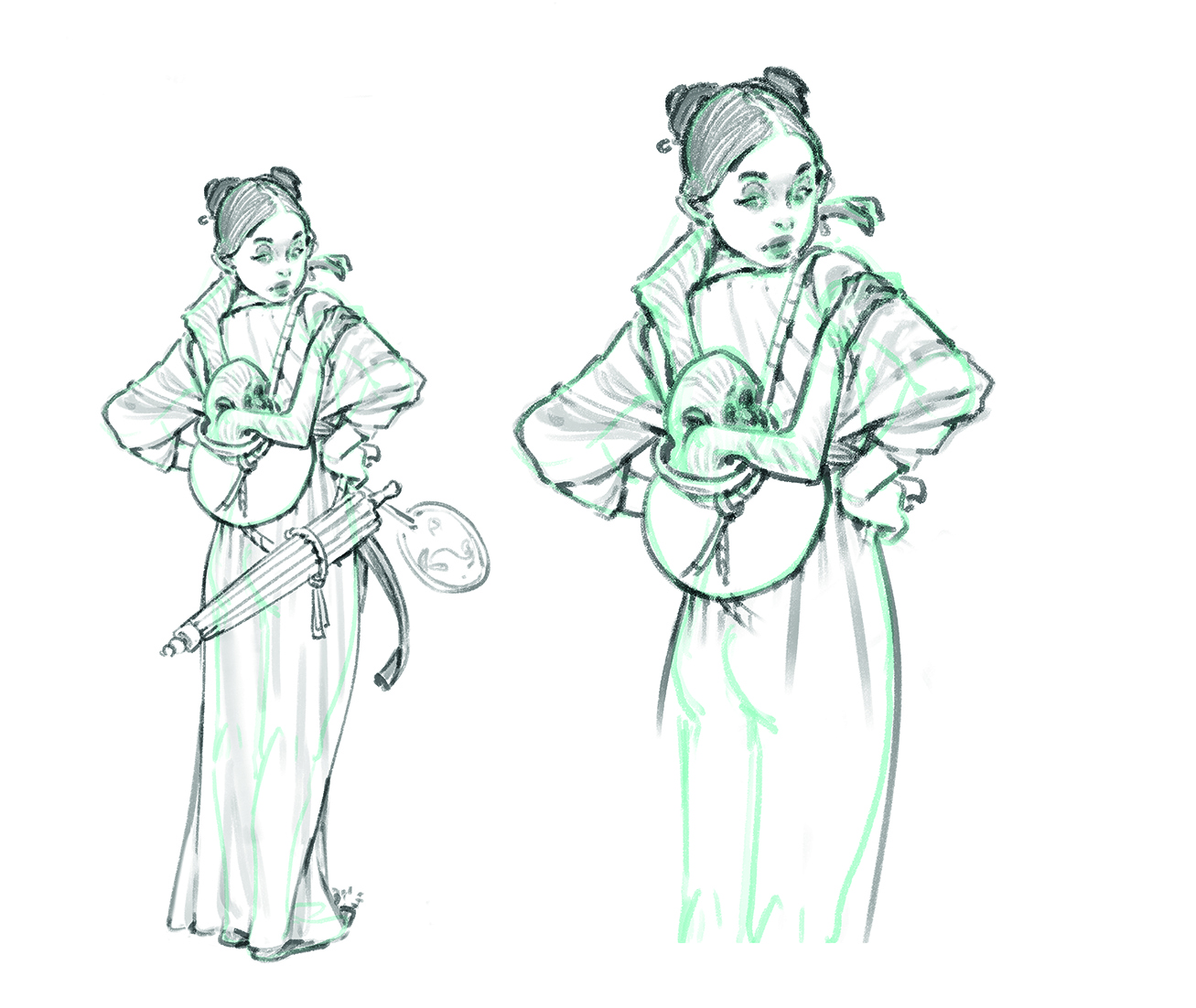
A significant adjustment made here, for instance, is tilting the angle of the monkey’s head to face the girl. This seemingly minor alteration dramatically strengthens the sense of interaction between the two, making their relationship feel more immediate and engaging. This iterative refinement allows for dynamic improvements that elevate the narrative and emotional connection of the characters.
06. The Client’s Vision: Picking the Winner and Feedback Integration
Client collaboration is an indispensable part of the character design process. After presenting various options, one particular design often emerges as the client’s preferred choice. In this case, the second option was selected, lauded for its enhanced activity and dynamism compared to its counterpart. This feedback validates the designer’s efforts to create a lively and engaging pose.
Crucially, client feedback can also introduce new elements that enrich the design. Here, the client requested the addition of a weapon—something that could serve a dual purpose, both for combat and for the character’s circus performances. This strategic addition not only broadens the character’s utility within the narrative but also contributes to a more interesting and complex silhouette, demonstrating how constructive feedback can elevate the design significantly. The designer quickly sketches this new element over the existing drawing, showcasing the adaptability of the process.
07. Strategic Adaptations: Finalizing the Design (Part 1)
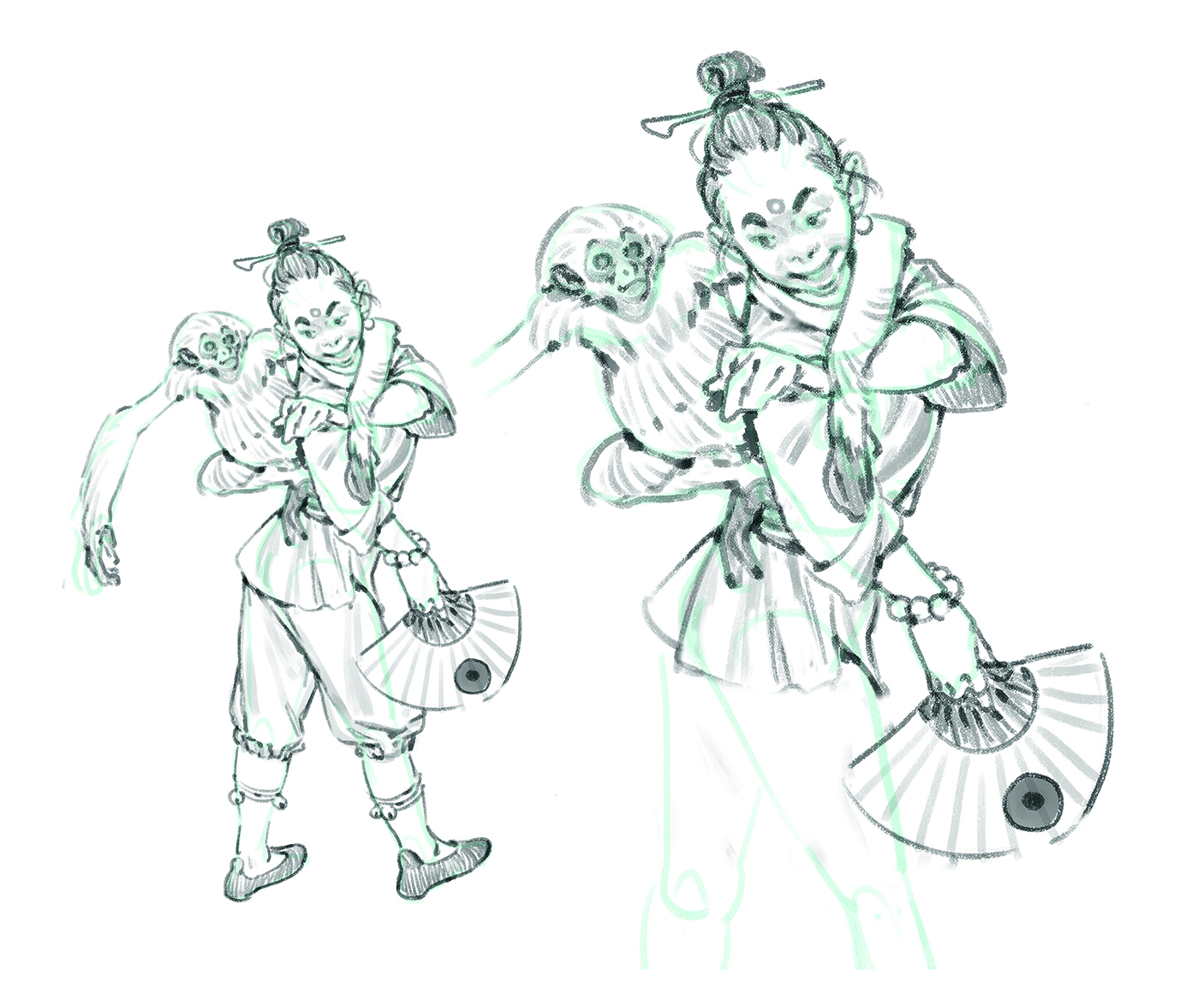
With the client’s feedback integrated and the preferred sketch selected, the designer proceeds to refine the drawing further. This stage is not just about implementing external suggestions but also about applying internal refinements that enhance the character’s "acting"—how their pose and expression convey their inner state and intentions.
For instance, the girl’s fan is repositioned to her waist, accompanied by a bottle, suggesting a more practical and self-sufficient aspect of her personality. More significantly, the monkey is now depicted looking intently at a grape, with its arm reaching out to grab it. This small adjustment creates a much stronger dynamic between the girl and her companion, implying a playful exchange and deepening their bond. These subtle changes collectively contribute to a more believable and engaging narrative through visual cues.
08. Precision without Loss: Finalizing the Design (Part 2)
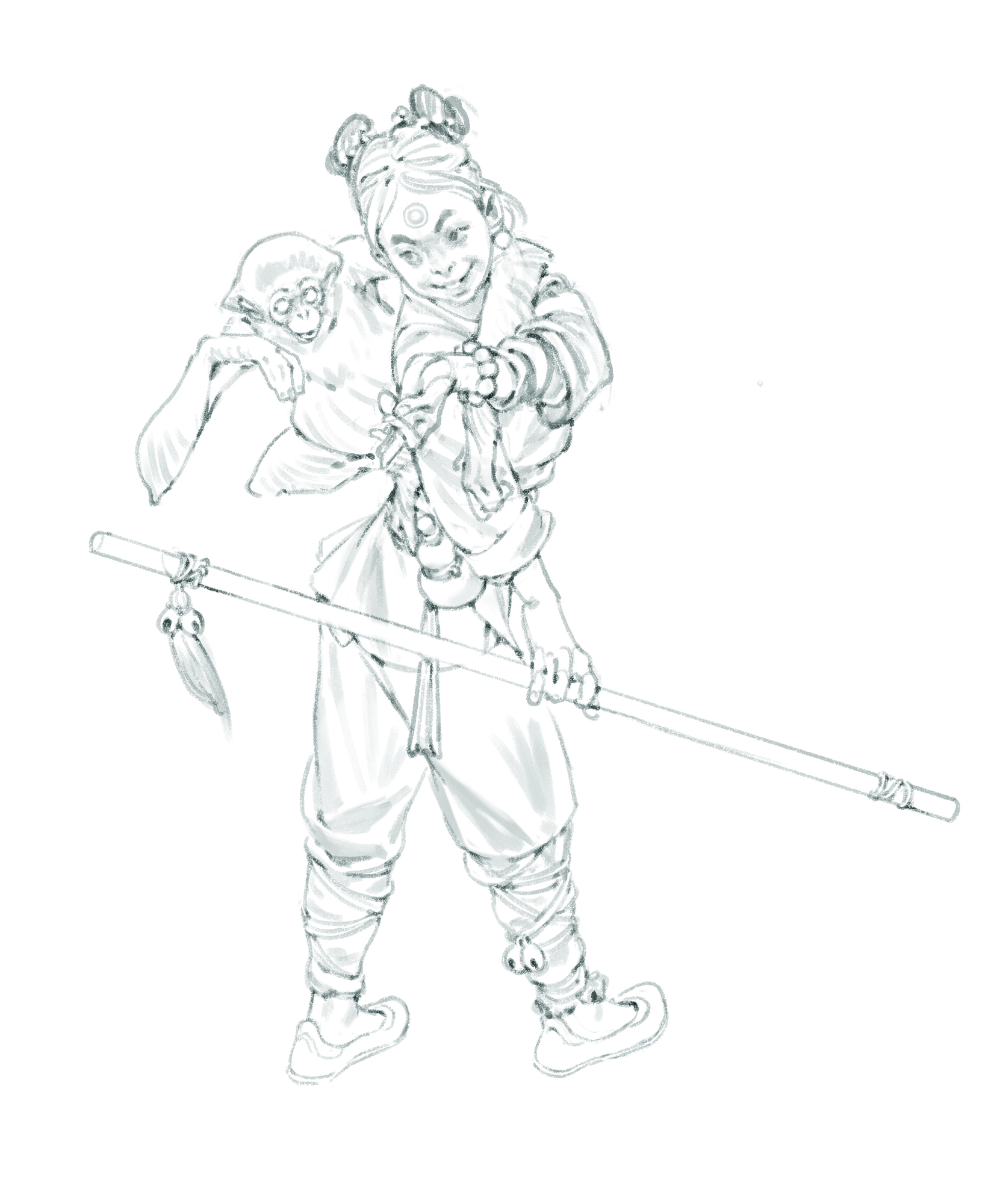
The ultimate goal of this final sketching phase is to achieve a higher degree of precision without sacrificing the spontaneous gesture and vibrant expression captured in the earlier rough sketches. To accomplish this, the designer consciously approaches the drawing as if starting anew, allowing the previous sketch to serve as a very low-opacity guideline underneath. This technique encourages fresh lines and forms while ensuring the core essence remains intact.
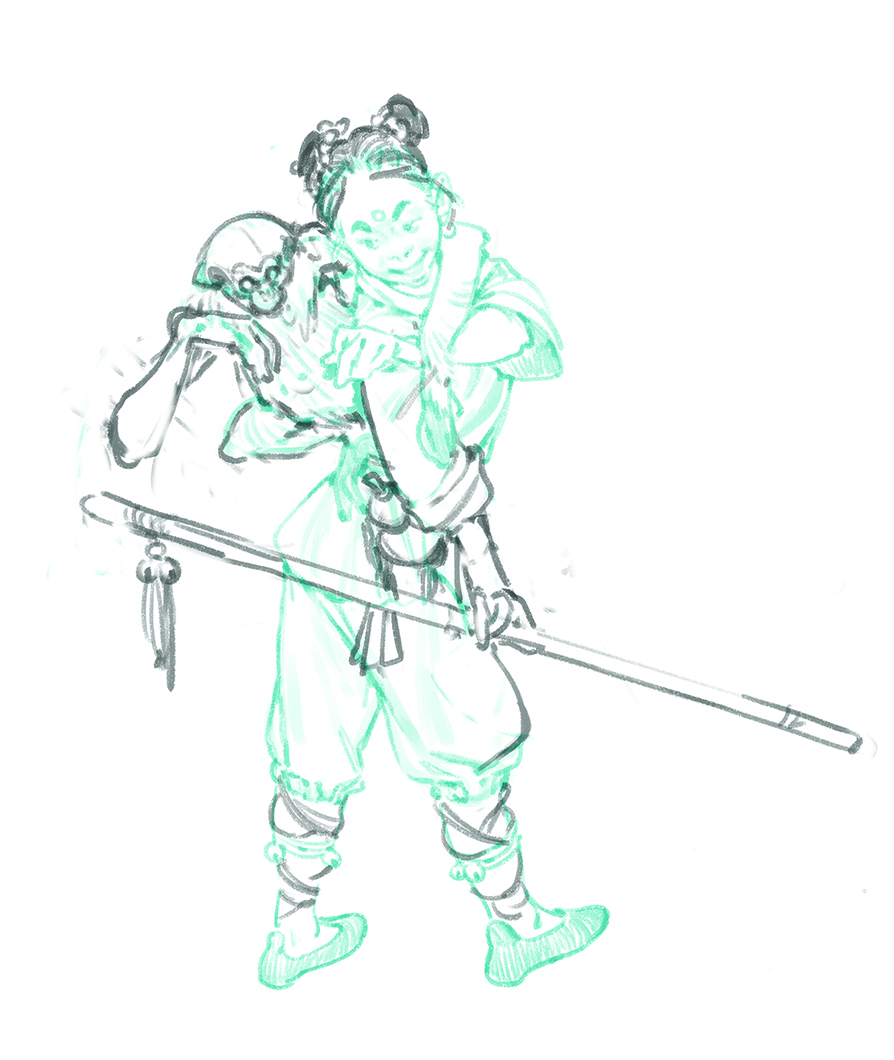
Maintaining understated, lighter lines at this stage is a deliberate choice. It prevents the drawing from becoming too heavy or "noisy," which would make the subsequent coloring process more challenging. The focus remains on clearly communicating the design’s intent and personality, preparing a clean canvas for the introduction of color and light.
09. The Art of Atmosphere: Placing Flat Colours
Transitioning to color, the designer aims for a watercolor-like aesthetic, starting with soft, understated tones. This approach prioritizes a gentle, diffuse quality over sharp, defined edges. A conscious effort is made to avoid perfectly filling in shapes, instead allowing for subtle variations in hue within each flat color. This technique introduces a degree of organic fluidity and depth from the outset, contributing to the desired ethereal and artistic feel. The slight variations in hue prevent the colors from appearing monolithic and add a nuanced richness that hints at the complexity of light and form.
10. Illuminating the Narrative: Lights and Shadows
This crucial stage involves intensifying the interplay of light and shadow to define form and direct the viewer’s eye. The designer focuses on enhancing lights around the focal point, introducing distinct highlights that catch the eye and give surfaces a tangible quality. Simultaneously, subtle temperature shifts are introduced between light and shadow areas, adding atmospheric depth and realism.
Occlusion shadows—the soft, dark areas where surfaces meet or block light—and cast shadows—the darker areas projected by objects—are strategically applied, albeit with a loose, painterly hand. This step is also a critical point for client approval, ensuring the chosen color palette and initial lighting scheme align with their vision before moving into more detailed rendering.
11. Layered Refinement: Painting On Top
Having established the foundational colors and lighting underneath the line work, the process now shifts to painting directly on top of the lines. While the overall image is intended to remain consistent with the approved color pass, this stage allows for the transformation of soft edges into more defined, harder ones where appropriate. This adds crispness and dimension to the forms.
A strategic order of detailing is observed: elements crucial for conveying gesture and expression, such as the monkey and the characters’ hands, are defined first. The girl’s face, being a highly expressive focal point, is often reserved for last. This sequence ensures that the most impactful communicative elements receive focused attention, bringing the characters’ personalities to the forefront.
12. The Expressive Core: Defining the Face
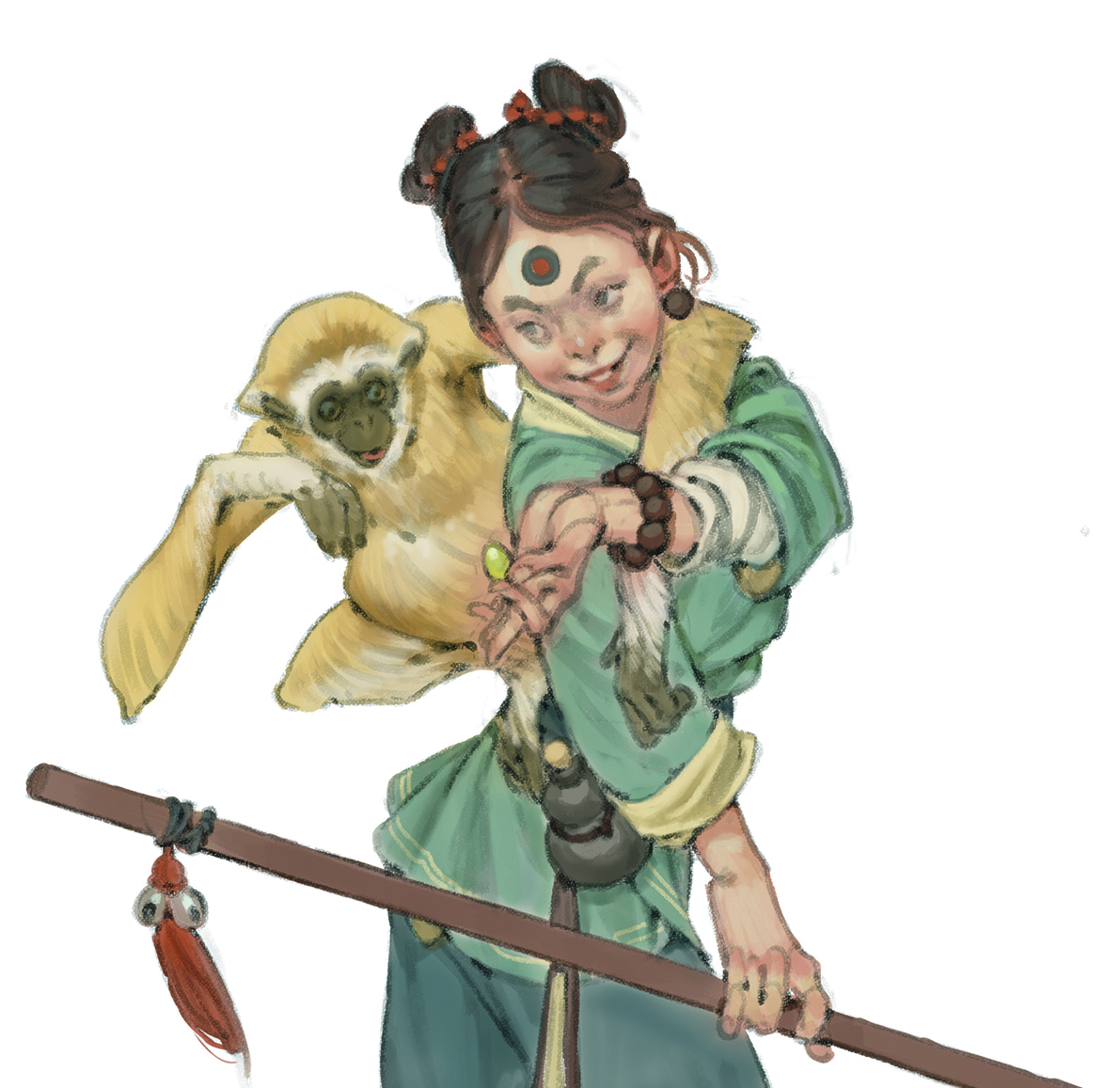
Defining the character’s face is a delicate balance, aiming for minimal deviation from the original expressive sketch while enhancing its impact. The designer primarily focuses on refining the subtle desaturated shadows and transitions that might have seeped through from the underlying sketch. These are replaced with warmer and brighter shadows, infusing the face with vitality and a healthy glow.
Concurrently, the contrast in key areas, particularly where occlusion shadows naturally occur, is pushed. This strategic use of contrast helps the facial forms read as three-dimensional and adds depth, ensuring that the character’s expressions are clear, engaging, and imbued with life. The face, as the primary conduit of emotion, is meticulously crafted to resonate with the viewer.
13. Holistic Refinement: Tightening the Rest of the Image
At this penultimate stage, the image begins to feel largely complete. All major elements of the character have undergone comprehensive rendering, and the gesture and acting of both figures convey a believable and engaging narrative. However, a critical eye is essential. The designer consciously steps back to identify any remaining inconsistencies or areas that require further refinement. This holistic review ensures that the entire composition works harmoniously, preparing it for the final, precise adjustments.
14. Perfection in Detail: Final Adjustments
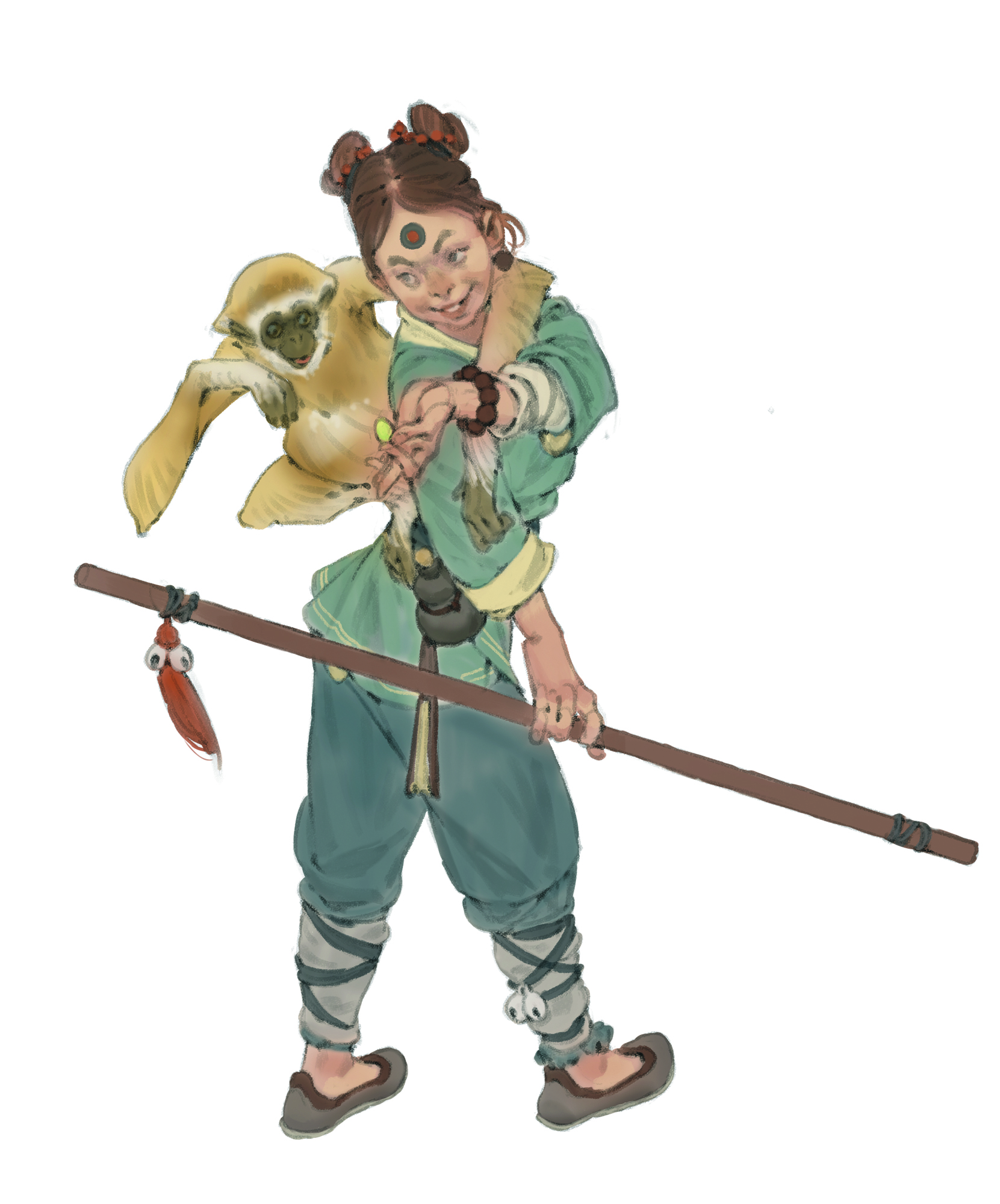
The final stage is dedicated to meticulous adjustments, aimed at elevating the character to its most polished form. This involves continuing to define major volumes, ensuring that the characters read as robust and three-dimensional even from a zoomed-out perspective. Specific areas, such as the gesture of the hand holding the staff, are fine-tuned, and the size of other elements, like the girl’s secondary hand, might be subtly reduced to improve overall balance and visual flow.
Reflecting on the entire journey, the designer assesses whether the initial playful vibe intended for the character has been successfully captured. This concluding thought often includes an introspective acknowledgment that while the current outcome is satisfactory, the dynamic nature of creative processes means there might always be alternative approaches to explore in future projects, underscoring the continuous learning and evolution inherent in character design.
The Enduring Impact: Why Character Design Matters
The journey from a fleeting concept to a fully realized character, as exemplified by Riccardo Moscatello’s meticulous process, underscores the profound significance of character design in visual media. It is through this intricate art that creators transcend mere imagery, crafting figures that resonate emotionally, convey compelling narratives, and establish an immersive connection with their audience.
The strategic emphasis on the silhouette, the dynamic interplay of pose and gesture, the subtle power of facial expressions, and the iterative refinement fueled by both artistic intuition and client feedback, collectively weave a tapestry of meaning. These techniques are not just about drawing; they are about storytelling, about building worlds, and about forging lasting impressions.
In an increasingly visual world, the demand for characters that not only look good but also feel real, that possess a discernible personality and purpose, continues to grow. Whether for the next blockbuster video game, a captivating animated film, or a compelling graphic novel, the ability to breathe life into fictional beings remains a paramount skill. Effective character design ensures audience investment, drives narrative momentum, and ultimately contributes to the enduring success and impact of any creative endeavor. It is a testament to the power of visual language, shaping perceptions and inviting us into fantasies that, for a moment, feel utterly real.
This article originally appeared in ImagineFX. Subscribe to ImagineFX to never miss an issue. Print and digital subscriptions are available.
Creative Bloq is now easier to access than ever before with our on-the-go app, which brings you all the content you know and love from our website, but in a super-streamlined design.
Download the Creative Bloq app for iOS
Download the Creative Bloq app for Android
Sign up to Creative Bloq’s daily newsletter, which brings you the latest news and inspiration from the worlds of art, design and technology.
 Evan Lee Salim
  Nana
Nana 