
 By Nana Wu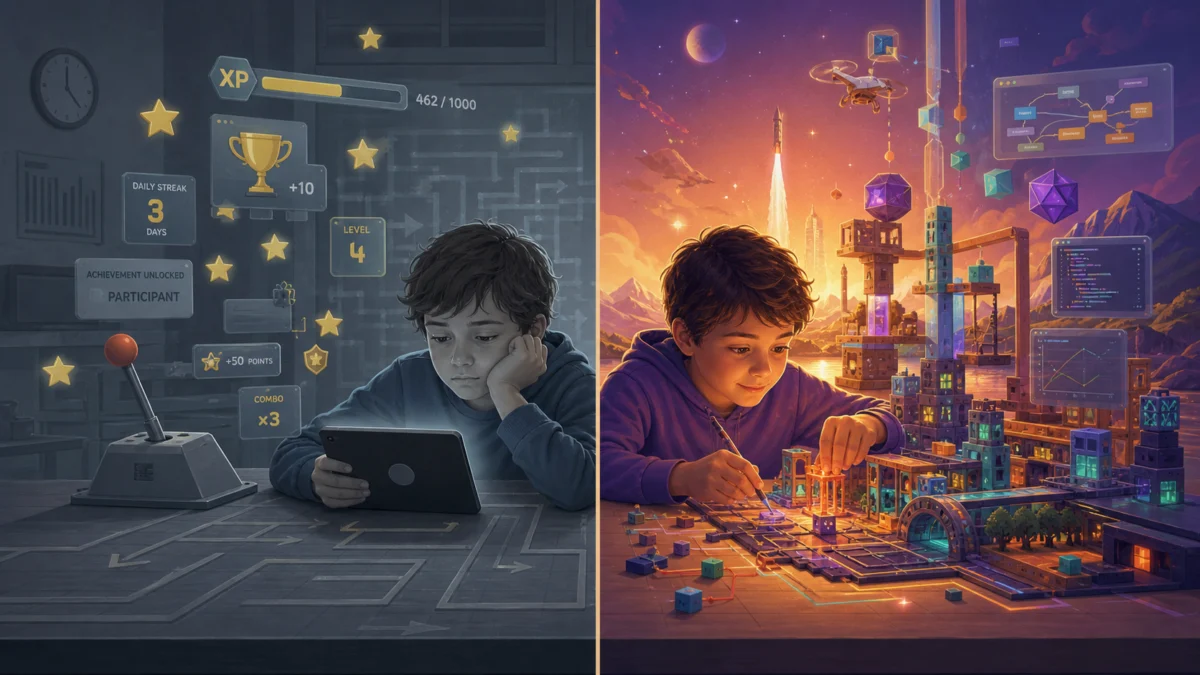
In the modern digital landscape, a quiet but profound conflict is unfolding between the architects of educational software and the students who inhabit it. On one side, we have developers and administrators clinging to the "gamification" trend—a design philosophy that treats education as a series of tasks to be completed for virtual stickers. On the other, we have a generation of digital natives—Gen Z and Gen Alpha—who have been raised in the hyper-sophisticated, creative, and social ecosystems of Minecraft, Roblox, and Fortnite.
When a twelve-year-old is asked to trade the infinite creative potential of a sandbox game for a "gamified" math app that doles out experience points (XP) for rote memorization, they do not see a game. They see an attempt at manipulation. As one student succinctly put it: "It’s not a game; it’s just homework with points."
The Main Facts: The Great Disconnect
The core of the issue lies in a fundamental misunderstanding of what makes a game "game-like." For the non-gaming professional, gamification is a spreadsheet of extrinsic motivators: leaderboards, progress bars, and badges. These are viewed as psychological triggers that compel a user to interact with a product.
However, for a child who has spent thousands of hours navigating the intricate mechanics of complex systems, these features are transparently hollow. Modern children do not play games because they receive an arbitrary "level up" notification; they play because they are granted agency, the ability to fail safely, and the space to innovate. When educational technology (EdTech) attempts to mimic the appearance of a game without replicating the underlying spirit of play, it fails to engage, and worse, it fosters a cynical relationship between the student and the tool.
Chronology of a Failed Trend
The obsession with gamification in education began in earnest in the early 2010s, riding the wave of "quantified self" culture. As mobile app development exploded, schools and startups sought to increase engagement in stagnant curricula by applying "game mechanics" to traditional learning.
- 2010–2014: The "Gold Star" era. Educational apps focused on digitizing worksheets. The prevailing theory was that immediate, dopamine-inducing feedback (pings, chimes, badges) would keep students glued to the screen.
- 2015–2019: The rise of the "Leaderboard" model. Developers began adding competitive elements to individual tasks, hoping that social comparison would drive participation.
- 2020–Present: The "Crisis of Authenticity." As the pandemic accelerated the shift to remote learning, students were flooded with low-effort gamified content. The result was widespread digital burnout. Today, students have reached a saturation point; they can identify the "Skinner box" mechanics of an app within seconds of logging in, leading to disengagement and the "gaming" of the system—where students seek the fastest, lowest-effort way to earn the points rather than engaging with the subject matter.
Supporting Data: Why "Bad Gamification" Fails
The failure of these tools is not merely anecdotal; it is structural. Psychological research into intrinsic versus extrinsic motivation suggests that when you attach rewards to a task that should be inherently interesting, you actually decrease the subject’s long-term desire to perform that task.
- The "Points = Boredom" Fallacy: Developers assume points are the engine of engagement. Data shows, however, that without a meaningful goal or a change in the state of the game world, points are perceived as "busywork."
- The Competency Gap: Students who are masters of game design intuitively understand the difference between procedural generation (which creates infinite possibilities) and linear progression (which offers only one path). When an app forces a user into a narrow, linear path disguised as a game, the student feels trapped rather than empowered.
- The Social Factor: In Fortnite or Roblox, social interaction is a primary driver. In many EdTech tools, "social" features are limited to empty leaderboards that do not facilitate genuine collaboration, making the experience feel lonely and performative.
Official Perspectives and Expert Critique
Educational theorists and game designers alike are beginning to push back against the "points-ification" of the classroom.
"Gamification is often used as a band-aid for poor curriculum design," says Dr. Elena Vance, a researcher in digital pedagogy. "When an educator or developer realizes that a lesson is dry or uninspired, their first instinct is to ‘gamify’ it rather than rethink the lesson itself. The result is a ‘chocolate-covered broccoli’ strategy: putting a thin layer of sweetness over something the student has already identified as unpalatable."
Conversely, developers who succeed in the space, such as the teams behind Minecraft Education Edition, operate on a different philosophy. They do not add points to chemistry; they build a chemistry lab inside a sandbox world. The "game" is not the reward; the game is the environment in which the learning happens.
The Implications for App Developers
For those building the next generation of productivity or educational tools, the stakes have shifted. The bar is no longer set by your competitors in the software industry; it is set by the most successful gaming giants in the world.
If your target audience is Gen Z or Gen Alpha, you are effectively competing with the entire gaming industry. If your app feels like a chore, you have lost. If your badges feel like patronizing placeholders, you have lost.
The core implications are as follows:
- Abandon the "Point-ification" Framework: If you are asking, "How do we add points to this?", you are already failing. Instead, ask what genre of experience your content aligns with. Is it a puzzle? A strategy simulation? A social sandbox?
- Design for Agency: Stop treating the user as a passive receiver of content. Allow for experimentation, trial and error, and failure. In a real game, failure is not a punishment—it is data that helps you win the next time. In bad EdTech, failure is often just a "try again" screen.
- Respect the User: Younger generations have an advanced "BS detector" regarding digital manipulation. They have lived through the evolution of predatory mobile game design and know when they are being nudged by an algorithm. Transparency and authenticity are now competitive advantages.
A Path Forward: Beyond the Badge
The path to effective educational technology is not found in the superficial imitation of games, but in the structural adoption of design principles that value the user’s intelligence.
We must move away from the "Skinner box" model of reward and punishment. Instead, we should look toward frameworks that emphasize systemic mastery. If a student is learning a language, don’t give them a badge for a streak. Instead, design a system where their growing vocabulary allows them to solve increasingly complex communication puzzles, much like a character in an RPG gains new abilities to overcome higher-level obstacles.
Ultimately, the future of education is not about "gamifying" the classroom; it is about recognizing that learning, at its best, is the most rewarding game of all. When we stop trying to trick students into learning and start giving them the tools to master their own curiosity, we won’t need to slap a "level up" animation on the screen to keep them engaged. They will be there because the work itself is worth doing.
Coming up in our series on the future of design: "Gamification 2.0: Moving Beyond Metrics to Meaningful Interaction."
 Ammar Sabilarrohman
  Neng Nana
  Sagoh
Sagoh 