
 By Muslim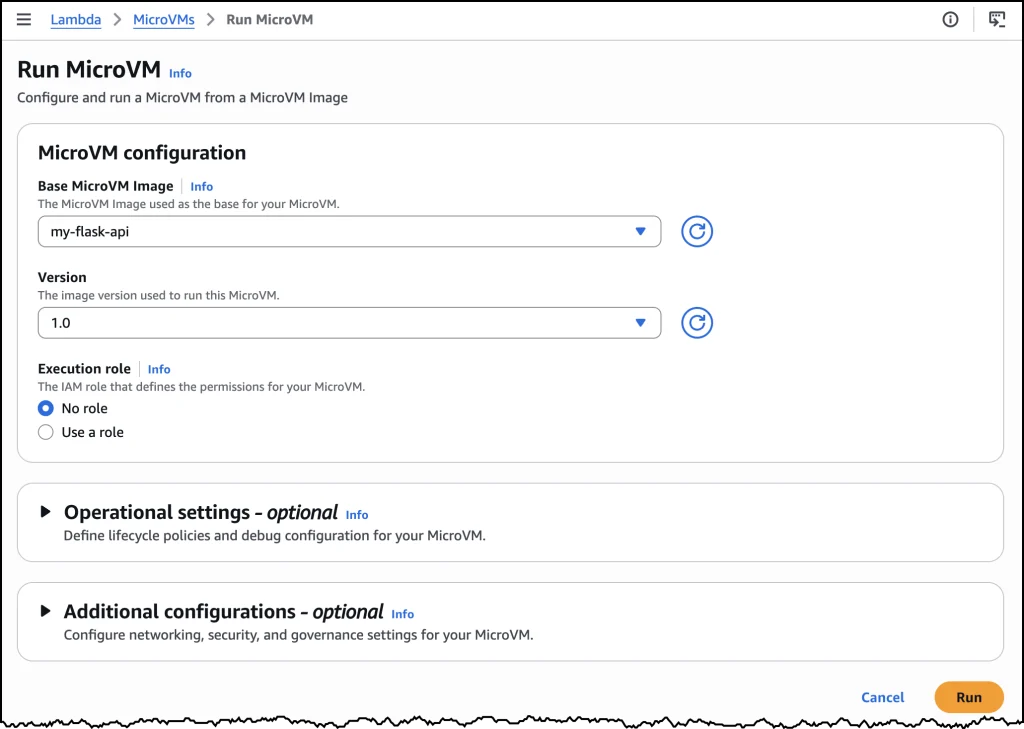
In a significant expansion of its serverless ecosystem, Amazon Web Services (AWS) today unveiled AWS Lambda MicroVMs, a groundbreaking compute primitive designed to bridge the long-standing gap between event-driven functions and traditional, stateful virtual machines. By leveraging the industry-standard Firecracker virtualization technology, AWS is empowering developers to provide end-users with dedicated, secure, and stateful execution environments without the traditional burden of infrastructure management.
This announcement marks a pivotal shift in how developers handle multi-tenant applications, particularly those involving AI-generated code, interactive data analytics, and user-supplied scripts.
The Core Innovation: Bridging the Isolation-Performance Gap
For years, software architects have faced an "uncomfortable trilemma" when designing multi-tenant platforms. On one hand, Virtual Machines (VMs) offer the robust security of hardware-level isolation but suffer from slow boot times—often measured in minutes—which are incompatible with modern, low-latency web experiences. On the other hand, Containers offer rapid startup times but rely on shared-kernel architectures, necessitating complex, custom-built security hardening to prevent cross-tenant data leaks. Finally, Functions-as-a-Service (FaaS) are highly optimized for transient, stateless requests but fail when an application requires a long-running, stateful session.
AWS Lambda MicroVMs effectively resolve this tension. By utilizing the same Firecracker microVM technology that powers over 15 trillion monthly Lambda invocations, AWS is now exposing the capability to run persistent, stateful code within a hardened, isolated sandbox. This allows developers to grant each end-user their own dedicated compute environment that retains memory, disk state, and process continuity across sessions, all while maintaining the agility of serverless infrastructure.

Chronology: From Concept to Production
The development of Lambda MicroVMs is the culmination of years of refinement in serverless virtualization.
- The Firecracker Foundation: The journey began with the open-sourcing of Firecracker, a Virtual Machine Monitor (VMM) designed specifically for serverless computing. Its ability to create secure, lightweight VMs in milliseconds set the stage for this new primitive.
- The Beta Evolution: Internal feedback from AWS’s own high-scale services highlighted the need for a more flexible execution model for interactive AI assistants and data science workbenches.
- The "Snapshot" Breakthrough: A critical milestone was the implementation of snapshotting technology. By allowing the system to "freeze" the memory and disk state of an initialized application and resume it instantaneously, AWS moved beyond the traditional "cold start" latency, enabling near-instant readiness for end-users.
- Official Launch (June 2026): AWS today officially rolled out the service in major regions, including US East (N. Virginia, Ohio), US West (Oregon), Europe (Ireland), and Asia Pacific (Tokyo).
Technical Deep Dive: How It Works
The magic of Lambda MicroVMs lies in its "Image-then-Launch" paradigm. Developers define their environment using a standard Dockerfile, which is then converted into a specialized MicroVM image.
1. The Build Process
The process begins by packaging code—such as a Flask or FastAPI application—along with its dependencies into an S3 artifact. Using the aws lambda-microvms create-microvm-image command, AWS triggers a build that initializes the container, installs the runtime environment, and performs a "pre-flight" execution. Once the environment is ready, the service takes a snapshot of the running memory and disk state.
2. Rapid Resumption
When a user triggers a session, the MicroVM does not "boot" in the traditional sense. Instead, it "resumes" from the pre-initialized snapshot. This ensures that the application is ready for traffic in milliseconds, regardless of how complex the underlying runtime or library stack may be.

3. Stateful Persistence
Unlike standard Lambda functions, which vanish once a request is completed, a MicroVM persists. It retains the state of the session, including temporary files, loaded AI models, and local databases. When a user stops interacting, the system utilizes an "idle policy" to suspend the VM to a low-cost, state-preserved state, automatically waking it up the moment a new request arrives.
Supporting Data: Scalability and Performance Metrics
The technical specifications of the new service demonstrate its capability to handle resource-intensive workloads:
- Compute Density: Each MicroVM can scale up to 16 vCPUs and 32 GB of memory.
- Storage: Each environment supports up to 32 GB of dedicated disk space.
- Architecture: The service launches with full support for the ARM64 architecture, aligning with AWS’s push for energy-efficient, high-performance computing.
- Lifecycle Efficiency: The ability to automatically suspend MicroVMs based on user inactivity significantly lowers the "idle cost," allowing businesses to offer interactive, persistent sessions without paying for 24/7 server uptime.
Implications for Industry Segments
The release of Lambda MicroVMs is expected to trigger a wave of innovation across several key sectors:
AI Coding Assistants and IDEs
Developers building AI coding platforms have previously struggled to provide real-time, sandboxed execution for generated code. With MicroVMs, these platforms can now run user-generated code in a secure, isolated environment that persists long enough to allow for iterative testing and debugging.

Interactive Data Analytics
Platforms that allow users to run complex Python or R scripts against large datasets will benefit immensely. By maintaining the "in-memory" state of data frames and loaded libraries, user sessions become significantly more responsive, removing the need to re-initialize data structures on every request.
Cybersecurity and Vulnerability Scanning
Security vendors performing on-demand code analysis or malware research require hardened environments to prevent malicious code from escaping into the host system. MicroVMs provide the necessary "air-gap" between the analysis engine and the underlying infrastructure, effectively automating the containment of untrusted payloads.
Official Responses and Strategic Vision
During the announcement, AWS leadership emphasized that Lambda MicroVMs are not intended to replace standard Lambda functions, but rather to complement them.
"Lambda Functions remain the gold standard for event-driven, request-response workloads," noted a senior AWS product architect. "MicroVMs are a distinct tool for a distinct job: multi-tenant, stateful, and interactive sessions. We are giving developers the ‘building blocks’ of virtualization without requiring them to become experts in the underlying kernel-level mechanics."
Industry analysts have noted that this move positions AWS to capture a larger share of the "AI Application Development" market. By offloading the complexity of secure container orchestration, AWS allows startups and enterprise teams to focus on the business logic of their AI agents rather than the underlying infrastructure of their sandbox.
Getting Started: The Developer Experience
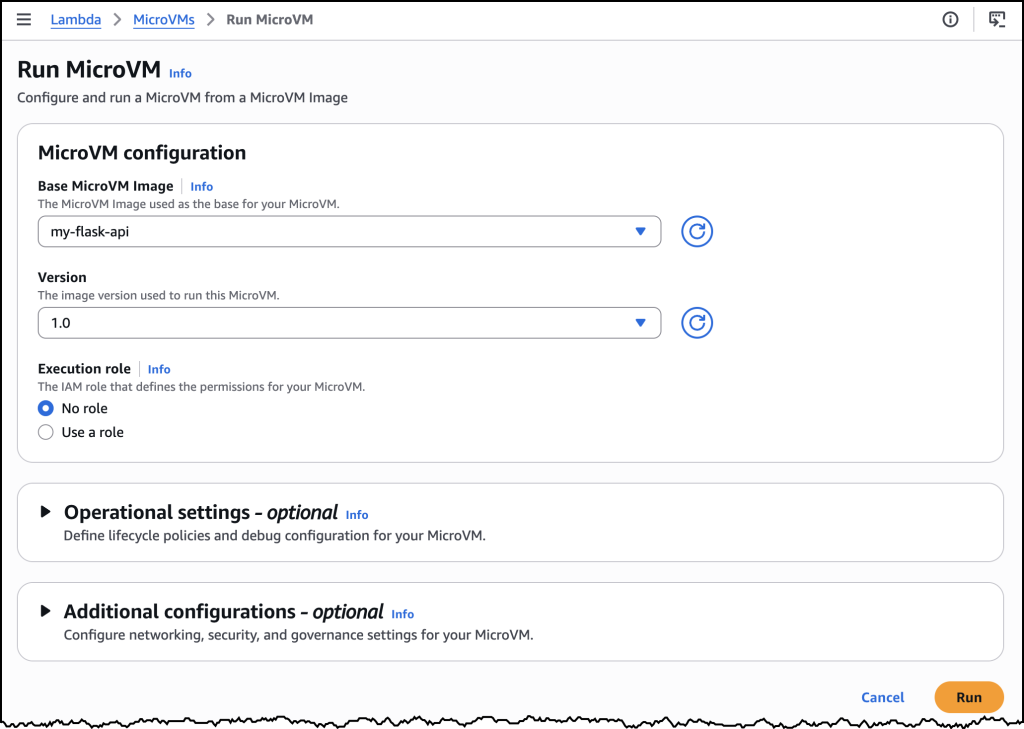
AWS has integrated MicroVMs directly into the existing Lambda console, ensuring a low barrier to entry. For developers comfortable with Docker, the transition is seamless.
- Preparation: Create your application code and a standard Dockerfile.
- Deployment: Use the AWS CLI to build the MicroVM image via an S3-based artifact.
- Lifecycle Management: Define your
idle-policyto balance cost and performance. - Execution: Send requests via the dedicated endpoint provided by the API, using standard auth protocols.
With comprehensive documentation and a clear developer guide, AWS is aiming for immediate adoption. As the industry continues to move toward more complex, user-driven compute workloads, AWS Lambda MicroVMs provides the necessary infrastructure to ensure those workloads are both secure and lightning-fast.
For further exploration, developers are encouraged to review the official Lambda MicroVMs Developer Guide and check the AWS Lambda pricing page for specific cost models regarding suspended and active compute states.
 Neng Nana
  Suro Senen
  Lina Hope