
 By Jia Lissa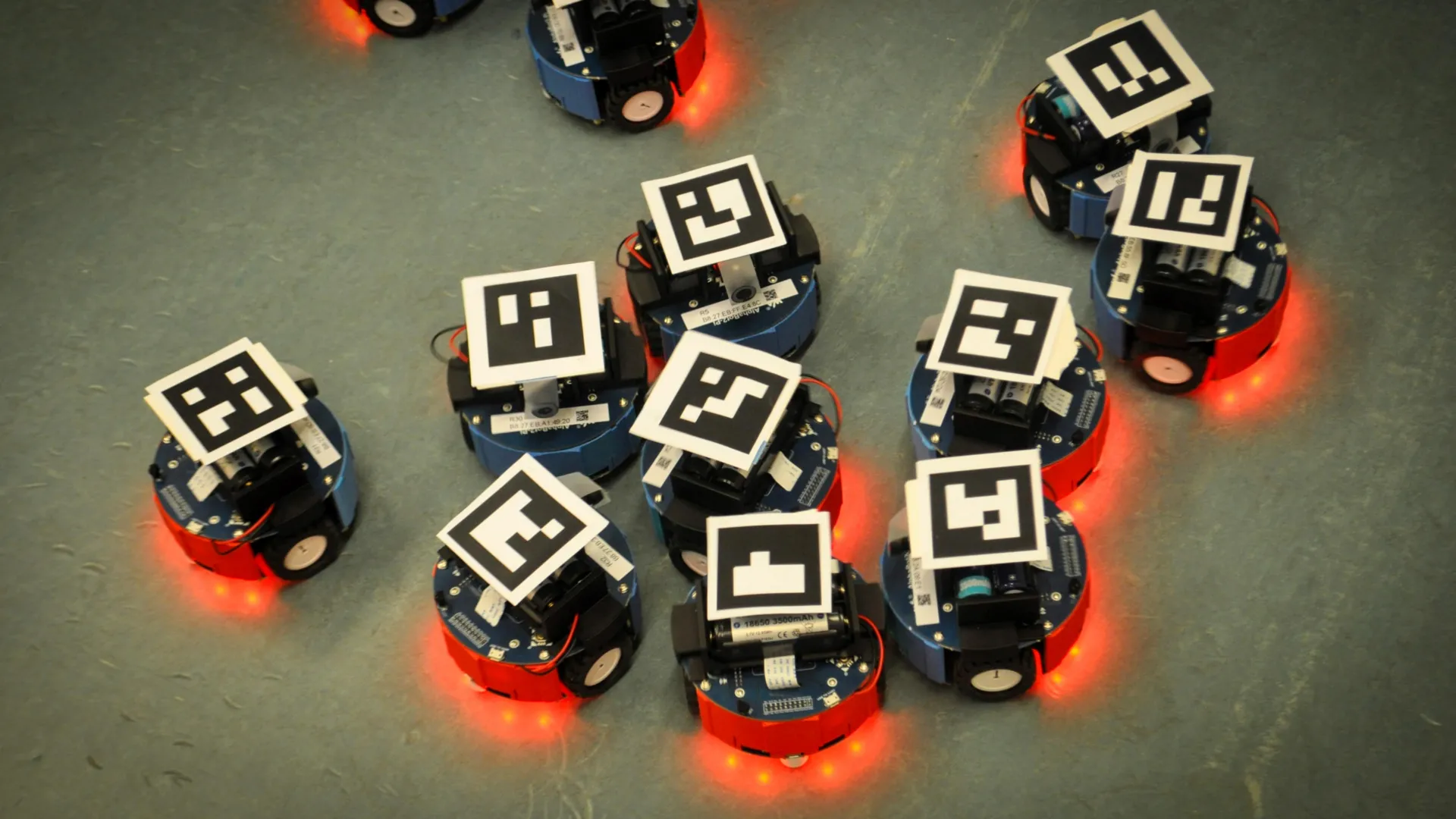
Imagine a disaster zone following an oil spill or a bustling factory floor operating at peak capacity. In these environments, speed is not just a preference; it is a necessity. Roboticists have long dreamed of deploying massive "swarms" of autonomous units to tackle these tasks, theoretically increasing efficiency by orders of magnitude. Yet, a fundamental problem persists: the "crowding paradox." Much like a rush-hour highway or a crowded hallway, there is a tipping point where adding more units actually causes a system to grind to a halt.
Researchers at Harvard University’s John A. Paulson School of Engineering and Applied Sciences (SEAS) believe they have cracked the code to this congestion crisis. In a study recently published in the Proceedings of the National Academy of Sciences, the team, led by applied mathematics Ph.D. student Lucy Liu and supervised by Professor L. Mahadevan, suggests that the secret to a high-functioning robot swarm isn’t more intelligence—it’s the strategic injection of "noise" or randomness into their movement patterns.
The Crowding Paradox: When More Means Less
The challenge of dense movement is one of the most stubborn hurdles in swarm robotics. When robots operate in a confined space, they are prone to "deadlock"—a state where agents become so tightly packed that their proximity sensors or collision-avoidance protocols cause them to freeze or stall.
"At first, adding more robots speeds things up, which is what we want," explains Lucy Liu. "But after a certain point, the space becomes crowded, robots start interfering with one another, and overall progress slows down significantly."
For years, the industry standard for solving this has been to increase the computational power of individual robots, allowing them to calculate more complex paths or communicate more effectively with their peers. However, the Harvard team took a counterintuitive approach. Instead of demanding more intelligence, they tested whether simpler, slightly erratic behaviors could actually outperform highly calculated, "perfect" trajectories.
A Chronology of Discovery: From Theory to Laboratory
The research trajectory was methodical, moving from abstract mathematical modeling to computer simulations, and finally to physical verification.
Phase 1: Mathematical Modeling
The team began by treating each robot not as a sophisticated computer, but as a "point agent" with a tunable parameter for noise. By mathematical definition, "noise" in this context refers to the intentional deviation from a straight-line path. The researchers developed equations to quantify "goal attainment rates"—essentially measuring how many tasks a swarm completes per unit of time relative to the density of the robots.
Phase 2: Computer Simulations
With the math established, the team built a digital environment. Each "agent" was given a start point and a random destination. Once a destination was reached, a new one was assigned, creating a continuous loop of movement. They observed the swarm at three distinct levels of noise:
- Zero Noise: The agents moved in perfectly straight lines. This resulted in the rapid formation of dense, immovable traffic jams.
- High Noise: The agents moved erratically. While they rarely collided, they spent so much time wandering that their productivity plummeted.
- The "Goldilocks Zone": The researchers found a middle ground where the agents occasionally bumped into one another, creating short-lived, transient clusters, but possessed enough "wiggle room" to eventually slip past one another and continue toward their goals.
Phase 3: Real-World Implementation
To validate the simulation, the team partnered with physicist Federico Toschi at the Eindhoven University of Technology. They deployed a swarm of small, wheeled robots in a physical lab. Each robot was equipped with a QR code, allowing an overhead camera system to track its position in real-time. Despite the physical limitations—such as friction and mechanical lag—the robots mirrored the simulated findings, proving that the theory held up in the physical world.
Supporting Data: The Physics of "Active Matter"
The study provides a significant contribution to the field of "active matter"—the study of systems composed of many self-propelled units. The researchers found that by introducing randomness, they were effectively converting a complex, unpredictable system into a predictable statistical one.
"This might be counterintuitive, because how could randomness make things easier to work with?" Liu noted. "But in this case, when you have a lot of randomness, it becomes possible to take averages—average distances, average times, average behaviors. This makes it a lot easier to make predictions."
The data suggests that there is a mathematical "sweet spot" for every density level. As the density of the robots increases, the amount of noise required to maintain flow also shifts. By utilizing the formulas developed in this study, engineers can now calculate the exact amount of "controlled chaos" needed to keep a specific fleet size moving optimally, preventing the catastrophic "gridlock" that currently plagues autonomous systems.
Official Perspectives: The Experts Weigh In
Professor L. Mahadevan, who oversaw the project, views these findings as a bridge between robotics and biology. "Understanding how active matter, whether it is a swarm of ants, a herd of animals, or a group of robots, becomes functional and executes tasks in crowded environments using the principles of self-organization, is relevant to many questions in behavioral ecology," Mahadevan said.
The research highlights a shift in the philosophy of robotics: the realization that centralized control is often a liability. When every robot tries to calculate the "perfect" move, they often end up making the same decisions, which leads to conflict. By allowing individual agents to act with a degree of local autonomy and randomness, the system becomes more robust and less prone to the cascading failures of centralized logic.
Justin Werfel, a SEAS Senior Research Fellow who co-guided the project, emphasized the simplicity of the solution. The study proves that highly complex coordination does not require advanced artificial intelligence or a central "brain." Instead, simple local rules—move toward the target, but deviate slightly when crowded—can produce highly efficient, organized group behavior.
Implications: Beyond the Laboratory
While the study focused on robots, the implications are vast and reach far beyond the factory floor.
Traffic Management
Autonomous vehicles currently rely on complex sensor arrays to navigate traffic. The Harvard findings suggest that if autonomous cars were programmed with a small, calculated amount of "probabilistic movement," they might be able to navigate dense urban centers more efficiently than humans, who are often inhibited by rigid lane-following behaviors.
Human Crowd Management
The principles of self-organization observed in the robots can be applied to architectural design and public safety. By understanding how "noise" affects movement, urban planners could design spaces—such as subway stations or sports arenas—that naturally encourage better flow during high-density events, reducing the likelihood of dangerous bottlenecks.
Industrial Logistics
In automated warehouses, where hundreds of robots retrieve and move goods, the "Goldilocks Zone" of noise could significantly increase throughput. By tuning the movement of these fleets, companies could increase the density of their robot workforces without the current penalty of increased collisions and traffic delays.
Conclusion: Embracing the "Wander"
The Harvard study serves as a humbling reminder that in nature, and now in engineering, "efficiency" is not always a linear pursuit. Sometimes, the most efficient path forward is not a straight line, but a slightly wandering one.
As we move toward a future defined by autonomous systems and crowded urban landscapes, the work of Liu, Mahadevan, and their colleagues provides a new framework for progress. By embracing a little bit of chaos, we may finally find the order we have been searching for all along.
Funding for this research was provided by the National Science Foundation Graduate Research Fellowship Program (Grant No. DGE 2140743), the Simons Foundation, and the Henri Seydoux Fund.
 Sagoh
Sagoh  Asro
Asro  Siti Muinah