
 By Azzam Bilal Chamdy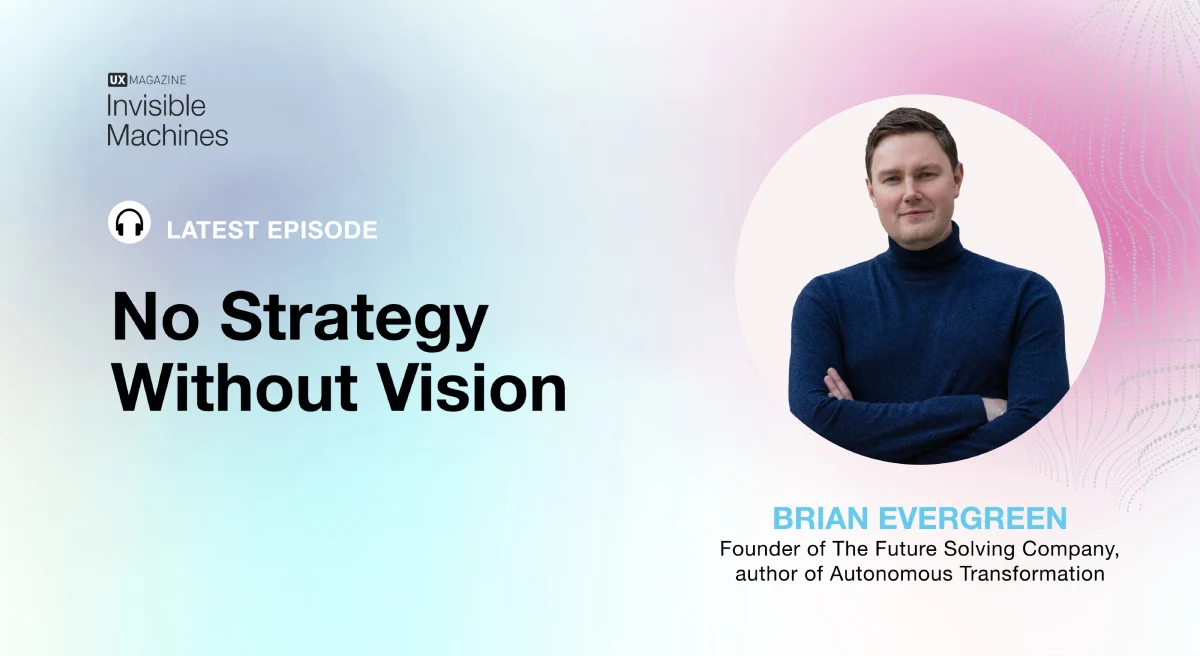
By Enterprise Technology Insights
Published: October 2023 / Updated for Enterprise Leadership
In the modern corporate boardroom, the introduction of artificial intelligence is rarely greeted with a lack of enthusiasm. Instead, it is met with a familiar, well-rehearsed ritual: the frantic assembly of an executive deck, a rush to achieve baseline "AI literacy," and the immediate drafting of a Request for Proposal (RFP).
Yet, according to Brian Evergreen, founder of The Future Solving Company and author of Autonomous Transformation, this entire motion is built for a commercial world that no longer exists. Appearing on a recent episode of the Invisible Machines podcast—hosted by OneReach.ai CEO Robb Wilson and joined by Josh Tyson—Evergreen dissected why traditional procurement models, static feature matrices, and bottom-up problem-solving frameworks are failing organizations attempting to implement agentic AI.
The core diagnosis is as provocative as it is urgent: enterprises are treating the dawn of autonomous systems like a software upgrade cycle, mistaking motion for architecture and procurement for strategy.
Main Facts: The Structural Mismatch of Enterprise AI
The central conflict in enterprise AI adoption lies in the fundamental mismatch between legacy procurement methods and the nature of autonomous, agentic systems.
- The Literacy Trap: Executives frequently use basic AI literacy—learning the definitions of generative models, classical machine learning, and agentic workflows—as permission to immediately sprint toward use-case lists and vendor shortlists.
- The Obsolescence of the RFP: Traditional purchasing mechanisms (RFPs, analyst quadrants, feature checklists, and oral defenses) are engineered to evaluate discrete, static products (SKUs). They fail when applied to agentic AI, where software capabilities can dramatically shift mid-flight due to underlying model updates.
- The "No Strategy Without Vision" Mandate: Evergreen’s core thesis posits that iterative, bottom-up efficiency improvements inherit existing organizational constraints as destiny. Without a vivid, top-down articulation of a desired future state, strategic planning collapses into hollow administrative motion.
- The Problem-Solving vs. Future-Solving Divide: Traditional problem-solving is an exercise in waste elimination and operational trimming. "Future-solving" requires defining a new category of value that does not yet exist and working backward to establish the necessary organizational, technological, and cultural conditions.
Chronology: From Blockbuster’s Blind Spot to Bell Labs’ Blueprint
To understand how modern enterprises stumble into the AI adoption trap, industry historians and technology strategists point to historical parallels that reveal how organizations mismanage paradigm shifts.
The Late-Fee Paradox: The Blockbuster Parallel
During the podcast, Evergreen and Wilson reflected on the classic cautionary tale of Blockbuster’s demise. Years before streaming became the dominant paradigm, Blockbuster possessed a credible, functioning streaming-shaped pilot.
However, corporate leadership evaluated the initiative through the lens of existing late-fee economics and franchise dependencies. Blockbuster’s primary "customer of record" was often the franchisee, not the end consumer. Consequently, a transformative streaming strategy was viewed as a direct threat to the balance sheet, cannibalizing the very revenue streams the organization depended on at the time.
The missing piece was not technological capability; it was structural alignment and a willingness to future-solve a new business model alongside stakeholders rather than against them.
The 1952 Bell Labs Reset
As a counter-move to incrementalism, Evergreen highlighted a historic exercise undertaken by Bell Labs in 1952. Confronted with the aging lifecycle of their top inventions, executive leadership forced an unnatural and radical exercise upon their researchers: Assume the entire telephone network has been completely destroyed and is utterly irreparable.
Teams were instructed to rebuild the infrastructure entirely from scratch, utilizing contemporary science, modern economics, and current regulatory frameworks. The lesson for modern AI adoption is clear: breakthrough innovation cadence cannot be left to serendipity or squeezed in between standard calendar holds. It must be deliberately convened.
Supporting Data: The Mechanics of "Future Solving"
Moving beyond traditional metrics of software implementation requires a fundamental rewiring of how organizations measure progress. In the enterprise landscape, pilot programs and user adoption metrics frequently mask strategic misalignment.
The Governance Layer: Morgan Stanley’s Blueprint
Citing early enterprise infrastructure work—such as Morgan Stanley’s development of a governed knowledge layer—Josh Tyson illustrated what a rigorous approach to "what would have to be true" looks like in practice. Rather than dumping unstructured PDFs into a retrieval-augmented generation (RAG) pipeline, successful organizations build systems anchored in:
- Explicit Ownership: Clear accountability for data inputs and outputs.
- Freshness Protocols: Real-time validation and decay management for institutional knowledge.
- Accountability Frameworks: Traceable decision paths that satisfy regulatory and internal audit requirements.
The Illusion of Adoption Metrics
A recurring trap in digital transformation is treating user adoption as an absolute proxy for success. As Wilson observed, high volume interaction with a poorly targeted tool is still a failure of strategy. If an organization deploys agentic workflows to optimize an obsolete business model, it merely accelerates inefficiency with unprecedented speed.
Furthermore, historical workplace language requires an overhaul. Metrics like "cost reduction" or "increased operational efficiency" function merely as scoreboards. A true vision must be visceral—something leaders and operators can picture vividly in a room: a clinical professional remaining fully present in a human moment because administrative burdens are handled autonomously, or a trusted partner whose relationship model renders shadow IT obsolete.
Official Responses and Expert Perspectives
The dialogue between Evergreen, Wilson, and Tyson highlights a fundamental philosophical schism in how technology leadership views the path forward.
"If you begin from the org chart as it exists today and ask how to make it slightly better, you inherit every constraint as destiny."
— Brian Evergreen, Founder of The Future Solving Company
Evergreen argues that design principles used in user experience (UX) and product development—such as making pathways concrete through user flows, states, and acceptance criteria—are actually detrimental when applied prematurely to agentic AI.
"That plan is rational right up until the moment you are no longer commissioning a defined product. Treating innovation like a science fair where the hypothesis is ‘which vendor checks the most boxes’ misleads you about what parity means."
— Robb Wilson, CEO of OneReach.ai
Wilson emphasizes that legacy organizations suffer not from an absence of planning, but from an over-engineered capacity to purchase known solutions. When software behavior becomes dynamic, the vendor checklist becomes not just stale, but actively deceptive.
Implications: The Shift to Intent-Led Architectures
The implications of an agentic, vision-first paradigm extend far beyond procurement departments. They signal a profound shift in how software is conceptualized, authored, and experienced.
The Collapse of Traditional Interfaces
As agentic systems mature, the classic transactional user interface—characterized by multi-step funnels, logins, dashboards, and discrete application silos—begins to dissolve. When intent can be handled end-to-end by autonomous agents, the logistics layer becomes invisible.
We are approaching an era where terms like "login" or "file directory" will feel as archaic to the next generation as a physical floppy disk icon used to represent saving a document. Interfaces will collapse because a single cohesive narrative owns the story across organizational silos. If an enterprise fails to author that narrative itself, an external platform company will write it by default.
Friction and Momentum
Friction within organizations—middle-layer resistance, compliance hurdles, and internal politics—is often treated as a pathology to be surgically removed. Evergreen warns, however, that friction is inexhaustible; an organization can always find more obstacles to analyze.
Vision acts as the necessary steamroller. When people are genuinely enrolled in a compelling future state they want to inhabit, they clear operational obstacles in its service. Conversely, without a shared north star, the energy spent managing friction yields zero cumulative progress.
Strategic Recommendations for Enterprise Leaders
- De-prioritize the Vendor Bake-Off: Halt the rush to release RFPs and evaluate feature matrices until the organization has explicitly mapped out the desired future state of its industry.
- Shift from Problem-Solving to Future-Solving: Stop treating AI exclusively as a waste-reduction tool. Instead, ask: What do we want to exist that does not exist today, and what must become true to make it happen?
- Invest in Architecture Before Automation: Build governed knowledge layers, establish clear data accountability, and align internal stakeholder incentives before deploying autonomous agents into high-stakes workflows.
- Author the Narrative: Take ownership of the end-to-end user and operational story. If internal leadership does not define the architectural vision, platform providers and market competitors will define it for them.
For further exploration of these concepts, listen to the full discussion on the Invisible Machines Podcast Hub or watch the full episode on YouTube.
 Ammar Sabilarrohman
  Neng Nana
  Sagoh
Sagoh 