
 By Muslim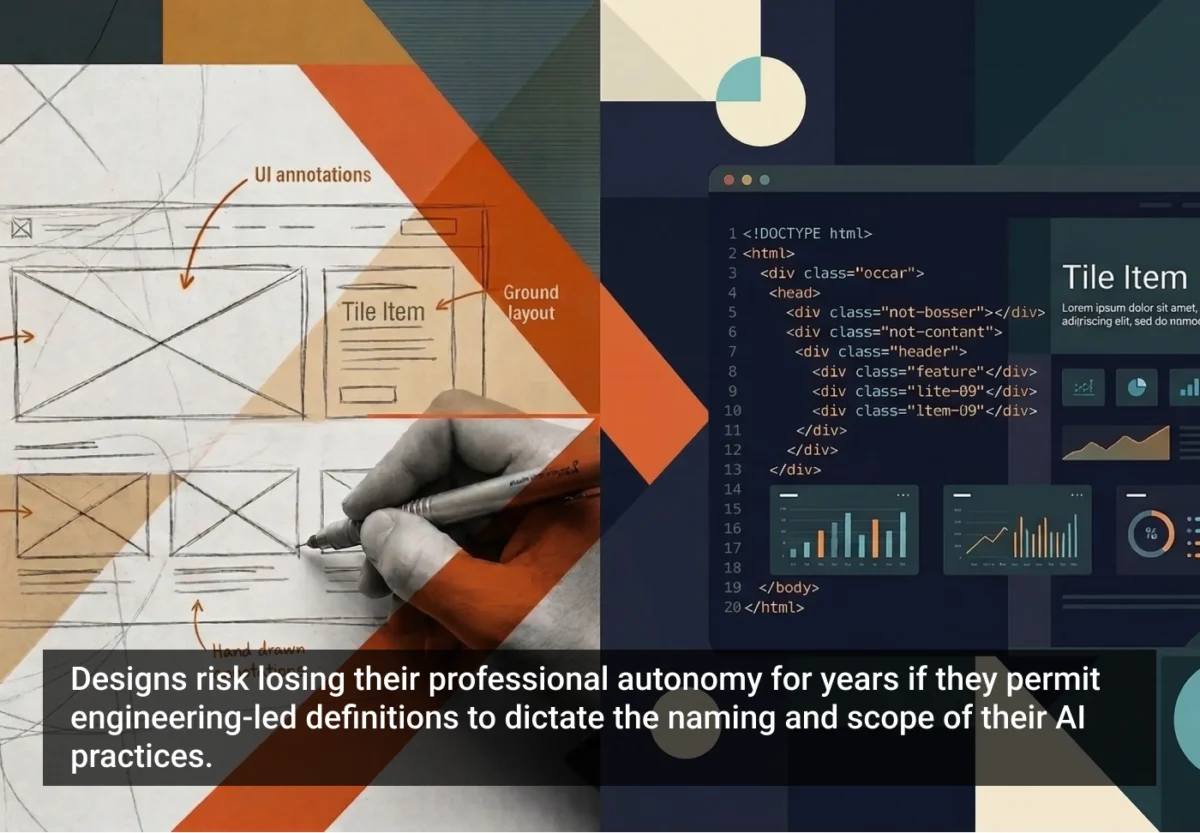
Introduction: The Battle for the Lexicon of Design
As artificial intelligence reshapes creative workflows, a quiet semantic war is being waged over how we talk about modern design. At the heart of this conflict is a phrase popularized by engineer and researcher Andrej Karpathy in early 2025: "vibe coding."
Originally coined to describe a loose, low-accountability style of software creation—where a user loosely describes a concept, accepts whatever generative output emerges, and largely ignores the underlying mechanics—the term has since broken containment. It has migrated across disciplines, increasingly being used by engineering cultures, product managers, and even designers themselves to describe advanced AI-assisted design workflows.
For many practitioners, accepting this label is more than a harmless linguistic concession; it is an abdication of professional authorship. When designers let passive, low-accountability terms define their craft, they invite an external culture to dictate the value, structure, and understanding of modern design leadership.
This article examines the growing chasm between passive AI generation and intentional, directed generation, exploring how the design community must establish its own rigorous vocabulary before external narratives permanently cement their practice as mindless prompt-engineering.
Chronology of an Identity Crisis: How "Vibe Coding" Colonized Design
To understand how the design industry reached this inflection point, we must look at the timeline of how technical jargon infiltrates creative fields.
- Early 2025 (The Origin): Andrej Karpathy coins "vibe coding" to characterize a specific, experimental programming behavior. It serves as an accurate shorthand for an exploratory, non-rigorous software-building process where human oversight is minimal.
- Mid-to-Late 2025 (The Migration): As generative UI and multimodal design tools mature, tech culture begins applying software-centric terminology to design spaces. Because design lacked an equivalent, snappy vocabulary for AI collaboration, "vibe coding" begins appearing in cross-functional team meetings, portfolio reviews, and tech commentary.
- Early 2026 (The Passive Acceptance): Designers notice their rigorous workflows—which involve complex visual references, strict behavioral constraints, and rigorous upstream curation—being casually dismissed as "just vibe coding." Many accept the label passively, failing to push back against the implications of low accountability.
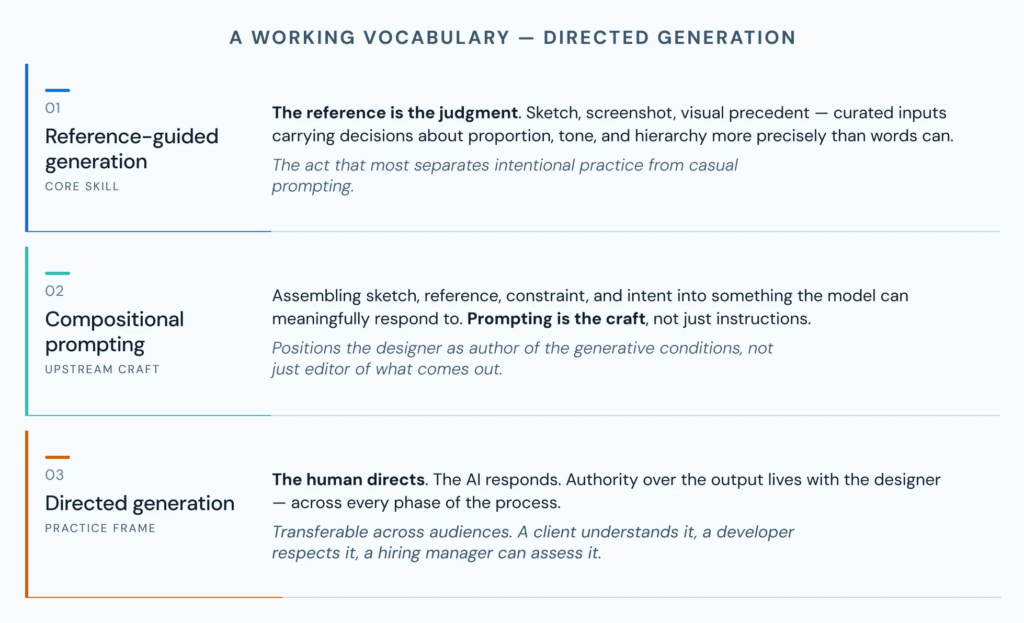
- Present Day (The Pushback): A counter-movement emerges within the design systems community. Practitioners begin advocating for distinct terminology like directed generation, reference-guided practice, and compositional prompting to reclaim intellectual ownership of AI-augmented design workflows.
Main Facts: Passive Generation vs. Directed Generation
The core divide in contemporary AI-assisted design is not about adoption—virtually all modern designers use AI tools to varying degrees. Rather, the fundamental split lies in where the authority lives within the process.
1. The Passive Model (Prompt and Pray)
In the passive, or low-accountability, model:
- Generation drives all decisions.
- The human workflow consists of prompting, accepting the model’s output, making minor surface-level adjustments, and shipping.
- The human acts strictly as a supervisor or quality-assurance filter at the very end of a pipeline largely controlled by the algorithm.
2. The Active Model (Directed Generation)
In contrast, serious, high-velocity design practice in the AI era relies on directed generation, characterized by several distinct phases:
- Judgment Arrives First: The process begins not with a blank text prompt, but with a curated input—a sketch, a visual precedent, a screenshot, or a multi-layered reference.
- The Reference as Intent: This reference carries implicit decisions regarding proportion, typographic hierarchy, tone, and spatial relationships. It communicates visual intent far more precisely than paragraphs of text ever could.
- Guarded Responsiveness: The AI responds to the designer’s strict parameters and constraints, not the other way around. The human author retains absolute authority over the aesthetic and architectural grammar.
Supporting Data and Technical Realities: Non-Deterministic Design
The evolution toward directed generation alters how design systems operate at scale. Traditionally, design systems have treated patterns as fixed, immutable artifacts—defined, documented, and replicated across products to ensure consistency. While this guarantees visual uniformity, it often sacrifices flexibility and slows down product iteration.
The Shift from Pixels to Patterns
Directed generation introduces non-deterministic design, a methodology backed by several structural shifts:
- Pattern-Level Judgment: Instead of forcing designers to manually specify every individual pixel or micro-component across dozens of screens, human judgment operates at the level of the pattern and its governing rules.
- Contextual Recomposition: When an advanced machine learning system understands a design pattern abstractly—comprehending its spatial, typographic, and behavioral logic rather than merely copying it—the pattern becomes a dynamic set of relationships. It can mold itself intelligently across unfamiliar surfaces, devices, and contexts without breaking core brand integrity.
- Upstream Craftsmanship: The designer’s role shifts from a pixel-pusher to an architect of conditions. Craft moves upstream into the precision of the primitives, the rigor of the constraints, and the quality of the reference inputs.
As this practice matures, the natural evolution points toward agentic delivery—autonomous systems capable of carrying forward design direction consistently across vast digital ecosystems. The designer authors the grammar; the system speaks it fluently.
Official Responses and Industry Perspectives
Design leaders and systems architects have increasingly voiced concerns over how language shapes professional valuation.
"When an imprecise term colonizes an emerging practice, it doesn’t just misdescribe the work. It pre-shapes how the work gets understood, hired, and valued before anyone’s had a chance to define it properly."
— Design Systems Community Insights
Industry veterans draw parallels to the early days of User Experience (UX) design. When UX first emerged as a distinct discipline, practitioners who actively named and defined their methodologies—distinguishing interaction design from information architecture—successfully shaped how enterprise stakeholders valued the field for decades. Conversely, designers who allowed adjacent engineering and product management cultures to define their practice spent years fighting to recover professional ground.
Furthermore, pragmatic design directors emphasize that adopting directed generation does not mean abandoning traditional, deterministic workflows entirely. Production-ready components, locked design tokens, and predictable handoffs remain essential for specific risk-tolerant environments. A mature, modern practice recognizes a hybrid approach: utilizing non-deterministic, generative wireframing and rapid concept exploration for high-velocity innovation, while locking down deterministic components for final production deployment.
Implications: Reclaiming the Lexicon and Future Proofing Practice
The debate over "vibe coding" versus "directed generation" carries profound implications for three crucial professional arenas:
- The Portfolio Review: When hiring managers ask how a project was executed, describing a workflow as passive generation undermines the intellectual rigor required to curate, constrain, and guide complex AI models. Precise language demonstrates true authorship.
- Client Pitch and Kickoffs: Clients pay for expertise, strategic judgment, and methodology. Framing AI collaboration as structured, reference-guided directed generation justifies agency rates and strategic value in ways that casual buzzwords never can.
- Mentorship of Junior Talent: Emerging designers need accurate mental models of what professional craft looks like in an AI-saturated world. Letting engineering shorthand define design leadership teaches the next generation that their role is merely supervisory rather than visionary.
What Should We Call It Instead?
To break free from borrowed terminology, the design community has proposed several alternative handles for high-accountability AI practice:
- Directed Generation: Highlighting human authority and proactive constraint over raw algorithmic output.
- Reference-Guided Practice: Emphasizing the curation of visual and structural inputs that dictate model behavior.
- Compositional Prompting: Focusing on the layered, systemic assembly of rules rather than casual chat-based prompting.
Ultimately, the exact phrase matters less than the intentionality behind it. Designers who actively define their own methodologies will retain their authority, secure their value, and lead the discipline into its next evolutionary phase. Those who inherit shorthand from outside their discipline risk watching their authorship dissolve into the background noise of automated generation.
 Laily UPN
  Lina Hope
  Asep Darmawan