
 By Nana Muazin
Main Facts: The Silent Decay of the Modern Website and the Rise of Continuous Optimization
Every digital product shares a quiet, inescapable tragedy: its peak moment of perfection occurs on launch day.
At the exact second the final production branch merges and the platform goes live, it represents the absolute zenith of its design, intent, and relevance. From that precise millisecond onward, a slow, unyielding process of degradation begins.
Crucially, this decay has nothing to do with catastrophic code failures or server crashes. The site continues to function, load, and serve requests. Instead, the decay is contextual and environmental. Market dynamics shift, competitor strategies evolve, design systems mature, typography tokens update, and messaging subtly misaligns with the company’s current identity. Within twelve months, a modern website risks becoming a digital period piece—fully operational, yet fundamentally behind the curve.
Historically, web development teams have treated this degradation as an immutable law of nature. Maintenance is viewed as a reactive burden: a cycle of frantic redesigns, hurried patch releases, and periodic overhauls that consume immense resources every few years.
Enter autonomous website platforms—such as Fimo, developed by Pierre Burgy and his engineering team. These systems utilize continuous background AI agents to optimize, update, and self-heal digital properties long after the initial launch. Rather than leaving a site to drift into obsolescence, autonomous web architecture promises a reality where a platform is measurably healthier, faster, and more aligned every single morning.
Yet, as Burgy and his team discovered firsthand during the development of Fimo, integrating full autonomy exposes a profound psychological and organizational barrier: While organizations want the benefits of continuous optimization, almost nobody actually wants a website that changes entirely on its own.
Chronology: From the Static Launch Paradigm to the Era of Agentic Web Operations
To understand the current pivot toward autonomous web management, it is necessary to examine the evolution of web production tools over the past two decades.
- The Era of Static Content Management (Early 2000s–2010s): Websites were managed via monolithic Content Management Systems (CMS) like WordPress, Drupal, or early enterprise platforms. Maintenance required direct manual intervention for every plugin update, security patch, and content revision. Stagnation was the default state.
- The Modern Jamstack and Git-Based Workflows (2015s–2020s): The developer ecosystem shifted toward decoupled architectures, continuous integration/continuous deployment (CI/CD) pipelines, and design systems. While deployment became automated, keeping the content, accessibility standards, and visual assets synchronized with real-world business changes still relied entirely on human bandwidth.
- The Emergence of LLMs and Generative Agents (2022–2024): Large Language Models and multimodal AI models matured to the point where they could interpret code, understand design tokens, analyze accessibility standards (WCAG), and execute minor codebase modifications safely.
- The Autonomous Pivot (Present Day): Platforms like Fimo emerged with the initial thesis that full automation—handing the keys of a website entirely over to AI agents—was the ultimate goal. However, early user testing and deployment metrics revealed immediate friction. Organizations balked at unmonitored changes, leading to a critical design realization: Autonomy cannot be an all-or-nothing toggle; it must be granular, role-based, and earned through verifiable trust.
Supporting Data: Categorizing the Workload of a Living Website
When building and testing autonomous web infrastructure, developers must map out exactly where human effort is spent versus where machine efficiency can take over. Analyzing modern digital maintenance reveals that web operations naturally split into three distinct categories:
1. The Rule-Bound Chores (Approx. 80% of Operations)
The vast majority of what keeps a website healthy is repetitive, algorithmic, and entirely devoid of creative taste. This category includes:
- Enforcing accessibility (WCAG) compliance as dynamic content changes.
- Propagating global design-system token updates across hundreds of subpages.
- Detecting and fixing broken meta tags, unoptimized image assets, and dead internal or external links (link rot).
None of this requires human creative genius. These are tedious, rule-bound hygiene tasks that engineering and design teams are actively relieved to delegate. Agents excel in this domain because success is defined by strict parameters rather than subjective aesthetic judgment.
2. The Untouchable Core (Creative & Strategic Judgment)
At the opposite end of the spectrum lies the core value proposition of human creators. An agent can verify contrast ratios, confirm heading hierarchies, and check copy against a style guide. However, an agent cannot determine what a digital brand should feel like or whether a bold new campaign captures the cultural zeitgeist.
This is the subjective, qualitative layer that human designers, copywriters, and product managers were hired to govern. Attempting to fully automate this layer leads to homogenous, sterile digital experiences. Recognizing and protecting this territory is essential for any sustainable human-AI collaboration.
3. The Gray Zone: Role-Based Boundaries
Between automated chores and untouchable creative work lies a vast operational gray zone where the boundaries shift depending on organizational roles.
Consider a specific, high-stakes change: Switching the website’s default user interface theme to dark mode.
- The Developer’s Perspective: To a frontend engineer, configuring a dark mode default is often a straightforward, rational state change—a single configuration line backed by data showing user preference trends. They are typically comfortable letting an agent implement this and move forward.
- The Designer’s Perspective: To a brand designer, the default visual theme is a profound statement of identity. It dictates how the brand introduces itself to the world for the first time. They view this as an intentional brand statement that demands human creative governance.
This divergence proves that "correctness" is not an objective property of the task itself; it is a function of organizational role and individual accountability.
Official Insights & Industry Perspectives: Redefining Control
In interviews detailing the philosophy behind Fimo, Pierre Burgy emphasizes that product design in the age of AI agents requires moving away from simplistic binary settings ("approve all" versus "delegate all").
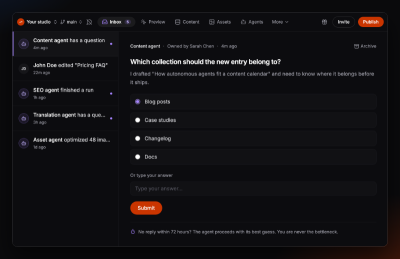
"The point of autonomy was never to remove you from your website. It was to remove the decay," Burgy notes.
Rather than offering a fixed menu of system-wide permissions, modern autonomous web platforms must treat the agent itself as the unit of customization. Teams do not simply toggle an "auto-pilot" switch; they compose specific agents tailored to precise workflows.
- The Content Agent: Kept on a tight leash, requiring human sign-off for brand-facing announcements, product positioning updates, and high-stakes marketing copy.
- The Accessibility and Asset Agent: Given high or complete autonomy to continuously compress newly uploaded images, correct alt-text tags, and fix broken hyperlinks in real time without human bottlenecks.
Furthermore, trust within these platforms is designed to be dynamic rather than static. As agents execute tasks, log their changes, and present clear before-and-after comparisons in audit trails, human teams can observe their reliability. Over time, tasks that initially required strict approval can graduate to autonomous delegation—not because standards were lowered, but because the agent systematically earned operational trust.
Implications: The Future of Digital Operations and Web Engineering
The shift toward continuous, agent-driven website optimization carries profound implications for digital agencies, enterprise engineering teams, and solo creators alike.
1. The Death of the "Redesign Cycle"
For decades, the standard digital lifecycle involved launching a site, ignoring it for three years while it decayed, and then spending hundreds of thousands of dollars on a panicked, ground-up redesign. Autonomous web optimization flattens this curve. By ensuring continuous, incremental micro-updates happen in the background every night, platforms remain perpetually modern, eliminating the violent financial and operational shocks of multi-year redesign cycles.
2. Shifting Human Focus to High-Value Strategy
When 80% of maintenance chores (broken links, uncompressed assets, minor CSS regressions) are absorbed by specialized background agents, web professionals are liberated from operational drag. Designers can focus entirely on brand storytelling, user experience architecture, and conversion rate strategy, rather than manually hunting down missing meta tags or updating typography tokens across fifty legacy landing pages.
3. Overcoming the Fear of the Unknown
The psychological hurdle of autonomous systems—the fear that an invisible algorithm will rewrite a corporate homepage without warning—is being solved through radical transparency. Modern agentic architectures rely on comprehensive run histories, immutable logs, and granular permission boundaries. By letting creators inspect every micro-change before or immediately after execution, platforms bridge the gap between machine efficiency and human peace of mind.
Ultimately, the goal of the autonomous web is not to replace human creativity, but to protect it from the relentless tide of digital entropy. By letting AI agents manage the maintenance chores of the digital world, creators can finally ensure that their work remains as sharp, vibrant, and effective as it was on day one.
 Iffa Jayyana
  Ammar Sabilarrohman