
 By Iffa Jayyana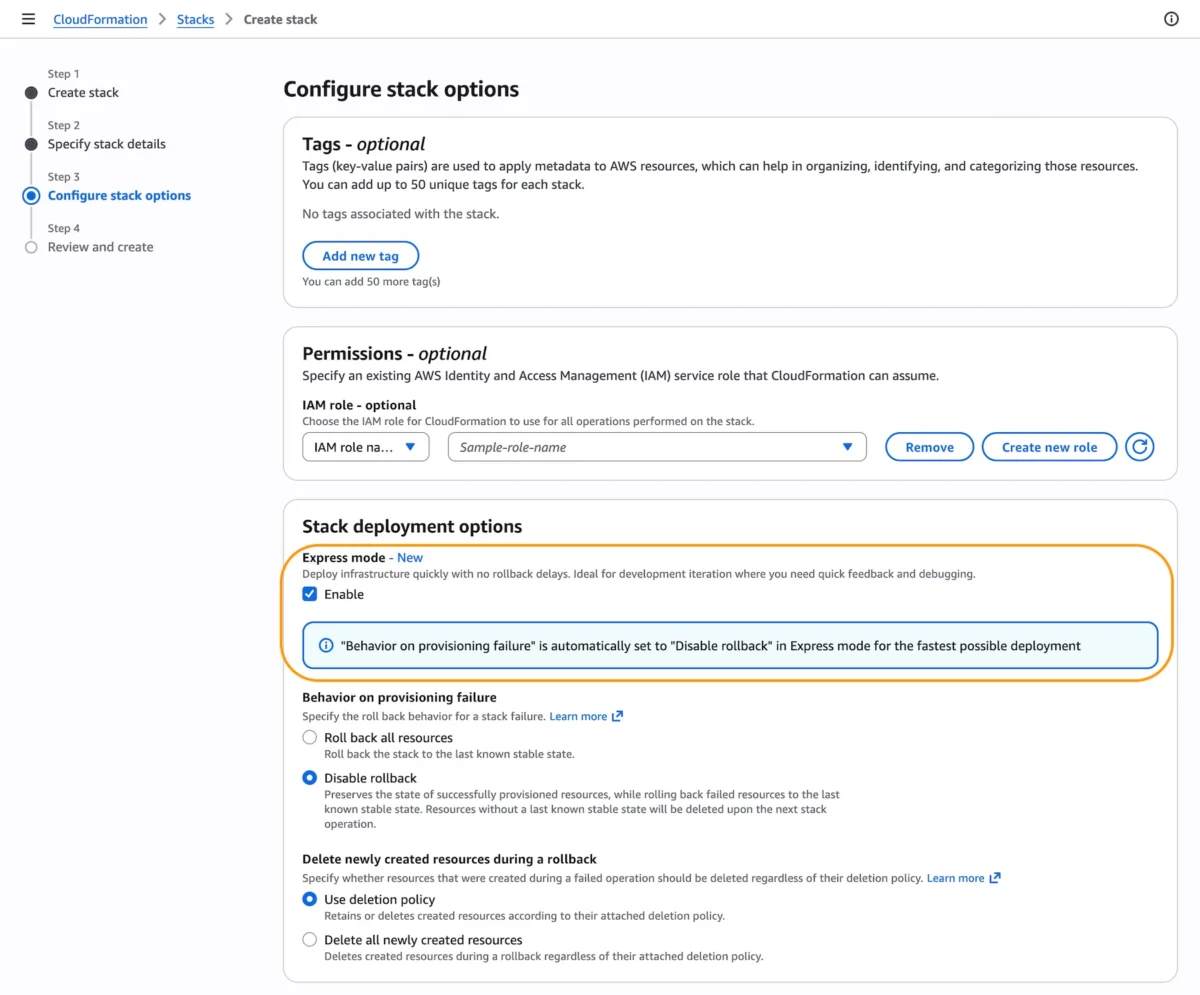
In a move designed to drastically accelerate the velocity of modern cloud engineering, Amazon Web Services (AWS) has officially launched CloudFormation Express mode. This new deployment architecture represents a fundamental shift in how developers and automated systems interact with AWS infrastructure, effectively decoupling the provisioning of resources from the time-consuming stabilization checks that have long been a hallmark of the CloudFormation experience.
By optimizing the deployment lifecycle, Express mode promises to reduce wait times by up to four times, offering a significant boon to DevOps teams, infrastructure-as-code (IaC) practitioners, and the growing ecosystem of AI-assisted coding tools.
Main Facts: A New Paradigm for Speed
At its core, AWS CloudFormation Express mode is an alternative execution path for stack operations. Traditionally, when a developer initiates a deployment, CloudFormation follows a strict sequence: it provisions the requested resources and then performs "stabilization checks"—a verification phase that ensures every component is fully operational and ready to serve traffic before marking the deployment as "complete."
While these checks are vital for production environments where service availability is non-negotiable, they often create unnecessary friction during iterative development, testing, and rapid prototyping. Express mode modifies this behavior by signaling a "success" state as soon as the resource configuration is successfully applied, allowing the infrastructure to finish its stabilization process in the background.
Key Technical Characteristics:
- Reduced Latency: By eliminating the wait for stabilization, deployment times are slashed significantly.
- Resilience: The system includes built-in, automated retries for dependent resources that encounter transient failures during provisioning.
- Zero-Template Changes: Developers do not need to modify their existing YAML or JSON templates to utilize the new mode.
- Flexibility: It is compatible with standard CloudFormation features, including change sets and nested stacks.
- Operational Control: It allows for custom configurations regarding rollback behavior, enabling developers to prioritize either speed or safety depending on the environment.
Chronology of Infrastructure Evolution
The introduction of Express mode is the culmination of years of feedback from the developer community regarding the "feedback loop" problem. Historically, the evolution of AWS infrastructure management has tracked the following arc:
- The Manual Era: Developers manually provisioned resources via the AWS Management Console, leading to "snowflake" environments that were difficult to replicate.
- The Rise of IaC: CloudFormation emerged as the gold standard for defining infrastructure as code, providing repeatability and auditability.
- The Complexity Tax: As architectures grew more complex (Lambda, SQS, VPC, etc.), the time required for CloudFormation to perform stabilization checks grew, often resulting in "waiting for stack update" delays that spanned several minutes.
- The AI-Assisted Era: With the rise of AI-driven coding assistants and automated CI/CD pipelines, the demand for sub-minute feedback loops became critical. Developers testing small logic changes in a Lambda function or adding a new SQS queue shouldn’t have to wait for the entire stack to stabilize.
The release of Express mode (announced in late June 2026) directly addresses this final hurdle, bringing infrastructure deployment speed into alignment with the rapid pace of modern software development.
Supporting Data: Benchmarking the Improvements
The performance gains offered by Express mode are not merely incremental; they are transformative. Based on benchmarking data provided by AWS, the reduction in deployment time is most pronounced in resource-heavy configurations that historically required extensive stabilization.
Comparative Performance Metrics:
| Scenario | Standard Mode | Express Mode |
|---|---|---|
| SQS Queue with DLQ | 64 Seconds | ~10 Seconds |
| Lambda Function (with ENI) | 20–30 Minutes | ~10 Seconds |
These figures highlight a critical realization: for many development tasks, the "stabilization" phase is a bottleneck that provides diminishing returns. By moving the stabilization process to the background, AWS has effectively compressed the developer’s feedback loop, allowing for faster iterative cycles—a requirement for teams moving toward a "continuous deployment" model.
Official Perspectives and Technical Implementation
During the announcement, AWS highlighted that Express mode is not a "stripped-down" version of CloudFormation, but rather a smarter execution engine.
How to Implement Express Mode
Implementing the change is straightforward, requiring no refactoring of existing IaC templates. Developers can opt into the new mode using the --deployment-config flag in the AWS CLI:
aws cloudformation create-stack
   --stack-name my-app
   --template-body file://template.yaml
   --deployment-config '"mode": "EXPRESS", "disableRollback": true'
The disableRollback parameter is a key feature here. By default, Express mode disables rollback for maximum speed, assuming the developer is performing rapid iterations. However, for production-ready deployments, users can set this to false to maintain the safety guarantees that CloudFormation is known for.
Integration with Modern Tooling
AWS has ensured that the new mode integrates seamlessly with the broader ecosystem:
- AWS CDK: Users can simply trigger
cdk deploy --expressto utilize the new functionality. - AI Tooling: Integration with tools like Kiro allows AI models to push infrastructure changes with near-instant validation, enabling a truly interactive development experience.
Implications for the Cloud Industry
The launch of CloudFormation Express mode has several far-reaching implications for the cloud computing industry at large.
1. The Rise of "Interactive Infrastructure"
We are entering an era where infrastructure is no longer a static setup phase but a dynamic component of the coding process. With Express mode, developers can treat infrastructure changes with the same fluidity as source code changes, facilitating a "live-coding" experience for cloud architectures.

2. Enhanced Productivity for AI Agents
AI agents currently struggle with high-latency feedback loops. If an AI agent attempts to debug an infrastructure configuration and has to wait 20 minutes for a deployment to "stabilize" before it can see the results of its change, its effectiveness is severely limited. Express mode provides the sub-minute feedback necessary for AI agents to learn, adapt, and refine cloud architectures autonomously.
3. A New Standard for DevOps
This update forces a re-evaluation of what constitutes a "deployment." By separating "configuration application" from "resource availability," AWS is encouraging engineers to think more granularly about their infrastructure. Teams can now implement a two-tier strategy: use Express mode for local development and rapid staging environments, and reserve Standard mode for production releases where strict stabilization verification is mandatory.
4. Competitive Pressure
As AWS sets a new bar for deployment speed, other cloud providers and IaC vendors (such as Terraform or Pulumi) will likely face increased pressure to optimize their own provisioning engines. The expectation for "instant feedback" is becoming a standard feature rather than a luxury.
Conclusion: A Step Toward the Future
AWS CloudFormation Express mode is a clear indicator of where the industry is heading: toward a future where infrastructure is invisible, instantaneous, and highly resilient. By focusing on the developer experience and the specific requirements of AI-driven workflows, AWS has provided a tool that not only saves time but also fundamentally changes how we think about the deployment of cloud services.
As adoption grows, we can expect further refinements to this mode, potentially including even more granular controls for resource-specific stabilization. For now, the message to developers is clear: the waiting game is over. Whether you are building complex microservices or experimenting with new cloud primitives, Express mode is designed to keep you in the flow, allowing you to build faster and with greater confidence.
To get started, developers are encouraged to visit the official AWS CloudFormation documentation and begin experimenting with the --deployment-config parameter in their existing CI/CD pipelines. As the cloud landscape continues to evolve, tools like Express mode will remain essential for those looking to maintain a competitive edge in velocity and innovation.
 Neng Nana
  Suro Senen
  Lina Hope