
 By Basiran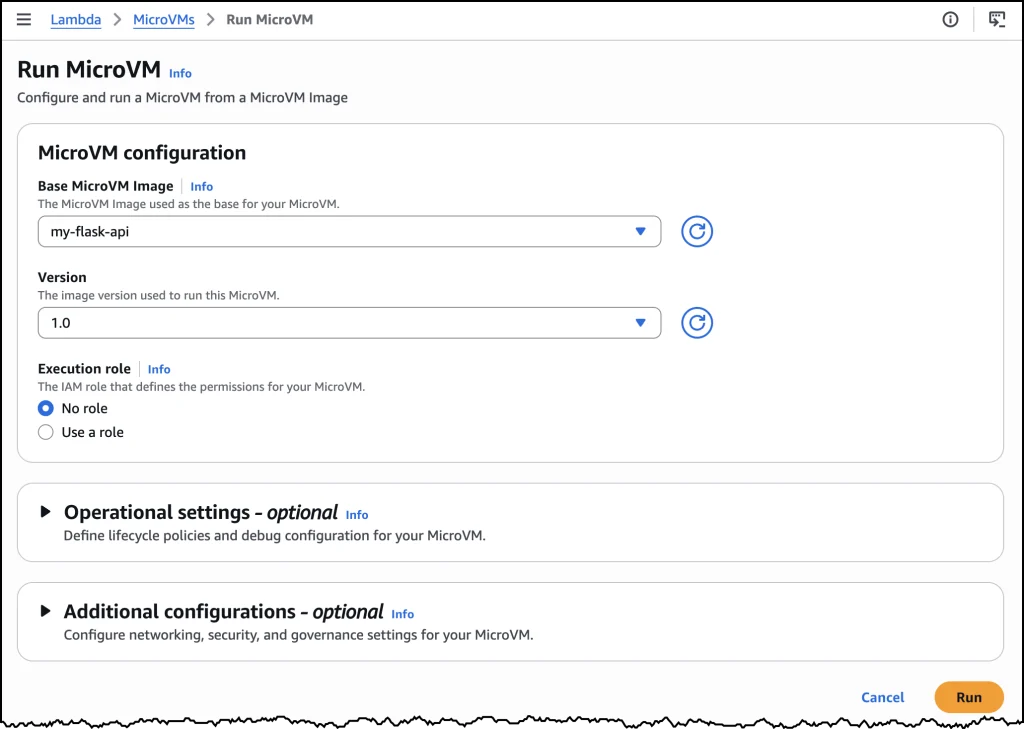
In a move that promises to redefine the landscape of multi-tenant cloud applications, Amazon Web Services (AWS) has announced the launch of AWS Lambda MicroVMs. This new serverless compute primitive marks a significant evolution in how developers handle untrusted, user-generated, or AI-authored code. By merging the isolation benefits of virtual machines with the agility and ease-of-use of serverless functions, AWS is targeting the specific needs of modern applications like interactive coding environments, AI assistants, and high-performance data analytics platforms.
The Core Innovation: What are Lambda MicroVMs?
At its simplest, AWS Lambda MicroVMs provide a dedicated, stateful, and highly isolated execution environment for every user session. Unlike traditional Lambda functions—which are optimized for short-lived, event-driven, request-response cycles—MicroVMs are designed to persist. They maintain memory, disk state, and running processes across a session, allowing for "warm" interactions that do not require the overhead of constant cold starts or the complexity of managing underlying server clusters.
The underlying engine for this service is Firecracker, the same open-source virtualization technology that has successfully powered over 15 trillion monthly Lambda function invocations. By leveraging Firecracker, AWS provides virtual machine-level security isolation while maintaining the "near-instant" launch times that developers have come to expect from the serverless paradigm.
The "Hard Choice" Problem: Why This Changes Everything
For years, software architects building platforms that execute user-provided code have faced a difficult, often binary, set of choices:

- Virtual Machines (VMs): These offer the gold standard for security and isolation. However, they are notoriously slow to boot, often taking minutes to initialize. This latency is detrimental to the modern, interactive user experience.
- Containers: While faster to launch than VMs, containers share a common kernel. To safely run untrusted, potentially malicious code in a container, developers must invest in significant, complex, and high-maintenance custom hardening—a task that consumes engineering time better spent on product features.
- Functions-as-a-Service (FaaS): While excellent for event-driven logic, FaaS models are inherently stateless. They were not designed for the long-running interactive sessions that require maintaining state, such as a Jupyter Notebook environment or an AI-driven IDE.
Lambda MicroVMs effectively eliminate these trade-offs. They provide the iron-clad isolation of a VM, the speed of a container, and the stateful persistence required by modern interactive applications—all without the need for the customer to manage a single server.
Chronology: From Concept to Deployment
The development of Lambda MicroVMs represents the culmination of years of iterative progress at AWS, building upon the operational maturity of the Lambda service.
- The Firecracker Foundation: Following the open-sourcing of Firecracker in 2018, the industry saw the potential for granular virtualization. AWS spent the subsequent years refining how this technology could be exposed to developers beyond the internal constraints of the Lambda function runtime.
- The Shift to Multi-Tenancy: As the rise of Large Language Models (LLMs) and AI-assisted coding tools surged between 2023 and 2025, the demand for "ephemeral yet persistent" environments became the primary bottleneck for developers.
- The Build-and-Snapshot Model: The technical breakthrough that led to the June 2026 launch was the refinement of the "image-then-launch" workflow. By allowing developers to package code in a standard Dockerfile and then snapshotting the memory and disk state post-initialization, AWS enabled the near-instant resume capability that defines the current product.
- June 2026 Launch: AWS officially introduced the service, providing developers with a dedicated API surface and console integration to manage the lifecycle of these MicroVMs.
Supporting Data: Performance and Scale
The technical specifications of the initial release demonstrate that this service is intended for resource-intensive workloads:
- Architectural Support: Built on ARM64, offering high power efficiency and performance.
- Resource Limits: Each MicroVM can scale up to 16 vCPUs and 32 GB of memory, with a 32 GB disk footprint, providing enough "headroom" for complex data processing tasks or heavy AI model inference.
- Lifecycle Management: The service supports an idle policy configuration. For example, a user can set a 15-minute auto-suspend window. During the suspension, the MicroVM’s memory and disk state are snapshotted, and the compute resources are released, drastically reducing costs while ensuring the session can be "resumed" instantly when the user returns.
- Scope: Available in major global regions including US East (N. Virginia, Ohio), US West (Oregon), Europe (Ireland), and Asia Pacific (Tokyo).
Official Responses and Strategic Implications
AWS leadership has framed this release as a necessary evolution for the "AI-native" software stack.

"We are moving into an era where every application will eventually run user-authored code," noted a senior AWS architect during the launch briefing. "The barrier to entry for developers building these tools was too high. With MicroVMs, we are effectively ‘commoditizing’ secure, stateful isolation. We want developers to focus on the intelligence of their code, not the infrastructure of their containers."
Implications for the Industry:
- Democratization of Secure Compute: Small teams can now build sophisticated, secure data platforms that previously required a dedicated DevOps team to secure and maintain.
- The Death of the "Cold Start" for Complex Apps: The snapshotting technology ensures that even a massive, multi-gigabyte application session can resume with zero perceptible delay, solving the biggest UX headache in the serverless space.
- New Security Paradigms: By providing hardware-level isolation as a default, AWS is likely to see an increase in the adoption of serverless for security-sensitive applications like vulnerability scanners and automated penetration testing tools.
Implementation Guide: A Developer’s Perspective
For developers looking to integrate Lambda MicroVMs, the workflow is designed to be familiar. It relies on the standard Dockerfile syntax, ensuring that existing container-based workflows are largely portable.
Step 1: Packaging
Developers create a standard Dockerfile. The public.ecr.aws/lambda/microvms:al2023-minimal base image is used as the foundation. The developer then installs their dependencies, copies their application code, and defines the startup command.
Step 2: The Build Process
Using the AWS CLI command aws lambda-microvms create-microvm-image, the developer points to their S3-hosted artifact. AWS performs the heavy lifting: it spins up a temporary build environment, runs the Dockerfile, initializes the application, and captures a "memory-state snapshot."

Step 3: Deployment and Lifecycle
Once the image is registered, the developer initiates a run-microvm command. A crucial feature is the Idle Policy. By setting maxIdleDurationSeconds, developers can balance performance against costs. When the system detects inactivity, it transitions to a suspended state—the "magic" moment where the application state is effectively frozen in time.
Future Outlook: Where does this lead?
The introduction of Lambda MicroVMs suggests that AWS is moving toward a more granular, "micro-service" infrastructure where compute, state, and security are no longer monolithic decisions. As AI assistants become more ubiquitous, the ability to run untrusted code safely will become a foundational requirement for almost every B2B software product.
Furthermore, the integration of these MicroVMs with existing Lambda functions creates a powerful "hybrid" architecture. A standard Lambda function can act as the "control plane," managing the event-driven traffic, while the MicroVM acts as the "data plane," providing a dedicated, stateful sandbox for the heavy lifting.
As the industry digests this release, the message from AWS is clear: the era of choosing between security and speed is over. By abstracting the complexity of virtualization, AWS has cleared the path for a new wave of interactive, stateful, and highly secure serverless applications. Whether you are building the next generation of AI coding assistants or a high-throughput data analytics dashboard, Lambda MicroVMs provide a robust, scalable, and operationally mature foundation to build upon.
 Neng Nana
  Suro Senen
  Lina Hope