
 By Azzam Bilal Chamdy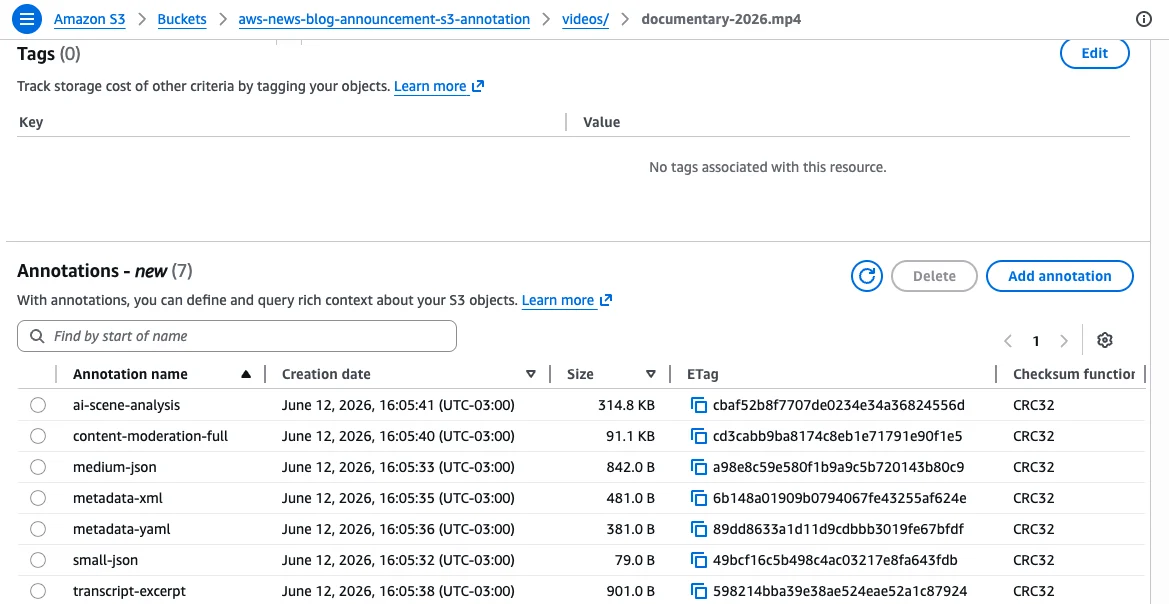
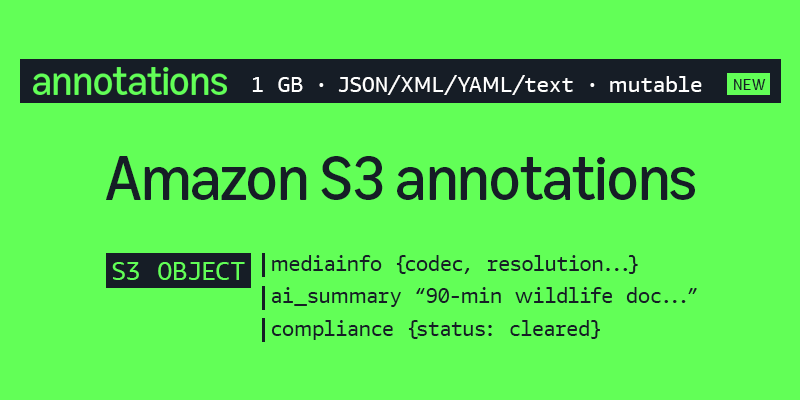
In a significant leap forward for cloud-native data management, Amazon Web Services (AWS) has announced the launch of Amazon S3 Annotations, a robust metadata capability designed to bridge the gap between static object storage and the dynamic requirements of modern artificial intelligence. By allowing users to attach up to 1 GB of rich, mutable context directly to individual S3 objects, AWS is effectively transforming S3 from a simple repository into an intelligent, queryable data foundation for agentic workflows.
The Evolution of Metadata: From Tags to Annotations
For nearly two decades, Amazon S3 has served as the bedrock of the internet’s data storage. While features like system-defined metadata, user-defined headers, and object tags have long facilitated operational tasks—such as lifecycle management and access control—they were never designed for the scale of modern AI.
Historically, developers wishing to associate rich context (such as AI-generated summaries, high-fidelity technical specifications, or complex compliance data) with their storage assets were forced to maintain "sidecar" files or external databases. This "split-brain" architecture created synchronization headaches, increased latency, and ballooned operational costs.
The introduction of S3 Annotations fundamentally changes this paradigm. With the ability to store up to 1,000 named annotations per object—each up to 1 MB—in formats like JSON, XML, or YAML, users can now house critical business context directly alongside their primary data. Because these annotations are intrinsically linked to the object, they automatically persist through copy, replication, and cross-region transfer operations, ensuring data integrity across complex distributed architectures.
Chronology: A New Era for S3 Metadata
The release of S3 Annotations follows a multi-year effort by the AWS S3 engineering team to modernize how metadata is handled at petabyte scale.
- Pre-2026: Users relied on limited 2 KB user-defined metadata headers or a maximum of 10 object tags. These constraints necessitated the creation of external metadata stores (e.g., DynamoDB or RDS) to track granular file details, leading to complex API orchestration and higher costs.
- Early 2026: AWS began rolling out enhanced S3 Metadata tables, leveraging the performance of the Apache Iceberg open table format. This laid the groundwork for large-scale, SQL-based querying of object properties.
- June 2026 (Launch Date): AWS officially announced the "Annotations" feature, enabling native support for mutable, large-scale object metadata. This update allows for the integration of AI-agentic workflows directly via the S3 Tables MCP (Model Context Protocol) server.
- Post-Launch: AWS has committed to the continuous refinement of S3’s query capabilities, promising tighter integration between annotation tables and SageMaker-based AI training pipelines.
Supporting Data: Why Annotations Matter
The technical requirements for AI agents—which must "understand" data without human intervention—have outpaced the capabilities of traditional storage headers. To illustrate the shift, consider the following comparison of metadata capabilities:
| Capability | Max Size | Mutable? | Best For |
|---|---|---|---|
| System Metadata | Fixed | No | Size, class, timestamp |
| User Metadata | 2 KB | No | Small, static key-value pairs |
| Object Tags | 10 tags | Yes | Access control, lifecycle rules |
| Annotations | 1 GB (1,000 x 1MB) | Yes | Rich business context/AI data |
The ability to store 1 GB of context per object is not merely an incremental improvement; it is a structural revolution. By leveraging Apache Iceberg, these annotations are indexed into fully managed tables, allowing for high-performance SQL queries via Amazon Athena. This eliminates the need for expensive "restore" operations, as metadata remains queryable even if the object itself is stored in an archived S3 Glacier class.
The Mechanics of Implementation
Getting started with S3 Annotations requires minimal friction for existing AWS users. The implementation follows a standard API-driven approach, utilizing the AWS CLI or SDKs.
Attaching Context
Developers can attach multiple annotations to a single object, each with a unique name. This allows for modular metadata management. For instance, a video production company might have one process writing technical codec specifications (JSON) while a separate AI-driven media-tagging engine writes descriptive summaries (plain text). These processes do not interfere with one another, as each annotation is independently addressable via the PutObjectAnnotation API.
Querying at Scale
The true power of this feature is realized when users enable S3 Metadata Annotation Tables. By configuring these tables, S3 automatically orchestrates the ingestion of metadata into an Iceberg-compatible format.
For the data analyst, this means complex queries are now possible without building custom indexers. For example, finding all "PG-rated" video assets that contain specific subtitle languages across a multi-petabyte bucket is now a single SQL query:
SELECT DISTINCT bucket, object_key
FROM "s3tablescatalog/aws-s3"."b_my_media_bucket"."annotation"
WHERE name = 'content_classification'
AND json_extract_scalar(text_value, '$.rating') = 'PG'
AND json_extract_scalar(text_value, '$.subtitles') = 'Spanish';
Implications: The Rise of Agentic Workflows
The implications for enterprise architecture are profound. We are witnessing the shift from "passive" storage to "active" storage, where the data itself carries the instructions for its own processing.

Empowering AI Agents
With the S3 Tables MCP (Model Context Protocol) server, AI agents can now interact with storage as a "knowledge base." Instead of an agent having to scan the binary content of a video or a high-resolution image to understand what it contains, it can simply query the object’s annotation. This drastically reduces the compute resources required for data discovery and accelerates the development of autonomous workflows.
Cost Efficiency
By centralizing metadata within S3, organizations can dismantle the secondary infrastructure previously required to maintain metadata databases. This leads to:
- Reduced Latency: Metadata is collocated with the data.
- Simplified Compliance: Deleting an object now triggers the automatic removal of its annotations, ensuring consistent data lifecycle management.
- Lower TCO: Users avoid the costs associated with maintaining separate database clusters, synchronization scripts, and error-handling logic for external metadata stores.
Official Perspectives and Industry Reception
AWS representatives have highlighted that this feature is a direct response to the "agentic revolution." As companies increasingly rely on LLMs to ingest vast troves of unstructured data, the bottleneck is no longer storage capacity, but rather metadata discovery.
"Organizations are building AI agents that need to act on data without human intervention," said Daniel Abib, an AWS technical lead associated with the launch. "To support these workflows, you need metadata that evolves alongside the data, scales to petabytes, and remains queryable without expensive retrieval."
Industry analysts have responded positively, noting that the tight integration with the Apache Iceberg standard ensures that users are not locked into a proprietary format. By adopting an open standard for the metadata tables, AWS is signaling a commitment to interoperability, allowing users to leverage their existing analytical toolchains—whether they are using Amazon Athena, Apache Spark, or Trino—to query their S3 objects.
Challenges and Considerations
While S3 Annotations provide significant benefits, organizations must plan for the lifecycle of their metadata. Because annotations are billed at S3 Standard rates, regardless of the parent object’s storage class, users should be mindful of the cost implications for massive, long-term archival datasets.
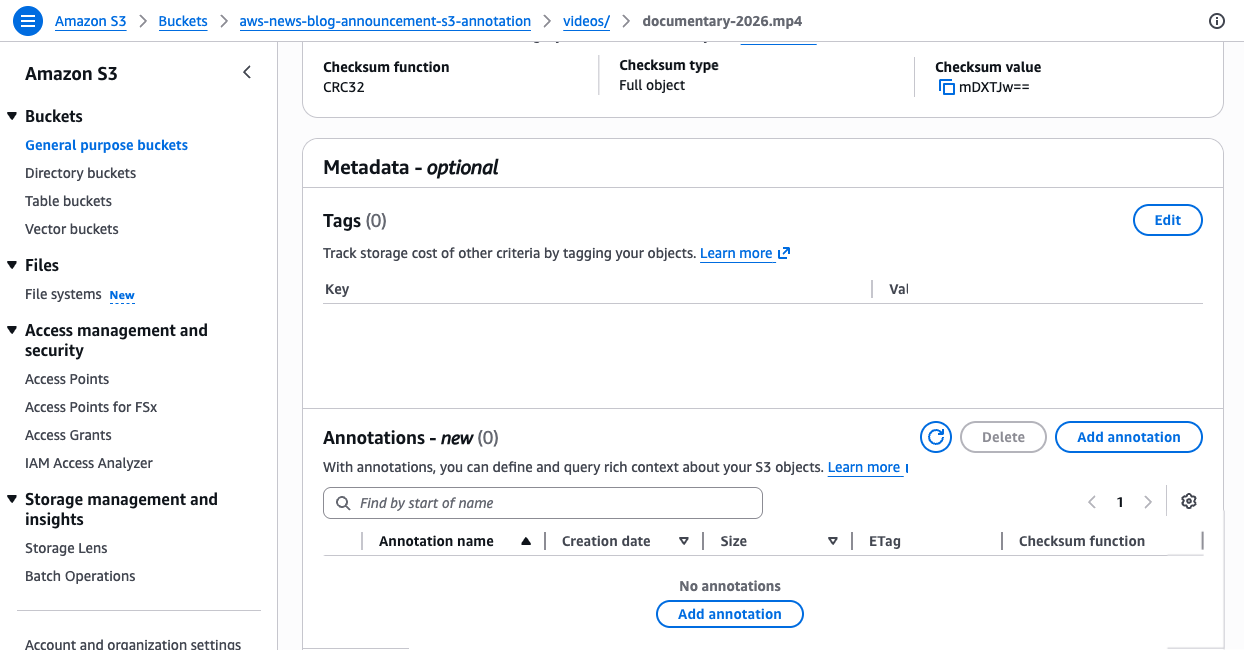
Additionally, while the backfill process for existing objects is automated, it is a background task that can take hours or days to complete for large-scale buckets. Architectural teams should account for this latency during the migration phase when enabling annotation tables for legacy data.
Conclusion
Amazon S3 Annotations represents a fundamental shift in how we conceive of cloud storage. By transforming objects into rich, self-describing entities, AWS has provided the missing link for enterprises seeking to harness the full potential of AI. As we move deeper into the era of autonomous data management, the ability to store, search, and update context at scale will be the primary differentiator for companies seeking to turn their data lakes into data assets.
For organizations looking to future-proof their infrastructure, the move to S3 Annotations is not just an operational update—it is a strategic investment in the intelligence of their digital architecture.
 Neng Nana
  Suro Senen
  Lina Hope