
 By Evan Lee Salim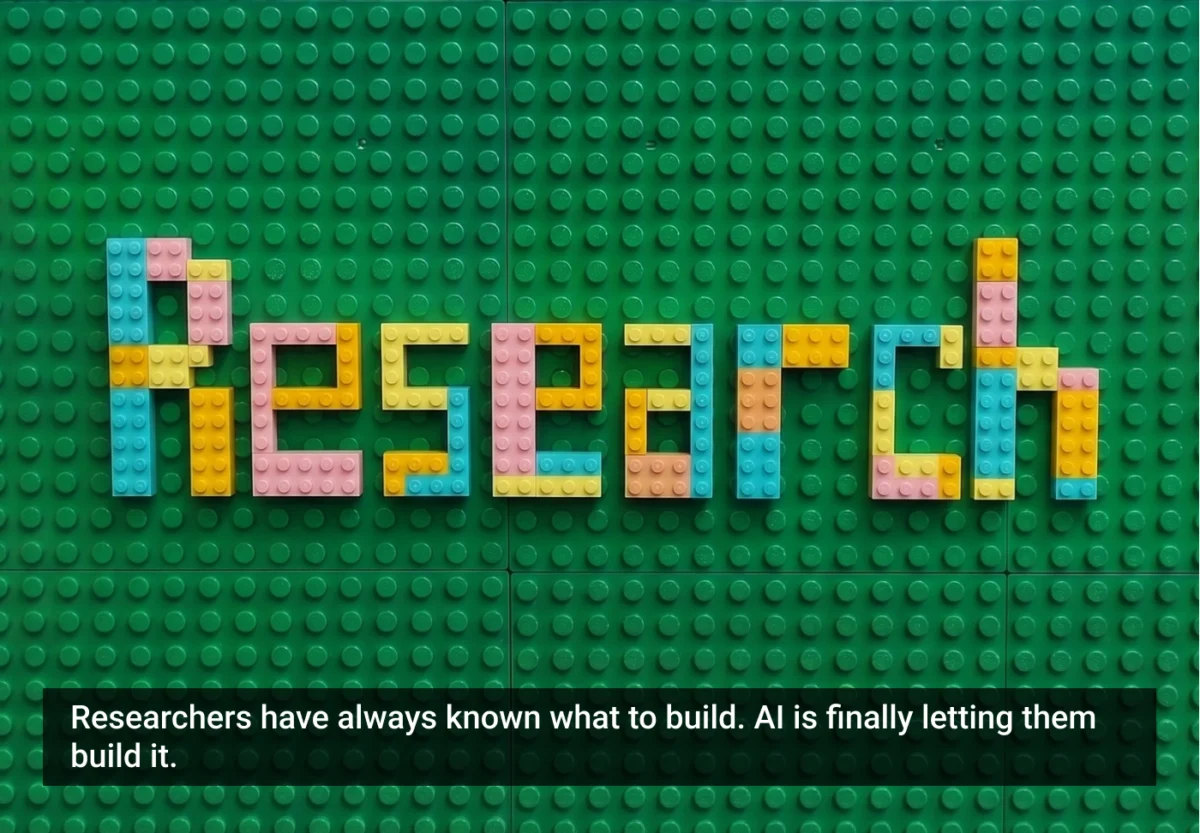
Freeze-dried backpacking food. A sophisticated personal finance application. A portable, high-end event photo booth. A community-driven dinner series for refugees. A perfectly weighted coffee mug. An AI-powered educational platform for children. These disparate, tangible products share a singular, unexpected origin: they were all conceived and executed by user researchers.
For decades, the professional trajectory of a researcher was clear-cut: work within the corporate machine, observe the human condition, distill insights into reports, and influence the product team from the sidelines. Today, that model is undergoing a radical, irreversible transformation. It has never been easier for researchers to move from being architects of influence to becoming the makers of the product itself.
The Shifting Paradigm: Why Now?
For many, the transition from "could" to "must" has been swift. A year ago, the integration of AI tools into research felt like a playground of potential—a collection of "could-haves." Today, that potential has hardened into an organizational requirement. As businesses restructure their product teams to prioritize rapid deployment, the demand for researchers who can prototype, code, and ship has reached a fever pitch.
This evolution is not universally welcomed. While some researchers are embracing the mandate with a sense of "this is our moment," others are watching from the periphery with trepidation, unsure of how these new expectations map onto their established professional identities.
However, the "researcher-maker" is not a new phenomenon. Quietly, and often without the formal label, researchers have been building tools, companies, and communities for years. By studying these pioneers, we can begin to map the journey, the inherent trade-offs, and the profound evolution of what it means to be a researcher in the age of generative AI.
Chronology of a Transition: The "Provisional Self"
The transition from researcher to founder or maker is rarely linear. It mirrors the cycle of "Provisional Selves," a concept articulated by Herminia Ibarra in 1999, which details the process of professional identity transition: observing role models, experimenting with new behaviors, and evaluating the fit.
Neha’s Story: The Founder’s Imperative
Neha, a veteran of corporate innovation labs, felt the power structure of product development was fundamentally flawed. "Research should be in the C-suite," she argued. "Why is a researcher not a CEO?" When the job market faced a severe contraction, the safety net of employment disintegrated. Neha responded by founding Incluya, a personal finance app built on anthropological principles.
Her transition was not without friction. Neha’s deep-seated researcher instinct—the tendency to weigh every angle and consider every outcome—initially stalled her momentum. Her solution was a masterclass in hybrid thinking: time-boxing decisions based on evidence. This ensured that Incluya remained grounded in research while maintaining the velocity required of a startup.
Jen’s Story: From Friction to Feature
For Jen, the path to making began with a frustration. After hiring a substandard photo booth for a UX conference, she couldn’t "unsee" the design flaws. Her instinct to solve the problem led her to purchase fifteen iPads and hire developers. She didn’t start with a business plan; she started with a vision of what the experience should feel like. Her business model evolved through the same iterative feedback loops she used in her research career, ultimately converging two threads of her life: her upbringing in a family showroom and her professional rigor as a researcher.
Supporting Data and the Researcher’s Edge
The skepticism surrounding the "researcher-founder" often stems from a misunderstanding of the skillset involved. Critics suggest that researchers lack the bias for action required in entrepreneurship. However, the data from these successful transitions suggests otherwise. Researchers possess a distinct competitive advantage: the ability to define a problem, formulate a hypothesis, and iterate based on reality rather than ego.
The "Researcher-Shaped" Model
Researchers who transition into making don’t stop being researchers. Instead, they apply a "researcher’s way of making"—a methodology characterized by:
- Ethical Deliberation: Prioritizing long-term user health over "blitzscaling."
- Empathy-Driven Discovery: Treating the sales process as an act of empathetic storytelling rather than transactional persuasion.
- Ambiguity Tolerance: Navigating the "unknown unknowns" of startup life with the same comfort they bring to complex qualitative studies.
Brian, the founder of AI Kids Club, notes that the epiphany for most researchers is visceral. "Oh, I have imagination, and oh my God, I made a thing," he explains. He argues that researchers are "perfectly positioned" to lead in the AI era, yet the transition remains rare because many researchers simply lack the interest in the mechanical side of "building the toy."
Official Responses and Corporate Implications
The shift has significant implications for how organizations view the research function. Traditionally, research was a "service" department. Now, as the democratization of software development continues, researchers are increasingly expected to take ownership of the outcomes.
However, this brings a new set of risks. As Sarah, founder of the freeze-dried food company Bowl & Kettle, points out, the romanticized version of the "founder’s journey" ignores the material reality. Many researchers are being pushed into entrepreneurship not by choice, but by layoffs or career burnout.
"I learned that you don’t have a business if you don’t have money," says Astrid, another researcher-founder. The financial and emotional toll of bootstrapping a business while maintaining one’s professional identity is a significant, often under-discussed, burden.
The Honest Costs of the Hyphenated Identity
The journey to becoming a researcher-maker is fraught with hazards:
- Isolation: The freedom of the maker can quickly devolve into the loneliness of the solo-operator. Without the "productive friction" of a team, even the most talented researchers can lose their sense of perspective.
- Identity Grief: Leaving a corporate environment often means losing a community. As Cris, a researcher who pivoted to ceramics, noted, the loss of internal channels and peer networks can make one feel "tribeless."
- The Trap of Perfectionism: In an organization, the researcher is the voice of caution. As a founder, that same instinct can become a liability. Learning when "done" is "good enough to ship" is perhaps the hardest hurdle for a researcher to clear.
The Path Forward: Recommendations for the Aspiring Maker
For those considering this path, the experiences of the 21 individuals studied suggest a pragmatic framework:
- Audit Your Energy: Track what drains and fuels you. If building causes you to lose the parts of research you love, it may not be the right path.
- Build in Public (Cautiously): Use communities—not just LinkedIn, but niche Slack groups and industry forums—to calibrate your progress.
- Embrace the Hyphen: Do not feel forced to abandon your "researcher" label. The power lies in the hyphen: Researcher-Maker, Researcher-Founder, Researcher-Developer. This identity allows for a more expansive, generous definition of what it means to create.
- Seek Peer Review: Even if you are a solo founder, you cannot research your own product. You need external eyes to challenge your biases, just as you would in a corporate setting.
Conclusion: The Evolutionary Power of the Hyphen
The question is no longer whether researchers should make things, but how they can do so without sacrificing the very sensibilities that make them valuable. The pressure to innovate is high, and the tools at our disposal are more accessible than ever.
As the stories of Cris, Jen, Sarah, and Brian illustrate, the transition is not about replacing one career with another. It is about evolving. By adding a new hyphen to their title, these individuals have unlocked a new way to apply their core skills. They have proven that the researcher’s way of making is not just a viable alternative to traditional product development—it is a distinct, necessary, and human-centric evolution of it.
For those standing on the precipice of this change, the advice is simple: you don’t need a five-year plan. You need a hypothesis, a desire to solve a problem, and the courage to claim the identity of a maker, even—and especially—if you are still, at your core, a researcher.
 Ammar Sabilarrohman
  Neng Nana
  Sagoh
Sagoh 