
 By Basiran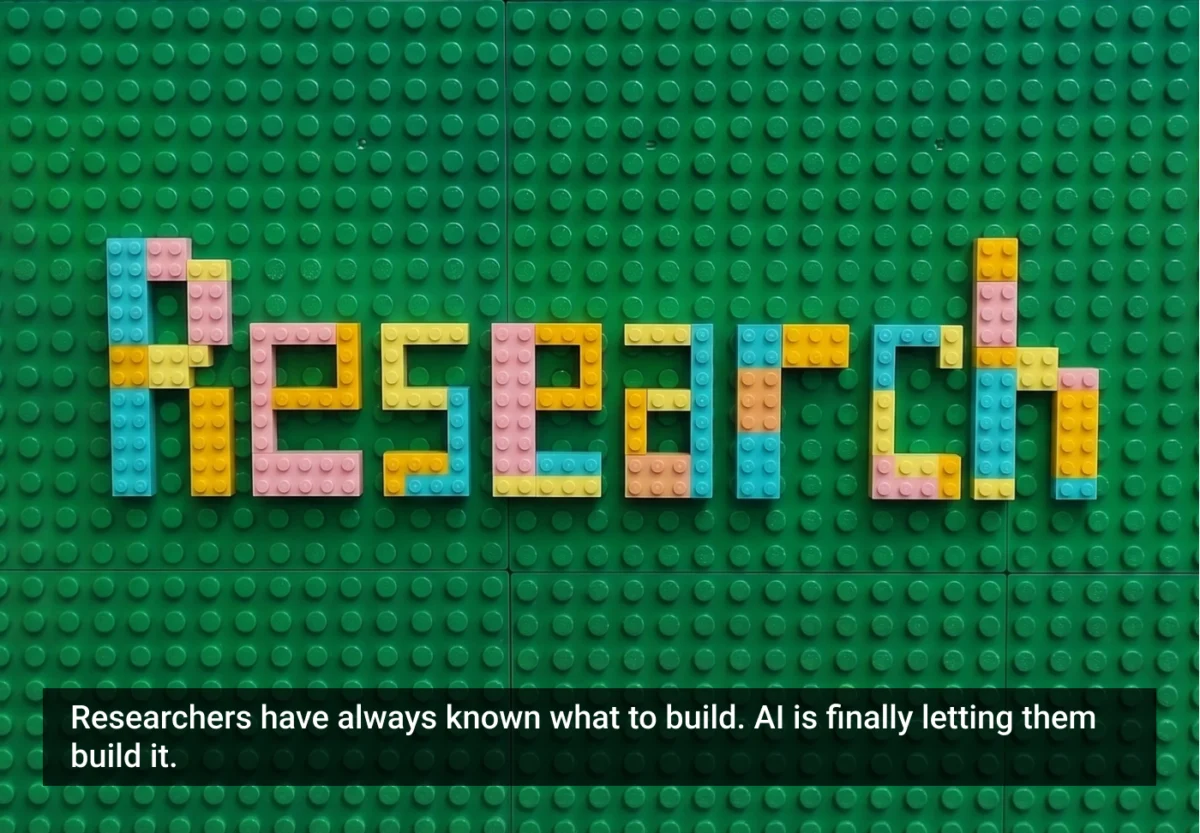
Freeze-dried backpacking food, a sophisticated personal finance app, an artisanal photo booth, and an immersive V&A Museum exhibit. At first glance, these projects seem to emerge from disparate industries—culinary, fintech, event services, and curatorial arts. Yet, they share a common origin: all were conceived and executed by user researchers.
For decades, the professional trajectory of a researcher was well-defined: study human behavior, generate insights, and influence the decision-makers who actually build the product. We lived in the “delivery gap,” one step removed from the tangible output. However, the landscape is shifting. With the rise of AI-powered tooling and a volatile job market, the traditional barrier between observing the world and shaping it is dissolving. For many, the question is no longer "should I build?" but rather, "how do I build without losing my identity?"
The Shift: From "Could" to "Must"
Just a year ago, the integration of AI tools into research felt like a playground of "coulds." There was a sense of potential, a horizon of possibilities. Today, for many in the industry, that potential has hardened into a professional imperative.
This transformation is not entirely organic. While some researchers have long acted as "stealth makers"—creating tools, communities, and businesses without using the formal label—others are finding themselves pushed into this role by organizational mandates. As product teams reorganize, the pressure to evolve into "researcher-makers" who can prototype, design, and even write production code is becoming a standard expectation.
This transition is fraught with tension. While some see this as a long-awaited moment to claim agency, others are watching with trepidation, unsure if the core values of research—empathy, rigor, and ethics—can survive the harsh realities of product shipment, quarterly targets, and commercial trade-offs.
Chronology of an Identity Shift
The journey of the researcher-maker is rarely linear. It typically follows a pattern of professional metamorphosis that mirrors the "Provisional Selves" framework identified by researcher Herminia Ibarra.
- Recognition: The realization that the existing power structure—where researchers are advisors, not architects—is failing to solve the problems they see.
- Experimentation: The "side-hustle" phase. Testing ideas on weekends, prototyping with AI tools, or applying research methodologies to personal hobbies.
- Internal Conflict: The friction between the "researcher" identity (deliberate, risk-averse, user-centric) and the "maker" identity (action-oriented, pragmatic, profit-driven).
- Synthesis: Embracing the hyphenated identity. Accepting that one can be both a rigorous researcher and a capable founder, provided the definition of success is recalibrated.
Take the story of Neha, who founded the personal finance app Incluya. Working in a corporate innovation lab, she felt the "power structure was backwards." When the job market collapsed, she didn’t just look for a new role; she built one. Within a year, she led a team of ten, balancing her anthropological instincts with the cold, hard reality of "time-boxed" decision-making. Neha’s experience highlights the central challenge: reconciling the researcher’s desire for perfection with the founder’s need for momentum.
The Researcher’s Way of Making
If we are to redefine what it means to be a maker, we must first broaden our definition of "making." We often reserve the term for those who build software or physical goods, overlooking the immense creativity involved in community building, service design, and policy-making.
Research-led making is distinct. It is not necessarily driven by the "move-fast-and-break-things" ethos that defines Silicon Valley. Instead, it is characterized by:
- Deliberation: A focus on identifying the right problem before rushing to a solution.
- Ethics: A built-in commitment to user safety and social impact, rather than just blitzscaling.
- Discovery-Led Sales: Viewing sales not as a predatory tactic, but as a form of deep discovery—understanding the customer’s needs well enough to provide a genuine solution.
As Brian, a researcher-turned-founder of AI Kids Club, notes, "Good sales is discovery. It is constructing an argument with an understanding of what the other person really needs." By reframing commercial activities through the lens of research, these practitioners strip away the "tech-bro" stigma of founding and replace it with a value-driven mission.
Supporting Data and Evidence
The move toward researcher-making is supported by a growing body of anecdotal and structural evidence. While comprehensive longitudinal data on this specific demographic is still emerging, the trends are clear:
- The AI Multiplier Effect: Tools like Claude, Notion, and specialized code-generation software have lowered the barrier to entry for solo-founders. A single researcher can now simulate workflows, build dashboards, and manage operations that previously required a dedicated engineering team.
- Retention and Autonomy: The "Great Resignation" and subsequent industry layoffs have forced a re-evaluation of career security. Researchers who have "foundered" report higher levels of professional satisfaction, even when their ventures are not yet self-sustaining, because they possess greater agency over the product’s ethical roadmap.
- Economic Realities: The stories collected from 21 prominent researcher-makers suggest a commonality: success is highly correlated with "runway." Those who manage to thrive often do so by maintaining a "two-flower" career—freelancing in research to provide financial stability while slowly cultivating their business venture.
Official Responses and Industry Sentiment
The industry reaction to this shift is mixed. On one side, professional bodies are beginning to acknowledge the "UX-as-Product" evolution, encouraging researchers to gain technical literacy. On the other, there is a protective instinct among senior practitioners who fear that the "research" label will be diluted if it becomes synonymous with "building."
However, the most compelling response comes from those who have walked the path. Mirjam, a specialist in innovation science, argues that building is the ultimate "gut-check." By creating prototypes—even "deliberately crappy" ones—researchers can test the viability of their own insights. "Building something alone is just very lonely," she cautions, emphasizing that while researchers have the tools to build, they should not abandon the collaborative nature of their original discipline.
Implications for the Future of Research
The move toward becoming a maker has profound implications for the future of the profession:
- The End of the "Advisory" Era: If researchers can build the solutions they recommend, the traditional "influence" model of UXR becomes obsolete. This places the burden of proof directly on the researcher; if a product fails, it is no longer because the team didn’t listen to the research—it is because the research didn’t lead to a viable solution.
- Accountability: With ownership comes liability. Researchers must now grapple with supply chains, tax law, code maintenance, and human resource management. This forces a maturity in the profession that has been shielded by corporate structures.
- Identity Expansion: We are seeing the birth of the "Hyphenated Professional." The future researcher may not just be a researcher, but a researcher-developer, researcher-potter, or researcher-founder. This shift suggests that the future of work is not about specializing in a single domain, but about applying a research-driven mindset to a wide variety of creative outputs.
Conclusion: Claiming the Hyphen
The journey to becoming a researcher-maker is not for everyone. It requires a high tolerance for ambiguity, the ability to sacrifice perfection for progress, and often, the financial security to endure the early, non-profitable stages of development.
Yet, for those who feel constrained by the traditional boundaries of their roles, the path is clear. It is a path of liberation—a way to turn "shoulds" and "musts" into an expression of personal and professional identity. As Cris, a researcher who turned to ceramics, discovered, the act of creating is not a departure from research—it is an extension of it.
"I’m not doing a five-year plan," she says. "I’m exploring." That, in its simplest and most powerful form, is the researcher’s way of making. Whether through code, clay, or commerce, the researcher-maker is no longer just observing the world—they are building the next one.
 Ammar Sabilarrohman
  Neng Nana
  Sagoh
Sagoh 