
 By Layla Zulfa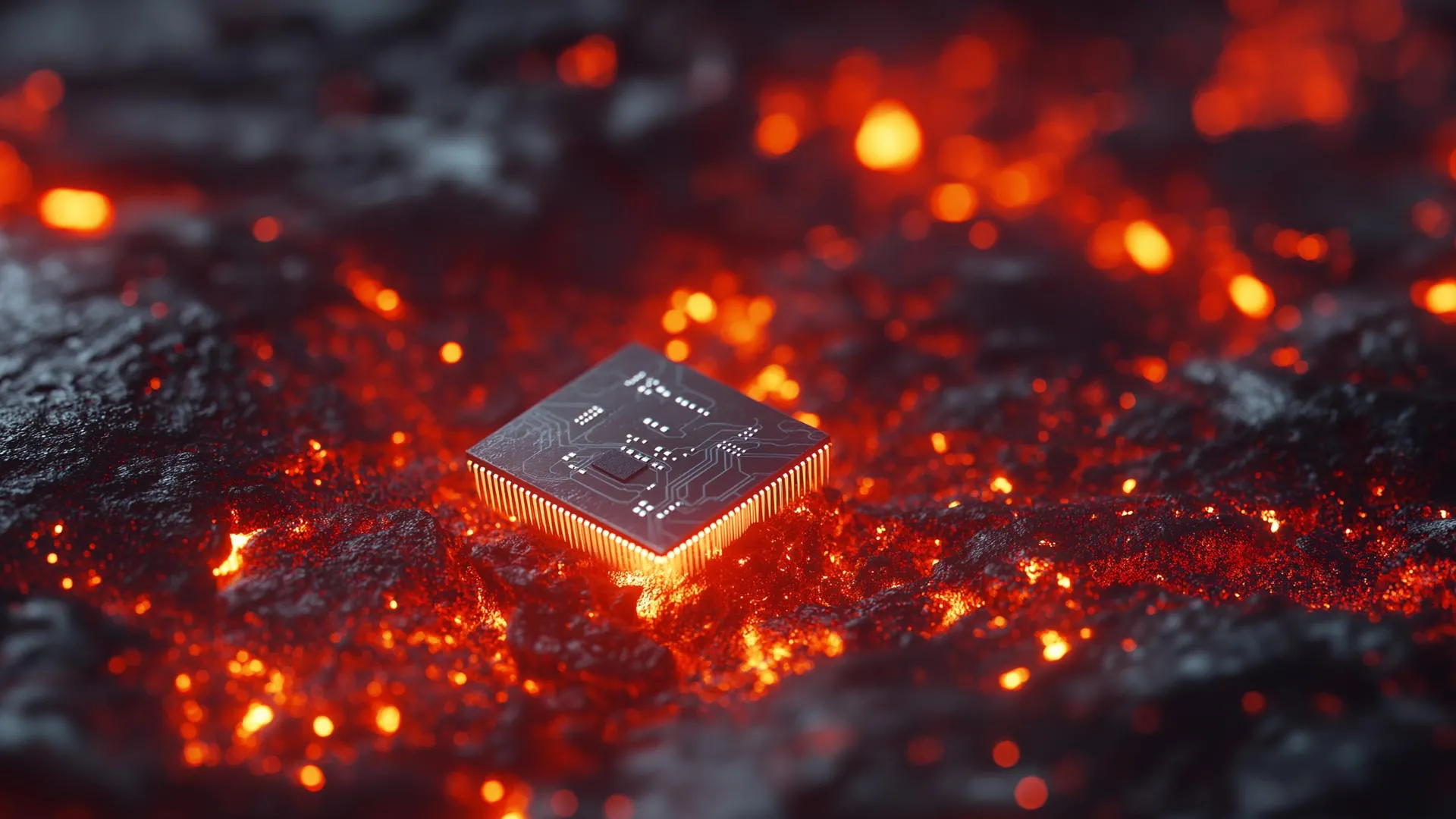
For over half a century, the progress of modern electronics has been governed by a silent, invisible adversary: heat. While our smartphones, laptops, and satellites have become exponentially more powerful, they all operate under a restrictive "thermal leash." Beyond 200 degrees Celsius, the delicate semiconductor architecture that powers our digital world begins to lose its structural integrity, leading to catastrophic failure. This thermal barrier has long been the "glass ceiling" of engineering, forcing designers to include heavy, power-hungry cooling systems or simply accept that their technology cannot survive in extreme environments.
That ceiling has officially been shattered.
In a landmark study published in the journal Science on March 26, 2026, a research team from the University of Southern California (USC) revealed a new breed of memory device capable of operating flawlessly at 700 degrees Celsius (~1,300 degrees Fahrenheit). To put this into perspective, 700 degrees is hotter than molten lava and well beyond the threshold where standard silicon-based electronics disintegrate. The device, a specialized memristor, showed no signs of degradation, limited only by the maximum heat capacity of the testing equipment used in the laboratory.
The Anatomy of an Unlikely Breakthrough
The device, categorized as a memristor—a nanoscale component that functions as both a data storage unit and a computational engine—represents a radical departure from traditional hardware design. The architecture is deceptively simple: a microscopic, layered sandwich consisting of a tungsten top electrode, a central ceramic layer of hafnium oxide, and a foundational base of graphene.
The selection of these materials was not merely a matter of convenience; it was a deliberate choice of materials science. Tungsten holds the distinction of having the highest melting point of any elemental metal, providing a robust top electrode. Hafnium oxide, a reliable insulating ceramic, serves as the stable middle layer. However, the true "secret sauce" of the device is the graphene bottom layer. Graphene, a single-atom-thick sheet of carbon arranged in a hexagonal lattice, is celebrated for its mechanical strength and its unique interaction with other materials.
The discovery was, in many ways, a serendipitous stroke of luck. The research team, led by Joshua Yang—the Arthur B. Freeman Chair Professor at the USC Viterbi School of Engineering and the USC School of Advanced Computing—was initially attempting to engineer a different type of graphene-based device. When that experiment failed to yield the intended results, the team shifted focus to analyze the unexpected behavior of their prototype.
"To be honest, it was by accident, as most discoveries are," Yang noted. "If you can predict it, it’s usually not surprising, and probably not significant enough."
Chronology of a Thermal Defiance
The development of this technology is the culmination of years of work within the CONCRETE Center (Center of Neuromorphic Computing under Extreme Environments). This multi-university center, supported by the Air Force Office of Scientific Research and the Air Force Research Laboratory (AFRL), has been tasked with solving the "extreme environment" problem for decades.
- Early Phase: Researchers focused on identifying why traditional electronics fail. They found that in standard chips, heat causes metal atoms to migrate through the dielectric (insulating) layer. At high temperatures, these atoms move like water through a sponge, eventually forming a permanent conductive bridge between the electrodes. This creates a permanent short circuit, locking the memory state and killing the device.
- The Interface Discovery: Through a combination of advanced electron microscopy, spectroscopy, and quantum-level simulations, the USC team identified the specific interaction between tungsten and graphene. They discovered that the two materials interact like oil and water. Tungsten atoms, when they approach the graphene surface, cannot find a stable anchor point. Instead of burrowing through the ceramic, they simply drift away.
- The Validation: Once the mechanism was understood, the team subjected the device to rigorous testing. The memristor retained its stored data for over 50 hours at 700 degrees Celsius without a single refresh cycle. Furthermore, it endured over one billion switching cycles, maintaining a low-power operating voltage of just 1.5 volts with speeds in the tens of nanoseconds.
Supporting Data: By the Numbers
The performance metrics of the USC memristor are as impressive as the temperatures they withstand:
- Thermal Resilience: 700°C (1,300°F) operational stability.
- Endurance: Over 1 billion switching cycles at peak temperature.
- Energy Efficiency: Operates at 1.5 volts.
- Speed: Switching speeds measured in tens of nanoseconds.
- Data Retention: Stable memory states held for over 50 hours at extreme heat.
- Materials: Tungsten (top), Hafnium Oxide (middle), Graphene (bottom).
Official Responses and Scientific Implications
Joshua Yang’s team, which includes key collaborators such as Jian Zhao (the study’s first author), Qiangfei Xia, Miao Hu, and Ning Ge, view this as more than just a material science victory; it is a foundational shift in how we conceive of hardware.
"You may call it a revolution," Yang said during the project’s announcement. "It is the best high-temperature memory ever demonstrated."
The academic community has received the findings with high praise. By utilizing materials like tungsten and hafnium oxide, which are already staples in the semiconductor industry, the researchers have ensured that their invention is not merely a laboratory curiosity but a potentially scalable technology. While graphene remains a newer entry into mass manufacturing, major industry players like TSMC and Samsung have already demonstrated wafer-scale graphene production, signaling that the supply chain hurdles are not insurmountable.
Implications: A Future Beyond the Heat
The applications for this technology are vast and transformative, touching sectors that have previously been forced to settle for mechanical or vacuum-tube-era solutions in high-heat environments.
Space Exploration and Planetary Science
Venus has long been a "graveyard" for space probes. With surface temperatures hovering around 460 degrees Celsius and a crushing atmosphere, current silicon electronics fail within hours. This new memristor technology offers a path toward long-duration Venus landers that can process data directly on the surface, rather than relying on brittle, shielded hardware.
Energy and Industrial Infrastructure
The deep-earth energy sector, particularly geothermal power, requires sensors and processors that can survive inside boreholes where rock temperatures can reach hundreds of degrees. Similarly, nuclear fission and experimental fusion reactors generate intense heat that typically requires remote placement of electronics. With this technology, "edge computing"—processing data right where it is collected—becomes possible in the heart of these reactors.
The AI Advantage
Beyond mere durability, the device is a game-changer for Artificial Intelligence. Modern AI systems are heavily dependent on matrix multiplication, a mathematical operation that is notoriously energy-intensive on standard CPUs. Memristors, however, perform this calculation in situ as electricity flows through the device, governed by Ohm’s Law.
"Over 92 percent of the computing in AI systems like ChatGPT is nothing but matrix multiplication," Yang explained. "This type of device can perform that in the most efficient way, orders of magnitude faster and at lower energy."
Yang and his colleagues have already co-founded a company, TetraMem, to bring memristor-based AI chips to the commercial market for room-temperature applications. This new, high-temperature research effectively extends that business model into the most hostile environments on (and off) Earth.
The Road Ahead: From Prototype to Product
While the breakthrough is significant, the research team is quick to temper expectations regarding immediate commercial availability. Memory is only one component of a functioning computer. To build a truly "high-temperature computer," researchers must now develop compatible logic circuits, transistors, and interconnects that can survive the same 700-degree environments.
"This is the first step," Yang said. "It’s still a long way to go. But logically, you can see: now it makes it possible. The missing component has been made."
As the CONCRETE Center continues its work, the focus will shift to scaling these laboratory prototypes into robust, mass-producible systems. The collaboration with the Air Force Research Laboratory and institutions in Japan underscores the global and strategic importance of this development.
For a field that has been constrained by the limitations of silicon for decades, the USC discovery marks the end of an era of thermal restriction. As Yang aptly summarized: "Space exploration has never been so real, so close, and at such a large scale. This paper represents a critical leap into a much larger, more exciting frontier." The heat is no longer a barrier; it is simply another environment for the next generation of computing to conquer.
 Sagoh
Sagoh  Asro
Asro  Siti Muinah