
 By Nana Muazin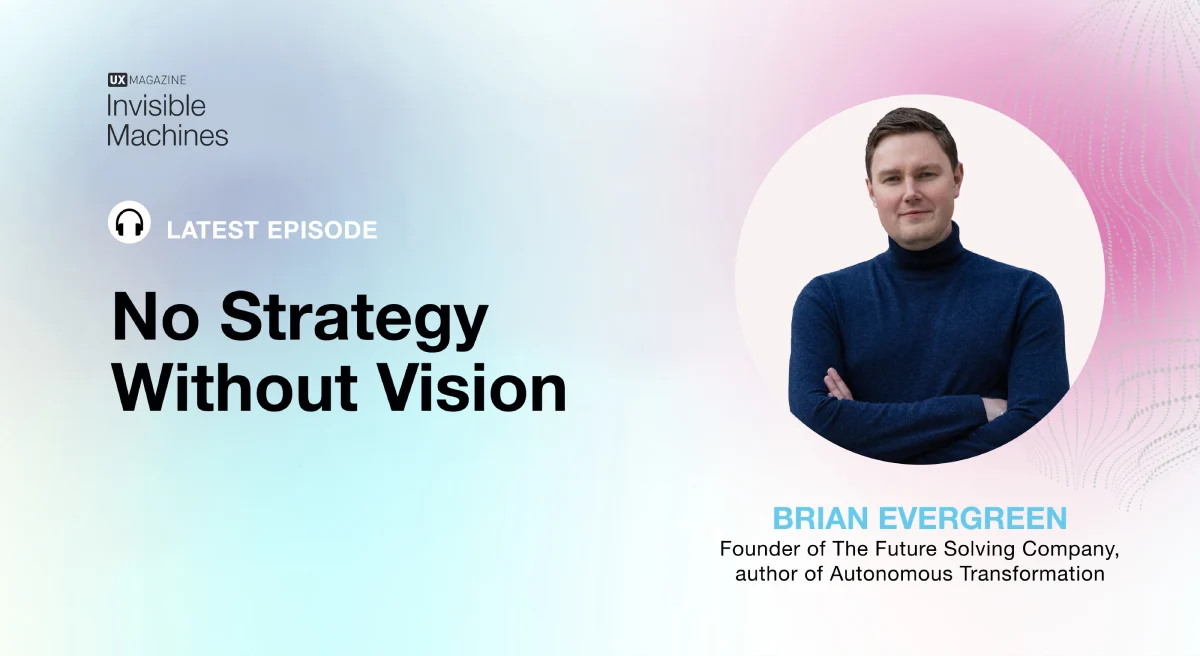
In the modern corporate boardroom, the ritual has become standardized. Executives gather, slide decks are projected, and the conversation inevitably pivots to "AI Strategy." Usually, this translates into a frantic, two-step sprint: first, a crash course in Large Language Models (LLMs) to ensure board-level credibility; second, a high-stakes scavenger hunt for use cases followed by a rigid Request for Proposal (RFP) process.
According to Brian Evergreen, founder of The Future Solving Company and author of Autonomous Transformation, this entire motion is fundamentally flawed. In a recent appearance on the Invisible Machines podcast alongside host Robb Wilson, CEO of OneReach.ai, Evergreen argued that the current procurement-first approach to AI is built for a world of static products—a world that has effectively ceased to exist.
The Crisis of the "Use-Case" Fetish
The core of the problem lies in the misapplication of traditional corporate procurement to the fluid, unpredictable reality of agentic AI. Historically, enterprise software procurement functioned like purchasing a SKU: you identified a problem, created a feature matrix, compared vendor offerings, and selected the most efficient "widget." This logic works perfectly when the solution is a defined product.
However, Evergreen posits that when dealing with agentic AI—systems capable of autonomous decision-making and task execution—the problem is not one of selection, but of creation. "The trouble starts," Evergreen notes, "when literacy becomes permission to sprint." Organizations are building "intelligent, hollow" AI plans. They are treating innovation like a science fair where the winner is the vendor who checks the most boxes on a spreadsheet.
This approach ignores the volatility of the AI landscape. In the time it takes for an enterprise to complete a six-month procurement cycle, a model update can render an entire "differentiated" feature obsolete, shipping it as a trivial side effect of an API upgrade. By focusing on current feature parity, organizations are not solving problems; they are effectively signing contracts for legacy technology disguised as innovation.
The Chronology of Failure: From Blockbuster to Modern Stagnation
The podcast conversation highlights a historical pattern of failure that serves as a cautionary tale for today’s AI adopters.
The Blockbuster Trap
Evergreen cites the collapse of Blockbuster as the definitive case study in "cannibalization anxiety." Blockbuster had the technology and the vision for streaming years before Netflix became a dominant force. However, because their "customer-of-record" was the franchisee—and because the streaming model threatened the lucrative late-fee revenue stream—leadership could not align their business model with their technical capability. The technology wasn’t the failure point; the alignment was.
The Bell Labs Counter-Move
Conversely, the panel points to Bell Labs in 1952 as the gold standard for breakthrough innovation. When faced with the stagnation of their own legacy, leadership forced an impossible constraint: imagine the entire telephone network had been wiped out and must be rebuilt from scratch, using only modern science and economics. This "rebuild from zero" mentality stripped away the institutional inertia that usually suffocates radical change. The lesson for today’s AI leaders is clear: you cannot iterate your way to a revolution by just slightly improving the existing org chart.
Supporting Data: Why "Problem Solving" Is the Wrong Framework
Evergreen’s professional philosophy hinges on a vital distinction between "Problem Solving" and "Future Solving."
- Problem Solving (The Elimination Exercise): This is the traditional management mode. It focuses on trimming waste, curating existing value, and optimizing current processes. It is inherently regressive, as it views the future through the lens of existing constraints.
- Future Solving (The Architecture of Appetite): This framework begins with a question: What do we want to exist that does not exist today? Once that vision is established, the organization works backward to identify the "necessary conditions"—data contracts, incentive structures, policy shifts, and partnerships—required to bring that vision to life.
The supporting evidence for this shift is found in the failure of "mass literacy" programs. If an organization trains every employee to use a hammer, they might build sturdier houses, but they will not accidentally build a cathedral. Mass-market AI literacy, without a centralized architectural vision, leads to "motion without direction"—a high volume of AI pilots that never graduate to production because they were never connected to a coherent business outcome.
The Emotional Work of Proof: A Response from the Frontlines
Robb Wilson and Josh Tyson, referencing successful implementations at institutions like Morgan Stanley, emphasize that "Future Solving" is not merely an abstract, philosophical exercise. It is a rigorous, often uncomfortable process of governance and accountability.
When organizations move away from "dumping PDFs into a vector database" and toward building a "governed knowledge layer," they are doing the hard work of defining ownership and accountability. This is where the vision becomes visceral. A successful AI strategy, according to Evergreen, is not a financial target like "we will increase efficiency by 15%." A true vision is a picture that can be held in a room: it is the advisor providing real-time, high-trust guidance; it is the clinician who can finally step away from the keyboard to connect with a patient because the AI has assumed the administrative burden.
If the workforce cannot "feel" the outcome, they will not carry the burden of change once the pilot phase concludes. The emotional work of proof is about creating a future that is more compelling than the status quo, even if the status quo is comfortable.
Implications for the Enterprise
The implications of this shift are profound and touch upon the very nature of human-computer interaction.
The Death of the "Login" Paradigm
As agentic AI matures, the traditional interface—characterized by silos, logins, and manual input—will likely collapse. If an organization can successfully define a future where "intent is handled end-to-end," the logistics layer becomes invisible. In this scenario, software doesn’t just process data; it builds relationships. If an incumbent organization refuses to build this integrated, story-driven experience, a platform-native competitor will do it for them, rendering the incumbent’s fragmented "digital transformation" efforts obsolete.
Friction is Inexhaustible
Evergreen offers a stark warning about the "friction mapping" currently popular in Agile workflows. "Friction is inexhaustible," he argues. You can always find more processes to optimize, more silos to break, and more steps to remove from a funnel. However, without a "North Star" vision, this work is just busywork. Friction only becomes meaningful when it stands between the organization and a defined, necessary future. When the vision is clear, teams will naturally clear the path; when the vision is absent, the team will simply optimize the status quo until the company is disrupted.
The Authoring of the Future
The final takeaway is one of authorship. The future is not a destination to be discovered through data analytics or vendor bake-offs. It is a product to be authored. Those who are willing to name the future in plain, human-centric language, and who possess the courage to map out the necessary conditions for that future, will be the ones who lead the next era of enterprise.
In the final analysis, an AI strategy is not a document to be signed by a procurement department. It is a declaration of intent. Until leadership agrees on the heading of the ship, the debate over which AI agent to buy or which vendor to partner with is merely rearranging deck chairs on a ship that has already lost its course. The technology is no longer the bottleneck—it is the alignment of the human architecture that remains the final, and most difficult, frontier.
To explore the full depth of this discussion, listen to the complete episode on the Invisible Machines podcast hub or watch the full interview on YouTube.
 Ammar Sabilarrohman
  Neng Nana
  Sagoh
Sagoh 