
 By Nana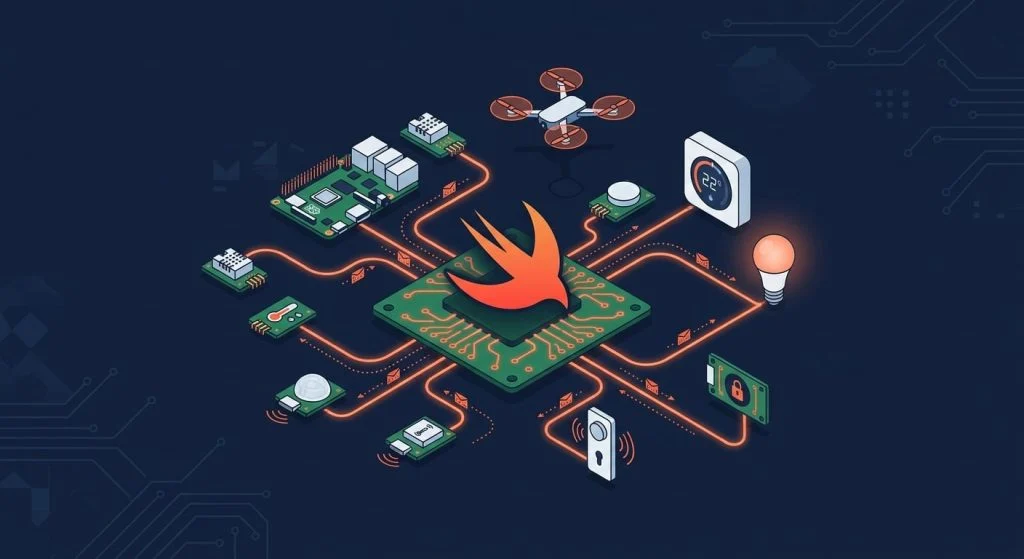
The cloud landscape is undergoing a profound transformation, marked by the blurring lines between massive data centers and the intelligent devices at the network edge. This week, Amazon Web Services (AWS) made significant strides in bridging these two worlds, signaling a strategic commitment to developer-centric ecosystems and enterprise-grade generative AI.
The most notable development is the general availability of the AWS IoT Device SDK for Swift. This move is not merely a routine library update; it represents a fundamental shift in how developers can build high-performance, secure, and production-ready applications across the Apple ecosystem and beyond. As the industry grapples with the complexities of managing decentralized fleets of intelligent hardware, AWS is betting heavily on Swift—a language once confined to mobile apps—to become a dominant force in server-side and IoT architecture.
The Rise of Swift: From Mobile to Mission-Critical IoT
For years, the Swift programming language was synonymous with iOS and macOS application development. However, the formation of the Swift Server Workgroup (SSWG) marked a turning point. By bringing production-ready MQTT 5 connectivity, Device Shadow, and fleet provisioning to the Swift ecosystem, AWS is enabling developers to deploy consistent, type-safe, and high-performance code from the cloud all the way down to the silicon on macOS, tvOS, and Linux-based IoT devices.
Implications for Edge Computing
The expansion of Swift into the IoT space is emblematic of a broader trend: the "intelligent edge." We are witnessing a move away from simple sensors toward complex, autonomous devices capable of running sophisticated logic locally.
Projects like WendyOS, an open-source operating system designed for physical AI, highlight this shift. By offering first-class Swift support for hardware platforms like the NVIDIA Jetson and Raspberry Pi, the industry is creating a pathway for developers to treat IoT devices with the same rigor and modularity as backend microservices. This maturation of Swift on the server—and now the edge—provides developers with a unified language, reducing the cognitive load of switching between different tech stacks when building end-to-end connected systems.
Major Headlines: Enhancing Enterprise Resilience and Intelligence
While the expansion of the developer toolkit is a long-term play, AWS also delivered immediate value to its enterprise customers this week with three critical updates.
1. Amazon RDS for SQL Server: Bridging the Legacy Gap
For many organizations, the migration to the cloud is hampered by complex licensing agreements and the high cost of moving legacy Microsoft SQL Server environments. With the introduction of "Bring Your Own Media" (BYOM) support for Amazon RDS, AWS is actively removing these friction points.
By allowing customers to reuse existing Microsoft SQL Server licenses—specifically those covered by Software Assurance—through the License Mobility program, AWS is making the transition to managed database services more financially attractive. Crucially, the integration with AWS License Manager ensures that this process remains transparent and compliant, allowing IT administrators to track license consumption with the same granularity they would have in a local data center.
2. Amazon Cognito: Strengthening Multi-Region Resilience
Reliability is the cornerstone of cloud architecture. This week’s announcement regarding Amazon Cognito’s multi-Region replication addresses a common pain point: user identity continuity during regional outages.
Previously, handling user identity across geographies required significant custom development and complex synchronization logic. Now, with the ability to synchronize credentials, pool configurations, and federation setups to a secondary "standby" region in near real-time, AWS is drastically reducing the recovery time objective (RTO) for mission-critical applications. This is an essential evolution for global enterprises that cannot afford even a momentary disruption in user access. The feature, available in both Essentials and Plus tiers across 16 Regions, provides a turnkey solution for disaster recovery.
3. The Generative AI Leap: OpenAI on Amazon Bedrock
Perhaps the most high-impact announcement is the general availability of OpenAI’s GPT-5.5, GPT-5.4, and Codex models on Amazon Bedrock. This integration represents a major victory for enterprises that want to leverage the latest in AI innovation without sacrificing the security, governance, and operational controls intrinsic to the AWS platform.
- GPT-5.5: As the most capable model in OpenAI’s stable, its arrival on Bedrock signals a maturation in how businesses will handle agentic coding and autonomous data analysis.
- Codex: By making Codex available via IDE integrations (Visual Studio Code, JetBrains, Xcode) and the Codex CLI, AWS is positioning itself as the primary infrastructure provider for AI-augmented software development.
Because these models function within the existing AWS ecosystem, enterprises can maintain strict control over their data, ensuring that their proprietary codebases remain secure while utilizing the world’s most advanced AI models. Pricing alignment with OpenAI’s first-party rates further simplifies the financial planning for organizations scaling their AI investments.
Chronology of Development: A Strategic Roadmap
The trajectory of these announcements reveals a clear, multi-layered strategy:
- Foundation (Earlier Years): AWS focused on the core primitives of cloud computing, storage, and networking.
- Expansion (2020–2024): The focus shifted toward serverless architectures, specialized databases, and the democratization of machine learning.
- Integration & Maturity (2025–2026): We are now in a phase where AWS is focusing on the "last mile"—connecting the edge to the cloud (Swift/IoT), ensuring business continuity (Cognito), and industrializing generative AI (Bedrock).
The decision to release these specific updates in the same week is not coincidental. It demonstrates a desire to satisfy three distinct segments: the Hardware Engineer (Swift/IoT), the Infrastructure Architect (RDS/Cognito), and the Software Engineer (OpenAI/Codex).

Supporting Data and Technical Context
The Scaling of Identity
The introduction of multi-Region replication for Amazon Cognito is supported by the rapid growth of distributed applications. As businesses expand globally, the latency of a single-region authentication service becomes a bottleneck. By moving the identity provider (IdP) closer to the user in a standby region, AWS is facilitating a seamless user experience that is resilient to regional AWS service disruptions.
The Economics of BYOM
The integration of BYOM with AWS License Manager is a response to the "License Debt" that many enterprises carry. Research indicates that a significant portion of IT budgets is still tied to perpetual software licenses. By allowing companies to migrate these licenses to RDS, AWS effectively lowers the barrier to entry for cloud migration, potentially accelerating the total addressable market for managed database services.
Implications: The Future of the "Builder"
The overarching theme of this week’s news is the empowerment of the "Builder." Whether it is a developer writing code for a remote sensor in a factory or an enterprise architect designing a global identity management system, AWS is providing the tools to build faster and more reliably.
The "Swift" Transformation
The move to support Swift in the IoT space is perhaps the most culturally significant. It signals that AWS recognizes the language’s growing dominance outside of the Apple ecosystem. As Swift continues to perform well on the server, it will likely replace older, more verbose languages in edge computing, where memory safety and performance are non-negotiable.
The AI-Integrated Lifecycle
With GPT-5.5 and Codex now available on Bedrock, the "software development lifecycle" is being fundamentally rewritten. We are moving toward a future where the IDE is no longer just a text editor, but a collaborative partner. When this is combined with the ability to deploy the resulting code to IoT devices using the new Swift SDK, the loop between "idea" and "production" is tighter than ever.
Conclusion
This week’s updates reflect a mature, confident AWS. By focusing on the edge, strengthening the resilience of core services, and deepening its commitment to the latest generative AI, Amazon is ensuring that it remains the platform of choice for the next generation of digital infrastructure.
For developers, the message is clear: the tools you need to build the future—whether it’s a global AI-powered application or a distributed network of intelligent edge devices—are already in your hands. The challenge now is not the technology, but the imagination of the builder. As we look toward the remainder of the year, it is highly probable that we will see these pillars—Edge, Resilience, and AI—converge even further, setting the stage for a new era of industrial and consumer innovation.
 Neng Nana
  Suro Senen
  Lina Hope