
 By Suro Senen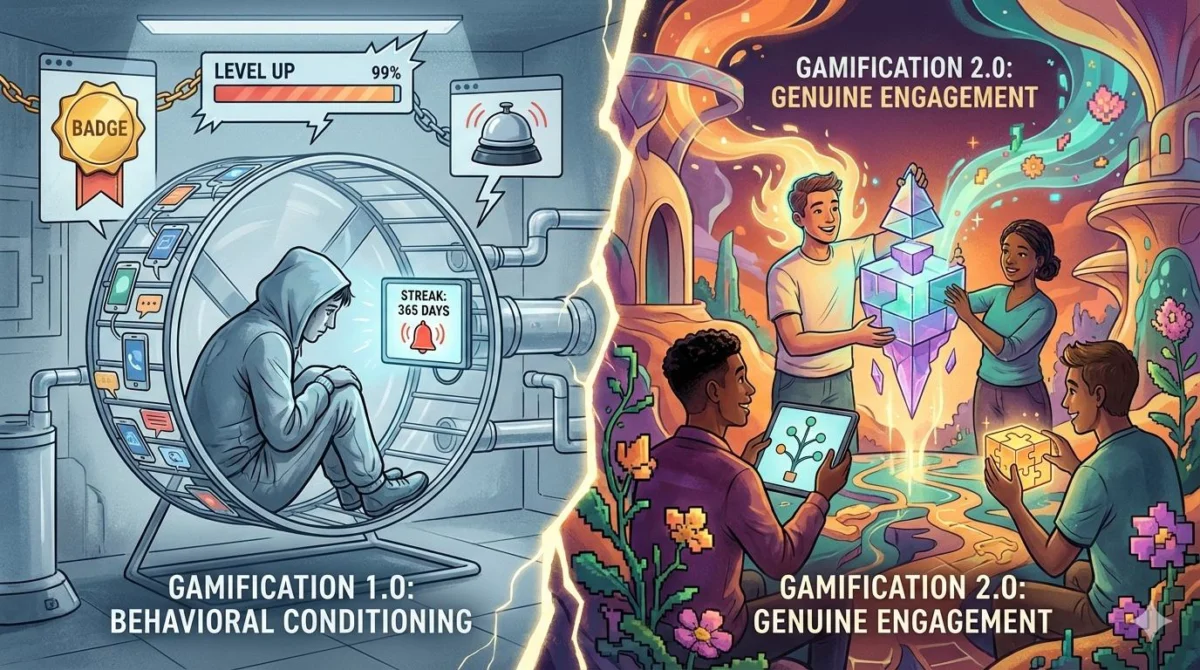
In the digital landscape of the 2020s, a pervasive, hollow phenomenon has taken root. It is a design philosophy masquerading as innovation, a "gamification" trend that leaves seasoned gamers cold and casual users confused. From the guilt-tripping streak notifications of language-learning apps to the hollow "All-Star" profile badges on professional networking sites, the industry is awash in superficial mechanics that provide the illusion of play without the substance of engagement.
This is the "Gamification Cargo Cult"—a term borrowed from the anthropological study of isolated cultures building bamboo radio towers in hopes of summoning supply planes. Today’s product managers and UX designers are building their own bamboo towers: points, badges, and leaderboards. Yet, despite these digital offerings, the intended engagement—the "planes"—rarely lands.
The Anatomy of a Digital Mirage: Main Facts
The current state of gamification is largely an exercise in behavioral theater. Apps are being built by professionals who have never shipped a game, following "best practice" checklists derived from blog posts rather than psychological research.
The primary markers of this cargo cult are:
- Artificial Urgency: Apps leverage guilt-tripping mechanisms, such as "streak loss" warnings, which prioritize user retention metrics over genuine educational or professional progress.
- Extrinsic Bribes: The use of badges and points to incentivize activity that should be inherently rewarding.
- The Compliance Loop: Designing for "rats in a cage" behaviorism, where the goal is to trigger a dopamine hit rather than facilitate a mastery-based experience.
The result is a cycle of rapid user acquisition followed by inevitable abandonment. The Fitbit that sits in a drawer, the LinkedIn profile updated once to reach an arbitrary completion status, and the Duolingo course abandoned after a missed streak are all symptoms of a system that fails to translate shallow engagement into long-term value.
A History of "Gamification": From Gaming Origins to Corporate Appropriation
To understand where we went wrong, one must look at the roots of true game design. The history of the industry is not one of points and leaderboards, but one of complex human motivation.
The Era of Mastery (1980s – 1990s)
Early game developers, including pioneers who programmed classics like John Madden Football or managed titles like Street Fighter, operated in a vacuum of "gamification." They didn’t need to bribe players to return; they needed to create systems so deeply satisfying that the act of playing became its own reward.
The Metrics Explosion (2010s)
As the "app economy" matured, the focus shifted from player experience to growth hacking. With the rise of mobile devices, product teams began treating users as data points. The term "gamification" was sanitized and sold to marketing departments as a silver bullet for churn reduction.
The Cargo Cult Era (Present Day)
We are currently in a period where gamification is commoditized. It is now common to see "Gamification as a Service" (GaaS) offerings that allow companies to plug in generic achievement systems. This has led to a saturation of "gamified" experiences that lack any soul, resulting in a public that is increasingly cynical toward notifications, badges, and progress bars.
Supporting Data: Why Extrinsic Rewards Fail
The fatal flaw in modern gamification is the reliance on extrinsic motivation. Behavioral psychology, particularly Self-Determination Theory (SDT), suggests that human motivation thrives on three pillars: Autonomy, Competence, and Relatedness.
Current industry standards, by contrast, focus exclusively on:
- Immediate Gratification: The "pellet-and-lever" model.
- Comparative Ranking: Leaderboards that often demotivate everyone but the top 1% of users.
- Feature Completeness: The "All-Star" status trap, which encourages users to optimize for the platform’s database rather than their own actual utility.
When companies rely on these, they create "compliance," not "engagement." Users will perform the absolute minimum to earn the reward—a phenomenon known as "gaming the system." They check in without reading, click through tutorials without learning, and exit as soon as the novelty wears off.
Compare this to the 100+ hour retention rates of titles like Elden Ring or the persistent, community-driven ecosystem of World of Warcraft. These games do not bribe players; they provide a sandbox for competence and agency. They don’t just reward the player for existing; they challenge the player to become better.
Industry Perspectives: The Divide
The disconnect is stark. In recent interviews, veteran game designers have voiced significant frustration with the corporate adoption of their craft.
"If your gamification could be spec’d out in a single Fiverr gig—’Add points, badges, and a leaderboard’—it’s not gamification. It’s a cargo cult," says one veteran designer with nearly four decades of experience in the industry.
Conversely, corporate product managers often defend these mechanics as "data-driven." Their official stance typically emphasizes the following:
- Retention: "Our data shows that streaks increase DAU (Daily Active Users)."
- Onboarding: "Gamified tutorials increase initial completion rates by 15%."
- Optimization: "These mechanics provide a standardized way to measure user progress."
While these metrics may appear positive in the short term, they ignore the long-term cost: the loss of brand trust and the eventual degradation of the user base into a group of people who are only present for the "points," not the value.
The Implications: Why We Need a Rescue Mission
The failure of the current gamification paradigm has far-reaching implications for the tech industry.
1. The Erosion of User Trust
Every time a user feels manipulated by a "streak" notification or an empty "level-up" badge, their trust in the platform diminishes. This creates a "cry wolf" scenario where legitimate engagement notifications are ignored, and users become increasingly hostile toward app communications.
2. Stagnation in Design Innovation
By relying on the "checklist" approach to gamification, companies are stifling actual innovation. Why invest in deep, meaningful gameplay or UX improvements when a simple badge system can temporarily boost retention metrics? This leads to a homogenized digital landscape where every app feels like a derivative version of the last.
3. The Pivot to Gamification 2.0
The rescue mission for gamification lies in a fundamental shift. We must move from extrinsic rewards to intrinsic satisfaction.
Designing for "Gamification 2.0" requires:
- Designing for Agency: Giving users meaningful choices that have a real impact on their experience.
- Focusing on Mastery: Creating systems where the user can see their own skill improve over time, rather than just seeing a progress bar fill up.
- Social Connection: Leveraging "Relatedness" through collaborative goals rather than competitive leaderboards that alienate casual users.
Conclusion: Toward a More Human-Centric Design
The era of the "Gamification Cargo Cult" must end if we want to build a sustainable digital future. We need to stop treating users like laboratory rats and start treating them like players.
Real gamification is not about adding a layer of superficial mechanics to a boring product; it is about finding the inherent joy in the activity itself and magnifying it. It is about understanding that a person who truly learns a language on Duolingo does so because of their desire to connect with the world, not because of a digital badge.
If we can stop copying the mechanics of games and start understanding the psychology of play, we can move beyond the bamboo towers. We can finally start landing the planes.
Up next in this series: "Gamification 2.0. Beyond Points and Badges: Designing for Players, Not Metrics. Chapter 2: The Solution."
 Ammar Sabilarrohman
  Neng Nana
  Sagoh
Sagoh 