
 By Sagoh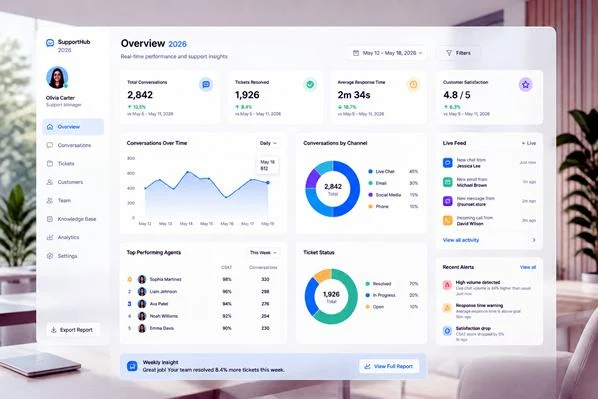
In the modern digital landscape, the "post-mortem" culture of customer support—where leadership reviews service failures in weekly reports three days after they occurred—is rapidly becoming an organizational liability. Today’s customers operate in a state of immediate gratification; when they face a technical glitch or a billing discrepancy, they expect a resolution that is as fast as it is accurate.
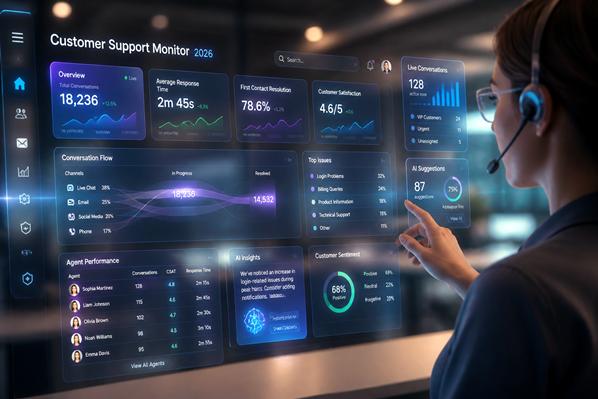
To bridge the gap between expectation and reality, forward-thinking support organizations are pivoting toward real-time monitoring. This approach moves beyond passive data collection, enabling managers to catch slow replies, faulty AI logic, and messy escalations while the shift is still in progress. By shifting the focus from historical reporting to live observability, companies can salvage customer relationships before a single ticket is marked "closed."
The Strategic Imperative: Why Real-Time Visibility Matters
The shift toward real-time support monitoring is driven by a simple, cold reality: the cost of a single bad experience. Research from PwC indicates that 32% of customers will abandon a brand they love after just one negative interaction. In an era where switching costs are low and social media provides a megaphone for frustration, waiting for a monthly report to identify systemic issues is a recipe for churn.
Fast visibility acts as a strategic "smoke alarm." By tracking a curated, essential set of metrics, leaders can identify pressure points—such as queue spikes or sentiment degradation—in real-time. This allows for immediate tactical adjustments, such as re-routing traffic, deploying additional human oversight, or temporarily disabling an underperforming AI workflow.
Chronology of an Effective Monitoring Strategy
Building an effective monitoring ecosystem is not about flooding screens with data; it is about creating a deliberate flow of information that informs immediate action.
Phase 1: Identifying the "Leading" Indicators
To act in the moment, teams must prioritize leading metrics. These are the early warning signs that show pressure while customers are still waiting in the queue.
- Queue Health: First response time, current queue length, and active backlog volume.
- Friction Points: Transfer rates and escalation frequency, which indicate that the primary channel is failing to solve the problem.
- Live Sentiment: Using natural language processing (NLP) to gauge the "temperature" of incoming chats and calls.
Phase 2: Integrating "Lagging" Metrics for Context
While leading metrics tell you there is a fire, lagging metrics tell you if the water you used actually put it out. Handle time, resolution rates, CSAT, and repeat contact rates serve as the final verdict on quality. When viewed alongside real-time data, these metrics help managers determine if their mid-shift interventions were successful or if they merely shifted the burden elsewhere.
Phase 3: The "Live" Calibration
The final stage of the chronological process involves constant tuning. If a spike in negative sentiment is observed at 2:00 PM, a manager must have the autonomy to adjust routing rules or provide "in-the-moment" coaching to agents. This closes the loop between identification and resolution, ensuring the organization is always learning.
Supporting Data: The High Stakes of Support Speed
The HubSpot State of Service Report underscores the urgency of this transition, noting that 90% of customers prioritize immediate responses when they reach out for support. However, speed is not a panacea.
The data reveals a nuance that many organizations overlook: speed without accuracy is a failure. A 20-second response that provides incorrect information or forces a customer into a circular "loop" is, in the eyes of the consumer, indistinguishable from a slow response. The goal of real-time monitoring is not just to speed up the clock, but to ensure that the quality of the interaction remains high under pressure.
Furthermore, the "human element" remains a critical variable. PwC’s findings—that 59% of consumers believe companies have lost touch with the human side of service—suggest that as organizations deploy AI to handle volume, they must double down on monitoring the empathy and tone of their human agents.
AI vs. Human Agents: A Dual-Lens Approach
One of the most significant challenges in modern support centers is the integration of AI agents alongside human counterparts. While they should be visible on the same dashboard for a holistic view, they must never be measured by the same scorecard.
The AI Scorecard
AI agents require a technical audit. Monitoring should focus on:
- Intent Match Accuracy: Did the bot correctly categorize the user’s issue?
- Confidence Scores: When does the AI "guess" rather than "know"?
- Fallback Rates: How often is the bot forced to hand off to a human?
- Safety/Brand Guardrails: Are the answers compliant with company policy?
The Human Scorecard
Humans, by contrast, require a qualitative lens. Metrics must focus on:
- Empathy and Tone: Does the interaction feel robotic or supportive?
- Handoff Judgment: Does the agent know when to escalate a complex issue?
- Policy Adherence: Are the solutions provided consistent with the brand’s knowledge base?
Implications for Organizational Leadership
The transition to real-time monitoring has profound implications for how support teams are managed, coached, and optimized.
Role-Based Visibility
A dashboard that shows everything to everyone is a dashboard that no one uses.
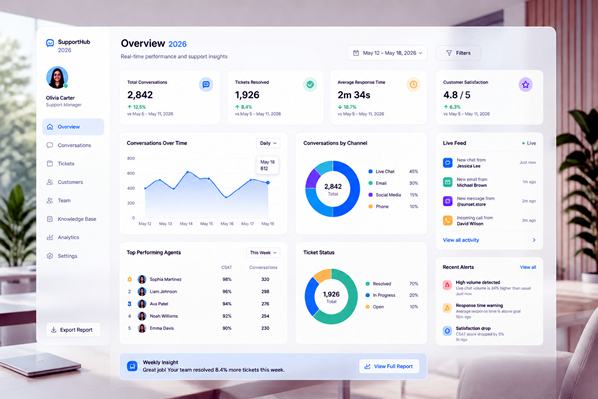
- Team Leads need to see "stuck" conversations and queue bottlenecks.
- QA Managers need to see trend lines, sentiment clusters, and patterns of failure.
- Operations Leaders need high-level views of SLA risk and channel volume.
By customizing views, organizations prevent information overload and ensure that the right person is empowered to solve the right problem.
Dynamic Coaching and Improvement
The most significant implication is the death of the "annual performance review" model for support. With real-time data, coaching becomes a continuous, lightweight process. A supervisor can nudge an agent during a live chat if they notice a departure from policy, effectively correcting the behavior before it manifests in the next ten conversations.
Similarly, AI models can be tuned on the fly. By reviewing failed intents and weak responses in near-real-time, technical teams can update knowledge bases and prompt-engineering strategies immediately, treating the support infrastructure as a living, breathing engine that is tuned while it runs.
Ethical Monitoring: Privacy and Fairness
The power of real-time monitoring comes with the responsibility of ethical stewardship. Because monitoring involves tracking transcripts, sentiment, and performance, it is vital to maintain a "safety-first" culture.
- Transparency: Employees and customers should be aware of how data is used. Monitoring should be framed as a tool for support, not a tool for surveillance.
- Contextual Judgment: One bad call should not trigger a disciplinary action. Data must be viewed in clusters. A high "handle time" might look like inefficiency, but in context, it could represent an agent providing high-touch, empathetic support that saves a high-value customer.
- Privacy Controls: Strict access controls and data masking are mandatory. Only those with a clear operational need should access raw interaction logs.
Conclusion: The Future is Responsive
Real-time monitoring is more than a technical upgrade; it is a cultural shift. By moving away from the "history lesson" of legacy reporting and toward a proactive, live-observability model, companies can transform their support departments from cost centers into engines of customer loyalty.
When you can see the friction as it happens, you don’t just solve problems—you prevent them. In a competitive market, the brand that catches the slip before the customer feels the fall is the brand that wins.
 Iffa Jayyana
  Raul Delapena Setiawan
  Laily UPN