
 By Nana Wu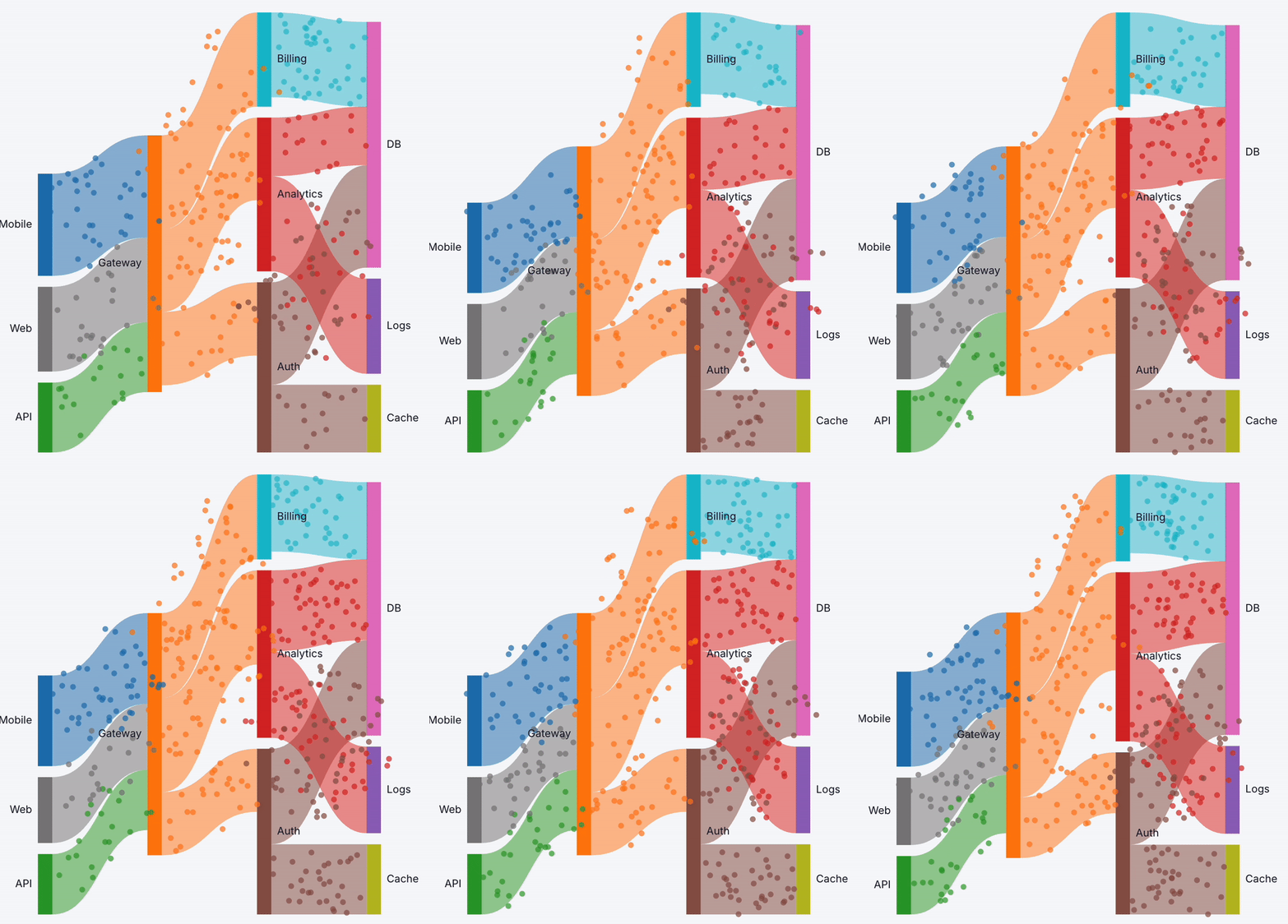
In the fast-evolving landscape of data visualization, the lifecycle of an open-source library is often defined by a familiar arc: a burst of creative energy, a period of community adoption, and the inevitable "maintenance drift" as the original author moves on. However, Elijah Meeks, a veteran in the data visualization space and Principal Engineer at Confluent, is bucking this trend. With the release of Semiotic 3, Meeks is demonstrating that the next generation of software development may not require massive teams, but rather a sophisticated synergy between domain expertise and generative AI.
Semiotic 3 marks a pivotal evolution for the framework, introducing first-class support for real-time streaming data—a feature set Meeks believes will redefine how developers and data scientists interact with dynamic information.
The Chronology of a Data Visionary
To understand the significance of Semiotic 3, one must look at the project’s lineage. The library began its life at Netflix as the "Abacus Viz Framework," an internal tool designed to streamline the company’s reporting and A/B testing infrastructure.
From Internal Tool to Open Source
Meeks, who has been a central figure in the data visualization community for over a decade, credits the project’s early success to a collaborative spirit. Without the foundational contributions of James Womack and the design-centric annotations of Susie Lu, Semiotic might have remained a mere tech demo. Throughout its lifecycle, the library benefited from the interventions of top-tier engineers like Tom MacWright and Oleksii Raspopov, who refined its build systems and performance, respectively.
Despite reaching over 2,000 stars on GitHub, Semiotic struggled to achieve widespread adoption. Reflecting on this, Meeks admits to a classic architectural misstep: falling afoul of Conway’s Law. Because the library was a manifestation of his own specific obsessions, it became difficult for the average developer to integrate. While Meeks prioritized "escape hatches" and flexibility, users often found the library’s complexity and substantial footprint daunting.
The Quiet Years
As Meeks transitioned through roles at Noteable and eventually to his current position at Confluent, Semiotic entered a period of relative dormancy. It remained a powerful, albeit niche, tool—often favored by Meeks himself because it avoided the XML-heavy composition patterns of rival libraries like visx. Yet, the vision for where the library could go—specifically regarding performance and streaming data—remained locked away, waiting for the right resources to materialize.
The AI Turning Point: Replacing the "Unrecruitable"
The catalyst for Semiotic 3 was not a sudden influx of venture capital or a new team of engineers, but the maturation of Large Language Models (LLMs). For Meeks, AI served as a force multiplier that allowed him to bridge the gap between his domain expertise and his technical limitations.
The "Goldilocks Zone" of AI Collaboration
Meeks is candid about his self-assessment as a programmer. "I’m not the best programmer," he admits. "I was never the best programmer." By recognizing his strengths—deep conceptual understanding and architectural vision—and his weaknesses—complex build system optimization and granular performance tuning—Meeks discovered a "Goldilocks Zone" for AI assistance.
He realized that AI struggles when asked to make high-level architectural decisions in a vacuum. However, when provided with highly specific, expert-level constraints—such as "this component needs to handle streaming updates by diffing incoming data against a rolling window"—the AI became an engine of execution.
"AI didn’t replace the best programmers I’ve worked with," Meeks notes. "It replaced the best programmers I couldn’t recruit."
Technical Implications: Why Semiotic 3 Matters
The release of Semiotic 3 is not just a cosmetic update; it is a fundamental shift in how the library handles data. By treating streaming data as a "first-class citizen"—a concept Meeks adapted from his work with Apache Flink—the library now sits at the bleeding edge of real-time analytics.
Key Technical Enhancements:
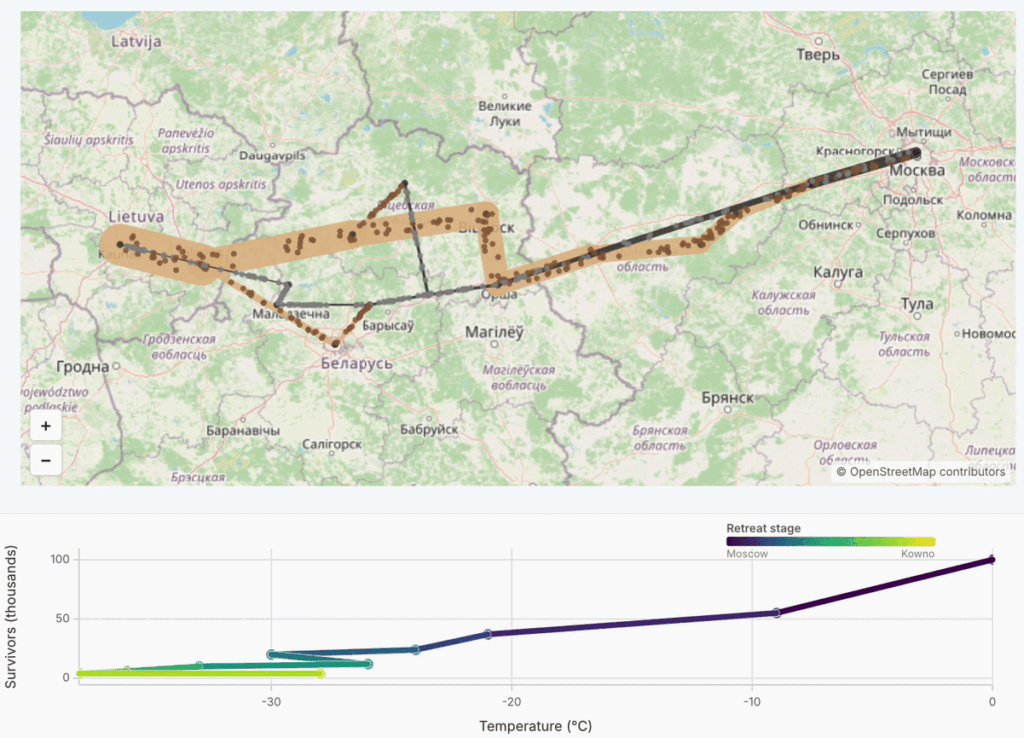
- Real-Time Streaming Mode: Almost every chart type in the library now features a native streaming mode, allowing developers to visualize data as it flows rather than waiting for batch updates.
- Performance Optimization: By offloading complex data pipeline logic to AI-assisted refactoring, the library has achieved significantly higher performance benchmarks, addressing the "hefty" nature of its predecessor.
- Server-Side Rendering (SSR): The library now supports SSR, a crucial requirement for modern web applications that demand fast initial load times and SEO compatibility.
- Testing and Stability: The codebase has been bolstered by a rigorous suite of tests, ensuring that the library is no longer just a "tech demo" but a reliable, production-grade tool.
Perhaps most illustrative of the library’s new capabilities is the inclusion of "particle Sankeys"—a visualization style that provides a vivid, real-time representation of data flows. For Meeks, this is a long-held dream realized through the efficiency of AI-driven coding.
Implications for the Industry
The release of Semiotic 3 serves as a case study for the future of "vibe coding"—a term used to describe the rapid, iterative development style facilitated by AI.
The Democratization of Complex Engineering
For years, the development of high-performance visualization libraries was restricted to elite teams with deep expertise in both UI frameworks and data processing. Meeks’ success suggests that as AI becomes more proficient at translating human intent into performant code, individual developers will be able to manage projects that previously required small departments.

However, Meeks provides a cautionary note: this only works if the author deeply understands the domain. The AI acts as a skilled intern or a highly efficient developer, but it requires a "Principal Engineer" level of guidance to ensure that the architecture is sound and the abstractions are meaningful.
A New Standard for Streaming Visualization
As Confluent continues to deploy Flink-based streaming charts, Semiotic 3 provides the visual vocabulary necessary to keep pace with modern data infrastructure. It empowers stakeholders to move beyond static dashboards, encouraging them to imagine UIs that treat data as a living, moving entity.
Conclusion: A Blueprint for the Future
Elijah Meeks has effectively turned his open-source project into a laboratory for the future of work. By refusing to let his limitations stop his vision, and by leveraging AI as a tactical partner rather than a replacement for critical thinking, he has breathed new life into a library that many had written off.
Semiotic 3 is more than a tool for drawing charts; it is an artifact of a shifting technological era. It proves that while the "best programmers" are still invaluable, the barrier to entry for building complex, performant, and beautiful software has been irrevocably lowered. As the library moves forward, its success will likely inspire other independent developers to stop waiting for a team and start building one with the tools currently at their disposal.
The era of the "one-person expert-led team" has arrived, and if Semiotic 3 is any indication, the results are going to be spectacular.
 Lina Irawan
  Nana
Nana  Nila Kartika Wati