
 By Pevita Pearce
In the evolving landscape of cloud-based accounting, the gap between Xero and FreshBooks has narrowed significantly in terms of feature overlap. Yet, despite both platforms offering robust double-entry accounting, automated reporting, and sophisticated financial tools, they remain distinctly optimized for different user archetypes. Choosing the right software is no longer just about which platform has the "most" features; it is about which tool aligns with the operational reality of your business.
Main Facts: The Strategic Divide
At its core, the choice between Xero and FreshBooks is a choice between a scalable business ecosystem and a streamlined client-management machine.
FreshBooks remains the gold standard for service-based professionals—freelancers, creative agencies, and consultants. Its architecture is built around the client lifecycle: sending professional invoices, managing retainers, and automating payment reminders. It is designed to be approachable for users who have never opened a general ledger in their lives.
Xero, conversely, is the powerhouse for growing enterprises, particularly those juggling e-commerce complexities. It excels in environments where managing multi-currency transactions, complex inventory levels, and multiple sales channels is a daily necessity. Unlike FreshBooks, which is built on a "per-user" pricing model, Xero allows for unlimited users, making it significantly more cost-effective for growing teams.
Chronology: The Evolution of Accounting Tech
The history of these two platforms reflects the changing needs of the modern workforce.
FreshBooks began in 2003 as a simple invoicing tool, born out of a founder’s frustration with the manual process of billing clients. Over the two decades that followed, it evolved into a comprehensive accounting suite, adding expense tracking, bank reconciliation, and project management to keep pace with its users as they scaled.
Xero, founded in 2006 in New Zealand, took a different trajectory. It was built from the ground up as a cloud-native accounting platform designed to provide an "always-on" view of a business’s financial health. By focusing on double-entry accounting and integrating deeply with third-party apps, Xero positioned itself as the central operating system for small and medium-sized businesses (SMBs).
In recent years, the "arms race" has centered on Artificial Intelligence. Xero has surged ahead with its JAX AI assistant, which offers predictive cash-flow forecasting and document evaluation. FreshBooks has focused its development on refining the "client experience," ensuring that the friction between service delivery and getting paid is as low as possible.
Supporting Data: Comparing the Financials
Pricing models often reveal the true intent of a software provider.
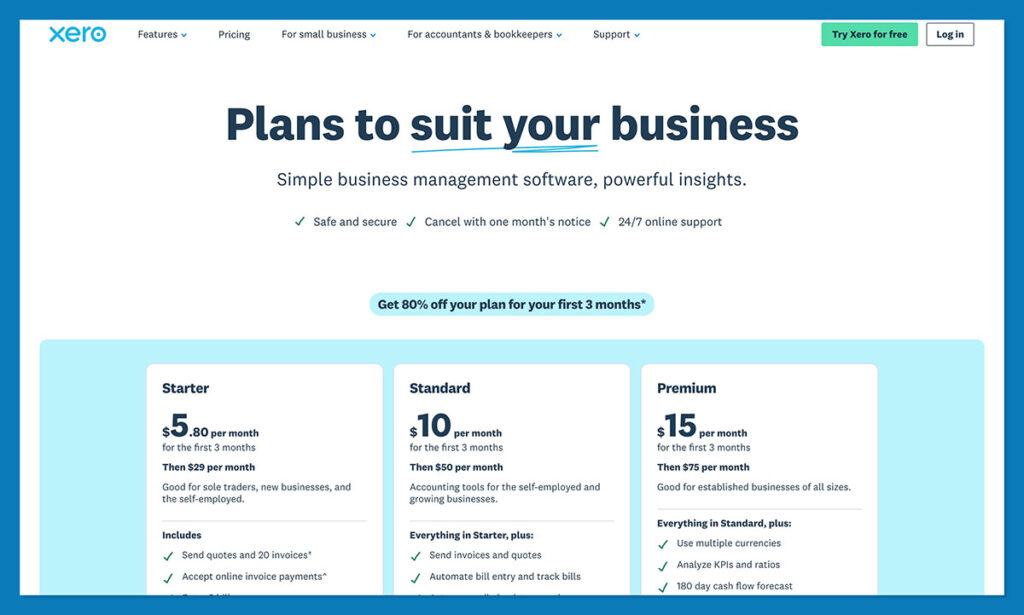
Xero Pricing and Value
Xero’s pricing is feature-gated but user-friendly regarding team access.
- Early ($25/month): Restricted to 20 invoices and 5 bills. Ideal for solopreneurs.
- Growing ($59/month): Removes invoice and bill caps.
- Established ($97/month): Unlocks multi-currency, advanced project tracking, and deep reporting.
- Note: These prices reflect upcoming adjustments for October 2026.
The primary advantage here is the "Unlimited Users" policy. Whether you have an internal bookkeeper, a CFO, or an external accountant, you do not pay extra for them to access your data.
FreshBooks Pricing and Value
FreshBooks utilizes a client-based pricing model:
- Lite ($23/month): Up to 5 billable clients.
- Plus ($43/month): Up to 50 billable clients.
- Premium ($70/month): Unlimited clients.
While the entry price seems lower, the cost scales quickly. Because FreshBooks charges for additional team members, a small agency with three employees will find their monthly overhead significantly higher than on a Xero plan with the same features.
Deep Dive: Key Accounting Features
Invoicing and Client Management
FreshBooks shines in service-based billing. Its ability to turn an invoice into a 12-installment payment plan and its sophisticated retainer management system make it a clear winner for consultants.
Xero, however, offers a more professional, corporate-style invoicing experience. With the JAX AI assistant now helping design and tailor invoices, Xero is closing the gap, but it remains a secondary strength compared to its primary focus on backend ledger management.
The Power of Bank Reconciliation
Xero was built for the accountant. Its bank reconciliation tools are designed to handle complex business structures, including multiple asset accounts and foreign currency conversions. It is the superior tool for businesses that require high-fidelity audit trails.
FreshBooks has significantly improved its reconciliation features, particularly for users on the Plus plan and above. It suggests matches for expenses and payments, which saves significant time. However, it falters when dealing with multi-currency reconciliation or complex financial instruments like crypto or lines of credit, which Xero handles with ease.
E-commerce and Inventory Management
For an e-commerce business, Xero is the undisputed champion. Its native Shopify integration is best-in-class, automatically pulling in sales data, payouts, and taxes. The "Inventory Plus" add-on brings a level of stock control—including COGS monitoring and backorder management—that is simply not available within the FreshBooks ecosystem.

FreshBooks offers basic product tracking, but it is best suited for businesses where inventory is a secondary revenue stream, not the core of the operation.
Official Responses and Strategic Directions
Both companies have signaled their long-term strategies through recent product updates.
Xero’s leadership has emphasized "Connected Accounting," focusing on building an ecosystem where payroll, inventory, and AI-driven analytics live under one roof. By embedding the Gusto payroll app deeply into the platform, Xero aims to ensure that once a business starts on their platform, they never have to leave.
FreshBooks, through its focus on the "client-facing portal," aims to keep the freelancer in their ecosystem. By providing a secure space where clients can log in to view invoices, approve estimates, and make payments, FreshBooks creates a "stickiness" that is hard to replicate.
Implications for Your Business
When deciding between these two, consider these three questions:
- Do you sell physical products? If yes, choose Xero. The inventory management and e-commerce integrations are far more mature.
- How many people need access to your financials? If you have a growing team, choose Xero. The unlimited user policy will save you thousands of dollars in the long run.
- Is your business primarily service-based? If you are a designer, writer, or consultant, FreshBooks will save you time. Its interface is less intimidating, and its billing features are perfectly tailored to the "retainer and hourly" model.
The Verdict
Xero is a tool for businesses planning to scale into complex environments. It is a robust, "set-it-and-forget-it" financial backbone that grows with you. The initial learning curve is steeper, and it requires a basic understanding of accounting principles, but the payoff is a level of control and insight that the competition struggles to match.
FreshBooks is the best friend of the creative professional. It removes the stress of accounting by simplifying the most common tasks: billing, invoicing, and expense tracking. It is the perfect choice for the individual or small team that wants to spend as little time as possible on their books and as much time as possible on their craft.
Ultimately, both platforms have proven that they can handle the financial demands of modern business. The "better" software is the one that allows you to focus on the work that actually generates revenue for your company. Whether you choose the granular power of Xero or the user-centric simplicity of FreshBooks, you are investing in a system that removes the manual headache of financial management, allowing you to focus on the future of your business.
 Sagoh
Sagoh  Asep Darmawan
  Nana Muazin