
 By Nana Muazin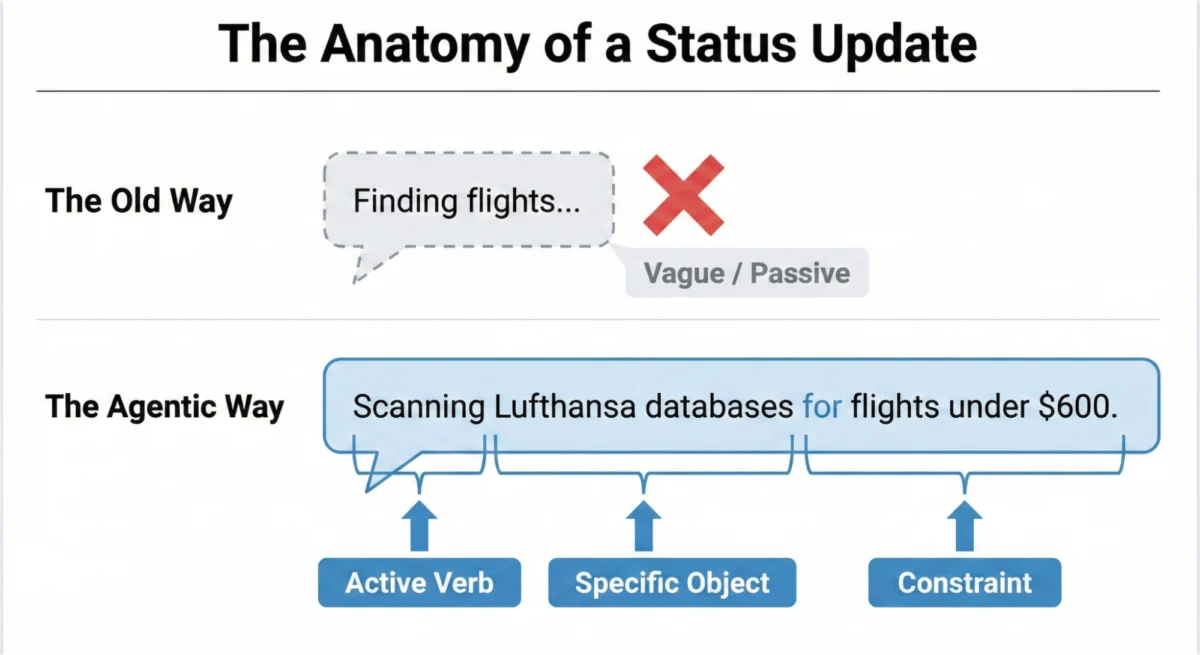
Main Facts: The Crisis of the "Thinking" Machine
As artificial intelligence shifts from simple chatbots to autonomous "agents" capable of executing multi-step workflows, a fundamental friction point has emerged in the user experience: the "black box" of latency. For over three decades, interface designers have relied on a singular visual shorthand to communicate system delays—the spinner. Whether a rotating wheel, a pulsing bar, or a "throbber," these patterns were designed for a technical reality where delays were caused by file sizes or bandwidth limitations.
In the era of agentic AI, the nature of the wait has fundamentally changed. When an AI agent pauses for thirty seconds, it is rarely downloading data; it is "thinking." It is weighing probabilistic outcomes, querying APIs, and synthesizing logic. Applying a legacy spinner to this process creates a "transparency gap." Users, unable to distinguish between a complex calculation and a system crash, experience rising anxiety and a subsequent erosion of trust.
Recent industry analysis and UX research suggest that the solution lies in "Decision Node Audits" and the implementation of specific interface patterns that reveal the system’s process. By moving from passive indicators ("Loading…") to active, informative microcopy and dynamic containers, developers can transform wait times into "reassurance moments," ensuring that AI is perceived not as a mysterious oracle, but as a reliable digital colleague.

Chronology: From Static Loading to Agentic Logic
The evolution of system status indicators reflects the broader history of computing. To understand why the current AI interface is failing, we must look at the timeline of how software has communicated its "internal life" to humans.
The Era of Bandwidth (1990s–2010s)
During the rise of the web, the "spinner" was an honest reflection of technical constraints. The system was waiting for packets of data to travel across a network. Transparency was simple: a progress bar showed the percentage of bytes received. The user understood that the system was a passive pipe.
The Era of the Cloud (2010s–2022)
As software moved to the cloud, latency became about server-side processing. However, the tasks remained deterministic. If you clicked "Save," the system either succeeded or failed. The spinner remained adequate because the "logic" of the software was fixed and predictable.

The Agentic Era (2023–Present)
The release of Large Language Models (LLMs) introduced non-deterministic software. When an agent is prompted to "Organize a team offsite," it begins a journey of unpredictable duration and complexity. It may search the web, check calendars, and draft emails. In this phase, the "wait" is no longer about file size—it is about the AI’s agency.
This shift has rendered the traditional spinner obsolete. The industry is currently in a transition period where top-tier AI platforms (like Perplexity and Devin) are pioneering "Process-Revealing Interfaces," while legacy SaaS products struggle with "Agentic Anxiety"—the user’s fear that the AI has either hallucinated or stalled.
Supporting Data: The Architecture of Transparency
Designing for agentic AI requires a shift from visual aesthetics to "Information Architecture of Intent." The following frameworks and patterns represent the emerging standards for building high-trust AI interfaces.

1. The Agentic Update Formula
Generic placeholders like "Working…" are remnants of the static era. To build trust, status updates must follow a rigorous linguistic formula that mirrors the AI’s actual operations.
The Formula: [Action Word] + [Specific Item] + [Defined Limit]
- Weak Update: "Searching for flights…"
- Strong Update: "Scanning 14 airlines for non-stop flights under $600."
This formula achieves two goals: it confirms the AI understood the user’s constraints and it provides a benchmark for the user to judge the "effort" the system is putting in.

2. The Impact/Risk Matrix
Not all tasks require the same level of transparency. Designers use an Impact/Risk Matrix to determine the "personality" and detail of the AI’s communication:
- Low Stakes (e.g., Drafting an email): A friendly, conversational tone ("Just polishing the tone of your reply") reduces friction.
- High Stakes (e.g., Financial migration): A clinical, mechanical tone ("Verifying account routing numbers against SWIFT database") provides the precision necessary to prevent user panic.
3. Core Interface Patterns
Four distinct UI containers have emerged as the "standard library" for agentic transparency:
- The Living Breadcrumb: For background tasks, a subtle pulsing text indicator (e.g., "Reading email" → "Checking tone") informs the user without demanding focus.
- The Dynamic Checklist: For high-stakes workflows, this pattern lists every planned step. It manages unpredictable time by showing exactly which step is currently processing, allowing users to be patient during complex phases like "Currency Conversion."
- The Thinking Toggle: Designed for power users, this "View Logs" chevron allows users to expand a friendly summary into raw logic logs. The presence of the toggle itself acts as a "trust signal," even if the user never clicks it.
- The Audit Trail: Real-time transparency is lost if the user switches tabs. The Audit Trail provides a persistent "receipt" of decision logic on the final result screen, allowing for post-task verification.
Official Responses and Expert Perspectives: The Cost of "Silent" AI
Experts in the field of AI ethics and development have raised alarms regarding the lack of transparency in current market leaders. A prominent example cited by developers and UX researchers is the "Memory" feature in ChatGPT.

The ChatGPT "Dossier" Problem
Developer Simon Willison highlighted a significant transparency failure in early 2025 regarding ChatGPT’s memory. The system began silently cross-referencing information from previous conversations to influence current outputs. Willison noted that an image generated of a dog in a pelican costume included a "Half Moon Bay" sign—a location the user had mentioned in a completely different thread.
Because there was no "Audit Trail" or "Memory Log" visible to the user, this appeared as "magic" or "creepiness" rather than helpful personalization. Expert consensus is that without a plain-language list of "what the AI has decided about you," personalization becomes indistinguishable from surveillance.
The Enterprise Perspective
In professional settings, the lack of transparency leads to "Rework Waste." Research into enterprise users, such as insurance underwriters, shows that professionals often ignore loading screens and judge AI solely on the final output. If a salesperson expects a $500 quote and the AI returns $900 without an immediate "Audit Trail" explaining the discrepancy (e.g., a high-risk surcharge), the user will abandon the AI and recalculate the quote by hand.

Industry leaders argue that for AI to be an "efficiency accelerator," it must provide the "why" alongside the "what." If a user has to spend ten minutes investigating an AI’s result, the AI has failed its primary business objective.
Implications: Trust as the New Product Moat
The shift from "Software as a Tool" to "AI as a Colleague" marks a turning point in human-computer interaction. The implications of this transition extend beyond simple UI design:
1. The Death of Binary Success
In standard software, things are black or white—a file saves, or it doesn’t. Agentic AI operates in the grey. Designing for "Partial Success" (e.g., "I booked your flight but couldn’t reserve the hotel") will become a requirement. Systems that report a binary "Request Failed" when 90% of a task was completed will be replaced by systems that allow for human-in-the-loop intervention.

2. Disentangling the Tool from the Agent
Transparency will require AI to "blame" external services when necessary. If an AI fails to check a calendar because the Google API is down, it must communicate that it is capable, but its "tool" is broken. This distinction is vital for maintaining long-term user faith in the AI’s competency.
3. Full-Stack Design Requirements
Implementing these patterns is not just a front-end task. A "Dynamic Checklist" requires a robust back-end webhook structure and state management system to reflect real-time progress. Companies will need to treat transparency as a core engineering requirement rather than a visual polish.
Conclusion: Reliability over Magic
We are not building magic tricks; we are building colleagues. A magic trick relies on misdirection and hidden mechanics, but a colleague relies on honesty and keeping others "in the loop." By adopting these practical patterns—specific updates, checklists, and audit trails—the industry can move past the "black box" era of AI. The ultimate goal of transparency is not to explain the complex math of a neural network, but to provide a clear, auditable history of decisions that allows humans to work alongside AI with confidence.
 Ali Ikhwan
  Jia Lissa
  Nila Kartika Wati