
 By Jia Lissa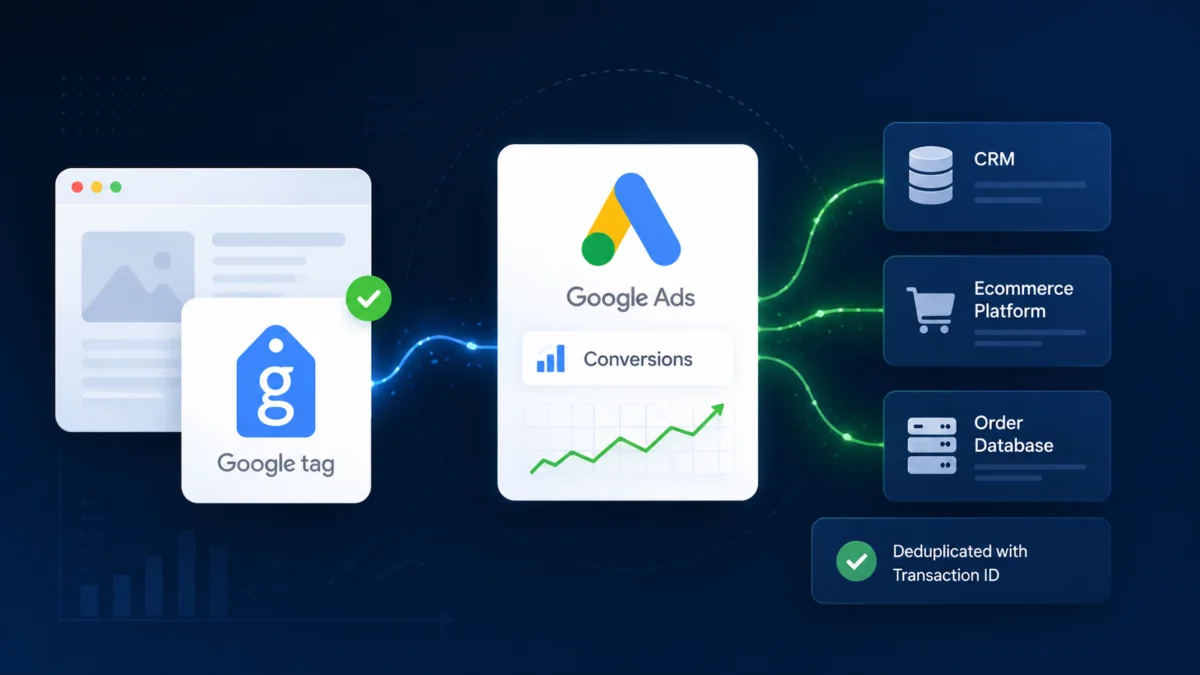
In an era defined by tightening privacy regulations, browser-level tracking restrictions, and the gradual deprecation of third-party cookies, digital marketers face unprecedented challenges in accurately measuring campaign performance. To address these blind spots, Google Ads has begun rolling out a new beta feature that allows advertisers to connect backend data sources directly to existing website conversion actions.
By integrating Google tags with offline transaction data from Customer Relationship Management (CRM) systems, order databases, and e-commerce platforms, the feature seeks to provide a unified, resilient measurement framework. This capability is managed through Google Ads Data Manager and the Data Manager API, signaling a major step forward in Google’s efforts to simplify first-party data onboarding for search and performance marketers.
1. Main Facts: The Direct Integration of Tag and Backend Data
The core of this new beta is the ability to supplement—rather than replace—traditional tag-based website measurement with deterministic, backend business data. Historically, advertisers had to choose between relying solely on browser-side tags (which are vulnerable to ad blockers, cookie expiration policies, and browser privacy features like Apple’s Intelligent Tracking Prevention) or setting up complex, separate offline conversion import pipelines.
+------------------------------------------------------------+
|                       Google Tag                           |
|  (Captures real-time browser event & Transaction ID "123") |
+-----------------------------+------------------------------+
                              |
                              v
             +----------------------------------+
             |    Google Ads Conversion Action  | <---+ [Deduplication Engine]
             +----------------------------------+       (Matches on Transaction ID)
                              ^
                              |
+-----------------------------+------------------------------+
|                      Backend CRM                           |
|  (Uploads offline transaction data & Transaction ID "123") |
+------------------------------------------------------------+
Under this new system, the two data streams are merged into a single conversion action. Advertisers can attach an additional first-party data source directly to a pre-existing website conversion action. This allows Google Ads to cross-reference real-time browser events with verified backend transaction records.
Key Capabilities of the Beta:
- Unified Streamlining: Advertisers can feed backend data directly into the same conversion action used for bidding and optimization, eliminating the need to manage separate online and offline conversion goals.
- First-Party Data Onboarding: Integration is facilitated natively through Google Ads Data Manager or programmatically via the Data Manager API, supporting direct connections to platforms like Salesforce, HubSpot, Shopify, and cloud data warehouses like Google Cloud BigQuery.
- Deterministic Deduplication: To prevent the double-counting of conversions, Google employs a deduplication engine driven by unique Transaction IDs.
2. Chronology: The Evolution of Google’s Conversion Measurement
To understand the significance of this beta, it is necessary to examine the historical trajectory of Google’s tracking technologies over the past decade. The transition from simple browser-side cookies to integrated first-party data pipelines reflects a broader industry shift toward privacy-first advertising ecosystems.
[2012] Google Tag Manager Launched
  │  (Simplified browser-side tag deployment)
  ▼
[2017] Global Site Tag (gtag.js) Introduced
  │  (Unified tracking across Google Ads and Google Analytics)
  ▼
[2021] Enhanced Conversions Rolled Out
  │  (Secure hashing of first-party user data in the browser)
  ▼
[2023] Google Ads Data Manager Announced
  │  (Centralized hub for managing first-party data connections)
  ▼
[2024] Website Conversion Data Integration Beta
(Directly merging backend CRM/database records with active web tags)- 2012–2017: The Era of Browser-Side Dominance. Marketers relied heavily on basic conversion pixels and the deployment of Google Tag Manager (GTM) to track actions directly in the user’s browser. Third-party cookies tracked users across domains with minimal friction.
- 2017–2020: The Rise of Privacy Initiatives. Apple introduced Intelligent Tracking Prevention (ITP) in Safari, severely limiting the lifespan of first-party cookies and blocking third-party tracking. Google responded by introducing the Global Site Tag (
gtag.js) to consolidate first-party measurement. - 2021: The Introduction of Enhanced Conversions. To combat deteriorating cookie matching, Google launched Enhanced Conversions. This feature allowed tags to capture user-provided data (like email addresses or phone numbers), hash it using the SHA-256 algorithm, and send it to Google to improve attribution matching.
- Late 2023: The Debut of Google Ads Data Manager. Recognizing that managing first-party data was highly fragmented, Google introduced the Data Manager. This consolidated interface designed to simplify the pipeline between data warehouses, CRMs, and Google Ads, reducing the need for extensive developer resources.
- Late 2024: The Launch of the Website Conversion Data Integration Beta. Building on the Data Manager infrastructure, Google introduced this beta. Rather than treating offline imports and online tags as separate measurement strategies, this update allows them to function as a singular, self-deduplicating loop.
3. Supporting Data & Technical Specifications
To implement this beta successfully, advertisers must adhere to strict data structures and operational guidelines. Understanding these requirements is critical to preventing reporting discrepancies and maintaining data integrity.
Data Deduplication Mechanics
When a user completes a purchase on a website, the Google tag fires, capturing a unique transaction_id. Simultaneously, the transaction is recorded in the merchant’s backend database. When the merchant uploads their backend database records to Google Ads, the deduplication engine evaluates both inputs.
- If the system detects matching Transaction IDs within the same conversion action, it merges the data points, enriching the tag-recorded conversion with any additional backend values (such as verified margin or shipping status).
- If a conversion was missed by the browser tag (e.g., due to an ad blocker) but is present in the backend upload with an associated attribution identifier, Google reconstructs the conversion event, recovering lost attribution.
Supported vs. Unsupported Configurations
The beta is structured to work with specific campaign setups. The table below outlines where the feature can and cannot be applied:
| Supported Configurations | Unsupported Configurations |
|---|---|
Website conversion actions using the Google tag (gtag.js) |
App conversion actions (Firebase, SDK-based) |
| Implementations managed via Google Tag Manager (GTM) | Phone call conversion actions |
| E-commerce transactions containing unique Transaction IDs | Offline-only conversion actions with no corresponding web tag |
| Direct CRM connections via Google Ads Data Manager | Third-party tag managers not mapped to Google tags |
Data Formatting and Upload Requirements
To ensure seamless processing, every uploaded dataset must include specific fields. The system will reject uploads that fail to meet these parameters:
Required Upload Fields:
├── Transaction ID (Unique alphanumeric identifier matching the web tag)
├── Conversion Name (Must match the exact name of the website conversion action)
├── Conversion Time (Timestamp including time zone offset)
├── Conversion Value (Numeric value representing the transaction's worth)
└── Conversion Currency (ISO 4217 three-letter code, e.g., USD, EUR, GBP)
In addition to the fields above, advertisers must provide at least one attribution identifier to link the offline transaction back to an ad interaction:

- Hashed Customer Information: SHA-256 hashed email addresses or phone numbers.
- Google Click Identifier (GCLID): The click tracking parameter appended to URLs from Google Ads.
- Device Identifiers: GBRAID or WBRAID (for mobile app-to-web conversions).
Recommendation: Google advises uploading backend data as close to real-time as possible—ideally within 24 to 48 hours of the transaction—to ensure the data is highly actionable for Smart Bidding algorithms.
4. Official Responses and Strategic Rationale
According to documentation released by Google, the primary motivation behind launching this integration is to provide a "more complete picture of conversions" that directly feeds into the platform’s machine learning systems.
Google’s product engineers have noted that as machine-learning-driven bidding strategies (such as Target CPA and Target ROAS) become standard, the quality of the input data dictates the efficiency of the output. When browser tags fail to record conversions, bidding models operate on incomplete information, which can drive up customer acquisition costs (CAC).
Why Google Launched It:
- Algorithmic Fuel: Providing Smart Bidding with a comprehensive, verified dataset ensures that budget allocation is optimized based on actual business outcomes rather than volatile browser sessions.
- Operational Simplification: Historically, syncing offline data required custom developer pipelines or expensive middle-tier integration tools. Google Ads Data Manager seeks to democratize this access.
- Addressing Signal Loss: With global privacy frameworks (such as GDPR, CCPA, and DMA) restricting consent paths, this hybrid approach helps brands extract maximum utility from their consented, first-party customer databases.
Industry analysts have noted that this move is also a competitive response to Meta’s Conversions API (CAPI). Meta’s CAPI has long allowed advertisers to share web and offline events directly from their servers to improve ad personalization and measurement. Google’s new beta offers a comparable native server-to-server and database-to-ad-platform bridge, reducing reliance on client-side browser execution.
5. Implications for Marketers and the AdTech Ecosystem
The rollout of this beta has broad implications for digital marketing strategies, resource allocation, and privacy compliance.
1. Precision in Smart Bidding and ROAS Calibration
When conversion data is lost to ad blockers or cookie expiration, Google’s automated bidding algorithms may assume a campaign is underperforming and prematurely lower its bids. By injecting verified backend data back into the primary conversion action, advertisers can restore lost conversion volume. This signal restoration ensures that machine learning models bid aggressively on search queries and audiences that drive actual business value.
2. Streamlining the Tech Stack
Historically, linking CRM systems to Google Ads required complex middleware solutions (such as Zapier or custom API integrations) that mapped offline conversions to unique offline conversion actions. This created messy accounts with duplicated conversion goals (e.g., "Purchase – Web" and "Purchase – CRM"). By allowing direct, deduplicated injection into a single conversion action, Google is simplifying the measurement setup, saving development hours, and reducing third-party software costs.
3. Compliance and the First-Party Data Mandate
As third-party identifiers fade, first-party data is becoming a primary source of competitive advantage. However, leveraging first-party data requires rigorous adherence to privacy regulations. Advertisers using this beta must ensure that the customer data they upload (such as emails or phone numbers) is collected with appropriate user consent, particularly in regions governed by strict privacy frameworks like the European Union’s Consent Mode v2.
4. Moving Toward Value-Based Bidding (VBB)
Many e-commerce and lead-generation businesses struggle with returns, cancellations, or fluctuating order values that occur after the initial web tag has fired. By linking backend databases directly to the conversion action, advertisers can adjust transaction values post-purchase. This capability lays the groundwork for advanced Value-Based Bidding (VBB) strategies, where campaigns are optimized for long-term profit margins and customer lifetime value (CLV) rather than simple, top-line revenue numbers.
As this beta progresses toward general availability, search engine marketing (SEM) professionals and data engineers should collaborate to evaluate their readiness. Establishing clean, automated pipelines from internal databases to Google Ads Data Manager will likely be a key operational differentiator for brands looking to maintain measurement accuracy in a privacy-first world.
 Nana Muazin
  Layla Zulfa