
 By Evan Lee Salim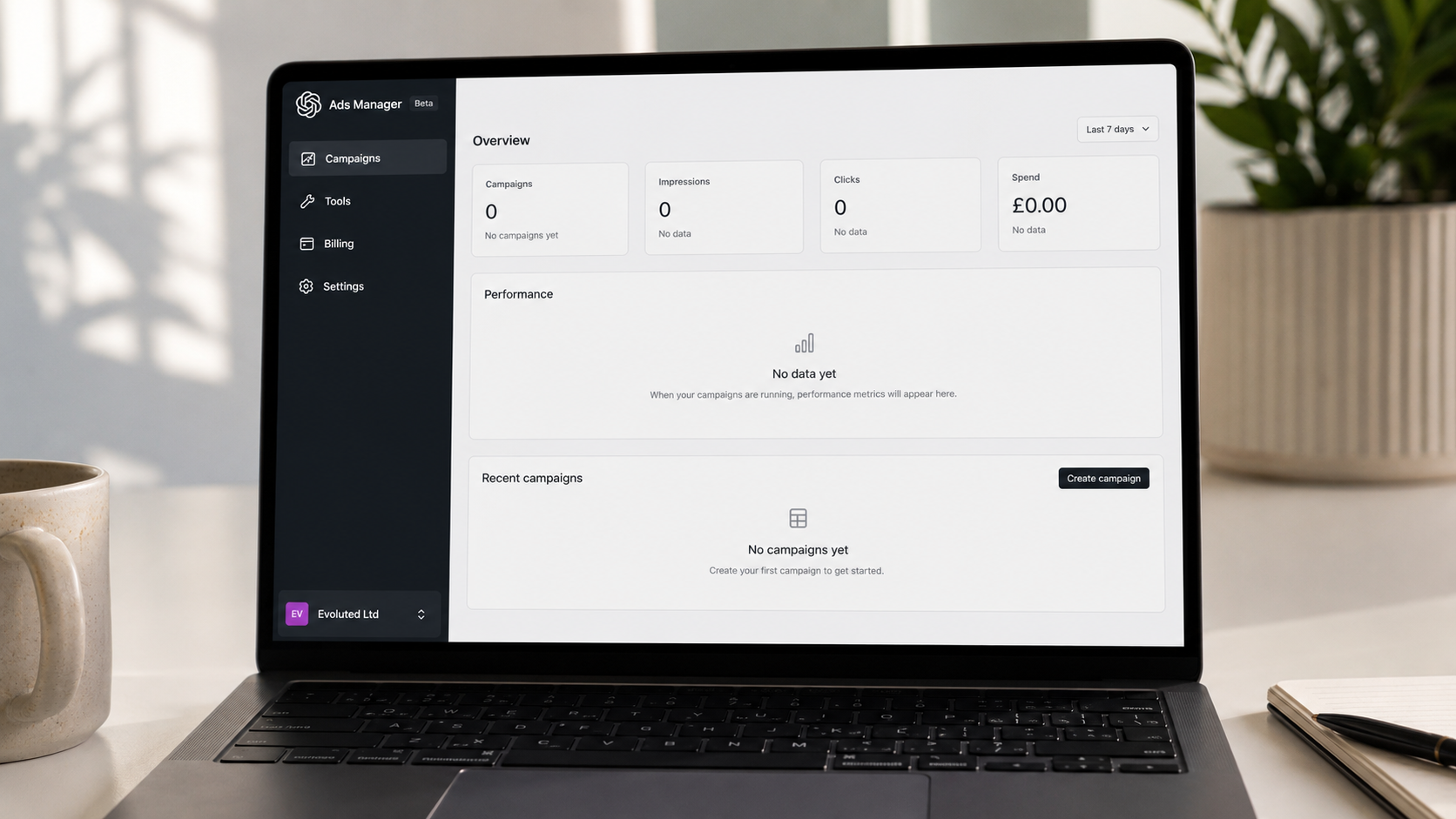
OpenAI has quietly initiated the rollout of a self-serve Ads Manager Beta for businesses in the United Kingdom. This represents a watershed moment in the monetization strategy of the world’s leading generative artificial intelligence company, signaling a transition from a subscription- and API-heavy revenue model to a highly scalable, digital advertising infrastructure.
By offering early access to UK-based advertisers, OpenAI is building the operational foundation required to challenge the long-standing search and social media advertising duopoly of Google and Meta. The launch, first spotted by digital marketing professionals, introduces a dedicated dashboard designed to let businesses experiment with campaign structures directly within the ChatGPT ecosystem.
1. Main Facts: Inside the OpenAI Ads Manager Interface
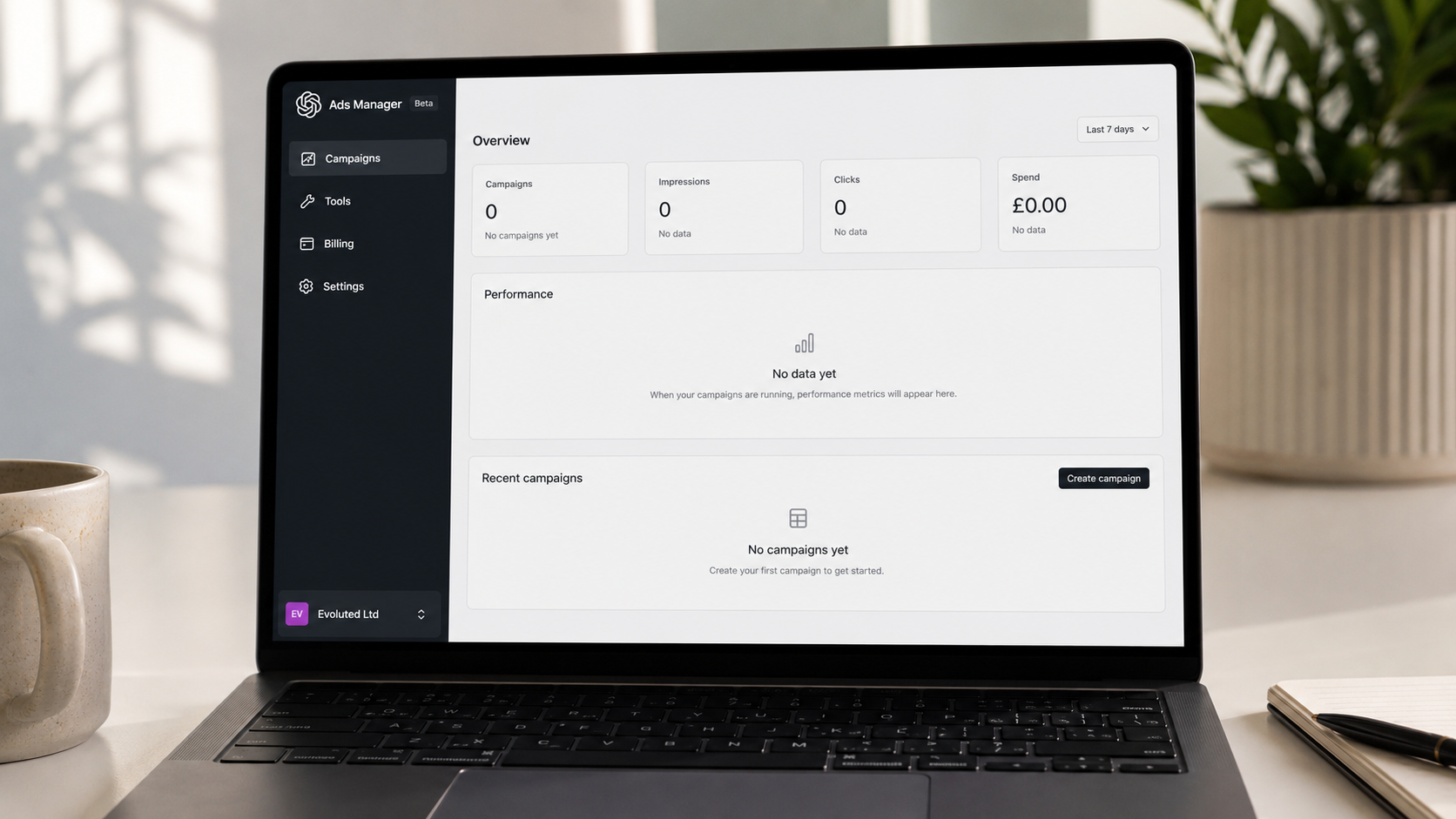
The rollout of the Ads Manager Beta provides a first look at the technical and structural design OpenAI is employing to attract digital marketers. Rather than reinventing the wheel, OpenAI has opted for a highly standardized user interface that mimics the workflows of established ad networks, thereby minimizing the learning curve for incoming performance marketers.
The Dashboard Architecture
The Ads Manager dashboard is structured around four primary administrative pillars:
- Campaigns: The central workspace where advertisers will eventually build, target, and monitor their promotional efforts.
- Tools: A section dedicated to auxiliary resources, which industry observers expect will eventually house audience builders, keyword/topic planners, and pixel tracking management.
- Billing: The payment processing and invoicing center.
- Settings: The administrative hub for account configuration, security, and user permissions.
By structuring the platform this way, OpenAI is signaling to digital agencies and in-house marketing teams that its advertising ecosystem will align with the programmatic and direct-response standards they already use.
[OpenAI Ads Manager Dashboard]
 ├── Campaigns (Creation, Targeting, Performance Metrics)
 ├── Tools (Audience Builders, Tracking, Asset Libraries)
 ├── Billing (Invoicing, Payment Methods, Budget Controls)
 └── Settings (User Access, Permissions, Business Verification)
Frictionless Onboarding and Administrative Limits
To accelerate adoption, OpenAI has removed several initial barriers to entry. Businesses can create an ad account and explore the platform’s interface without being forced to input upfront billing information or commit to minimum spend thresholds. This low-friction onboarding is designed to encourage widespread exploration and familiarity before active ad serving begins.
However, the beta currently lacks the sophisticated administrative frameworks required by larger agencies. Most notably, there is no centralized Manager Account (commonly known as a My Client Center or MCC in Google Ads).
Currently, advertisers and agency partners cannot view or manage multiple distinct client accounts from a single, unified dashboard. Instead, users must manually toggle between individual accounts.
Strict Guidelines for Agencies and Freelancers
Recognizing the current lack of a multi-tenant agency architecture, OpenAI has issued explicit guidelines to agencies and freelancers regarding account creation:
- Client Ownership: Agencies are instructed not to create ad accounts on behalf of their clients under the agency’s own credentials.
- Client-Initiated Setup: The client business must establish its own native OpenAI Ads Manager account first.
- Invitation Workflow: Once the account is created, the client must invite the agency or freelance partner as an authorized user via the settings menu.
- Account Switching: Once the invitation is accepted via email, the external marketer can access the client’s dashboard using their own credentials, switching between client spaces through the user profile menu.
2. Chronology: From Non-Profit Research to Commercial Ad Platform
To understand the gravity of this release, it is necessary to trace how OpenAI’s corporate structure and commercial ambitions have evolved since its inception.
2015: OpenAI founded as a non-profit research laboratory.
  │
2019: Transition to a "capped-profit" model; $1B Microsoft partnership.
  │
2022 (Nov): ChatGPT launches, reaching 100M monthly users in two months.
  │
2023: Launch of ChatGPT Plus ($20/month subscription model).
  │
2024 (Mid): SearchGPT prototype announced; search capabilities integrated into ChatGPT.
  │
2026 (Jan): Quiet rollout of self-serve Ads Manager Beta to UK businesses.
The Non-Profit Origins (2015–2018)
OpenAI was founded in December 2015 as a non-profit artificial intelligence research laboratory. Its stated mission was to build safe and beneficial artificial general intelligence (AGI). During this early phase, commercialization—and advertising in particular—was entirely absent from the company’s roadmap.
The Pivot to Capped-Profit and Microsoft Partnership (2019–2021)
In 2019, realizing that the immense computational power required to train large language models (LLMs) could not be funded solely through philanthropic donations, OpenAI transitioned to a "capped-profit" model. This structural shift paved the way for a $1 billion initial investment from Microsoft, which secured the computing infrastructure of Azure to train OpenAI’s models.
The Consumer Breakthrough and Subscription Era (2022–2023)
The launch of ChatGPT in November 2022 altered the trajectory of consumer technology, reaching an estimated 100 million monthly active users within just two months. To offset staggering API and computing costs, OpenAI introduced "ChatGPT Plus" in early 2023—a $20-per-month premium subscription model. This was followed by the launch of enterprise-grade subscriptions and an API marketplace for developers.
The Convergence of Search and Ads (2024–Present)
As competitors like Google (with Gemini) and Perplexity AI began integrating real-time search and monetization models, OpenAI recognized that subscriptions alone could not sustain its multi-billion-dollar infrastructure costs.
In mid-2024, the company announced its "SearchGPT" prototype, signaling a direct challenge to traditional search engines. By late 2024 and early 2025, these real-time web search capabilities were fully integrated into the core ChatGPT interface.
The launch of the UK Ads Manager Beta in early 2026 represents the logical next step: monetizing those search queries and conversational interactions through targeted advertising.
3. Supporting Data: The Financial and Market Forces Driving the Launch
The decision to build an advertising infrastructure is driven by clear economic realities. While subscription software-as-a-service (SaaS) models provide predictable recurring revenue, they capture only a fraction of the global digital spend compared to advertising.
The Cost of AI Search vs. Traditional Search
Traditional database searches (like Google’s index lookup) are computationally inexpensive, costing a fraction of a cent per query. In contrast, generative AI searches require massive inference workloads on expensive graphics processing units (GPUs).
| Search Type | Estimated Cost Per Query | Computational Intensity |
|---|---|---|
| Traditional Keyword Search | ~$0.003 | Low (Database Index Lookup) |
| Generative AI Search (LLM) | ~$0.01 – $0.03 | High (GPU Inference & Synthesis) |
Source: Industry analyst estimates of computational overhead.
To cover this 10x increase in operational costs, OpenAI requires a highly lucrative monetization model. Historically, advertising has yielded the highest average revenue per user (ARPU) in consumer tech.
The Scale of the Addressable Market
By entering the digital ad market, OpenAI is positioning itself to capture a portion of a rapidly growing global industry:
- Global Digital Ad Spend: Expected to exceed $740 billion by the end of 2026.
- Search Advertising Market: Accounts for over $220 billion globally, a market historically dominated by Google (holding roughly 90% market share).
- ChatGPT’s User Base: Boasting over 250 million weekly active users, ChatGPT has the critical mass of attention required to attract enterprise-level ad budgets.
If OpenAI can convert even 5% of its conversational queries into sponsored interactions, it stands to unlock a multi-billion-dollar high-margin revenue stream that can directly subsidize its ongoing AGI research and development.
4. Official Responses and Industry Reactions
The initial discovery of the Ads Manager Beta did not come through a formal OpenAI press conference, but rather through the digital marketing community itself.
The Discovery
The platform’s existence was first brought to light by Chris Ridley, Head of Paid Media at the UK-based digital agency Evoluted. Ridley received an official communication from OpenAI announcing the availability of the platform and shared screenshots of the invitation and dashboard layout on LinkedIn.
The marketing community quickly reacted to the news, with performance marketers expressing enthusiasm for a new, highly intent-driven channel, alongside reservations regarding the early-stage limitations of the platform.
Industry Commentary
Digital marketing experts point out that OpenAI’s entry into self-serve ads is a direct response to moves made by rival AI search engine Perplexity, which began rolling out sponsored follow-up questions in late 2024.
"What we are seeing is the professionalization of AI search space," noted one performance marketing director. "Up until now, advertising in AI was theoretical or limited to manual, high-ticket sponsorship deals. By building a self-serve manager, OpenAI is opening the floodgates to small and medium-sized businesses (SMBs), which make up the backbone of Google’s ad revenue."
OpenAI’s Strategic Silence
OpenAI has kept public commentary on the Ads Manager Beta to a minimum, preferring a quiet, phased rollout to gather system feedback and assess user experience.

In past statements, CEO Sam Altman has acknowledged that while he personally dislikes intrusive advertising, any platform aiming to provide free or low-cost services at global scale must eventually embrace advertising as a core business pillar to remain accessible to all socioeconomic demographics.
5. Strategic Implications: Shaking Up the Search and Media Landscape
The introduction of an Ads Manager by OpenAI has profound implications for digital marketing strategies, the competitive landscape of Silicon Valley, and the overall user experience of conversational AI.
                  ┌──────────────────────────────┐
                  │    OpenAI Ads Manager Beta   │
                  └──────────────┬───────────────┘
                                 │
         ┌───────────────────────┼───────────────────────┐
         ▼                       ▼                       ▼
┌─────────────────┐     ┌─────────────────┐     ┌─────────────────┐
│  For Agencies   │     │  For Big Tech   │     │  For Users/UX   │
│ • No MCC yet    │     │ • Google threat │     │ • Threat to trust│
│ • Client setup  │     │ • Meta rival    │     │ • Conversational│
│ • First-mover   │     │ • Ad spend shift│     │   integration   │
└─────────────────┘     └─────────────────┘     └─────────────────┘
The Existential Threat to Google Search Dominance
For over two decades, Google’s business model has relied on users clicking links on a Search Engine Results Page (SERP). ChatGPT bypasses the SERP entirely by synthesizing information and delivering a single, cohesive answer.
If OpenAI can successfully integrate ads into this conversational flow—such as sponsored recommendations, contextually relevant brand mentions, or sponsored follow-up prompts—it could redirect a significant portion of high-intent search traffic away from Google.
The Tracking, Attribution, and Measurement Challenge
One of the most critical hurdles OpenAI faces is attribution. Traditional digital advertising relies on cookies, tracking pixels, and clear click-through rates (CTR) to prove return on ad spend (ROAS).
In a conversational interface, user interactions are highly fluid:
- How will OpenAI measure the value of a brand mentioned during a 10-minute dialogue?
- Will advertisers pay on a Cost-Per-Click (CPC) basis, or will OpenAI introduce new metrics, such as Cost-Per-Response (CPR) or Cost-Per-Mention (CPM)?
- How will privacy regulations like GDPR in Europe and the UK’s Data Protection Act impact OpenAI’s ability to target users based on their deeply personal chat histories?
These technical questions must be resolved before the platform can attract significant portions of enterprise performance budgets.
The Agency Workflow Bottleneck
For agencies, the current lack of a centralized Manager Account (MCC) is a major operational hurdle. Managing dozens of clients requires seamless access control, unified billing, and cross-account reporting.
Until OpenAI develops an enterprise-grade agency partner portal, adoption among large media-buying agencies will likely remain limited to experimental, low-budget test campaigns.
The Delicate Balance of User Experience (UX)
The primary asset OpenAI possesses is user trust. Consumers turn to ChatGPT because they perceive its answers to be objective, direct, and free from the clutter of traditional SEO-optimized web pages.
If ChatGPT begins prioritizing sponsored brands over objective information, it risks alienating its core user base. OpenAI’s product designers face the difficult task of integrating ads in a way that feels organic and genuinely useful, rather than disruptive and biased.
What to Watch Next
As the UK beta progresses, global marketers should keep a close eye on several key developments:
- Ad Formats: Will OpenAI opt for sponsored links, rich media card integrations, or conversational prompts that guide users toward a brand’s service?
- Targeting Capabilities: How will OpenAI leverage real-time user intent without violating privacy policies? Will advertisers be able to target specific user prompts, user demographics, or conversational topics?
- US and Global Expansion: When will the beta expand to the United States and other major European and Asian markets?
- API Monetization: Will third-party developers building on OpenAI’s API be able to plug into this ad network to monetize their own custom GPTs and applications?
The UK rollout of the Ads Manager Beta is not just a feature release; it is the first blueprint of OpenAI’s long-term commercial engine. While the platform is currently in its infancy, its development marks the official start of the conversational AI advertising era.
 Jia Lissa
  Nana Muazin
  Layla Zulfa