
 By Lina Hope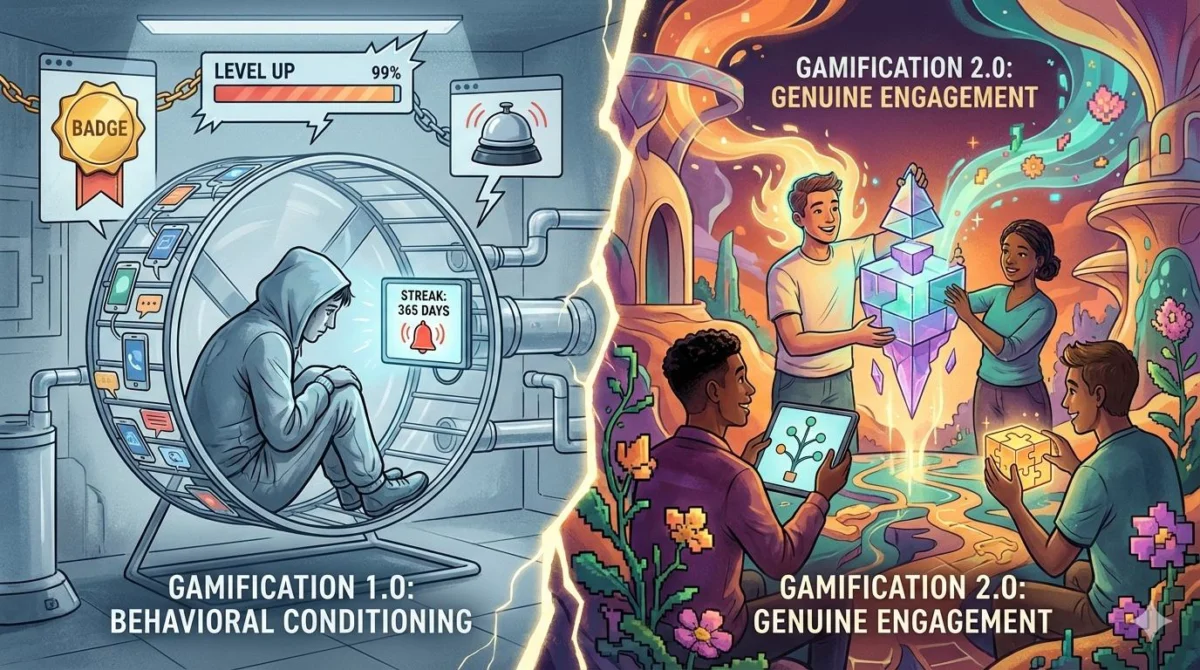
In the modern digital landscape, the term "gamification" has become a hollow incantation—a magic word invoked by product managers and growth hackers to conjure engagement out of thin air. From the persistent notification pestering you to maintain a language-learning streak to the hollow satisfaction of a professional social media site congratulating you on an "All-Star" profile, the current state of gamification is less of a design revolution and more of a "cargo cult."
We have built the bamboo control towers and fashioned the coconut-shell headphones, yet we are left wondering why the planes of sustainable user retention never land. As the digital economy pivots toward subscription models and high-frequency engagement, this failure of design is not merely an aesthetic annoyance—it is a fundamental misunderstanding of human psychology.
The Anatomy of the Cargo Cult: A Phenomenon of Imitation
The term "cargo cult" originates from post-WWII anthropology, describing indigenous populations who built mock airstrips in the hope that their ritualistic imitations would summon the return of supply-laden aircraft. In the tech industry, the "gamification cargo cult" follows the same logic. Designers look at the surface-level metrics of successful games—leaderboards, badges, progress bars—and assume that these artifacts are the source of the magic.
They are not. They are merely the exhaust of a well-designed engine.
Consider the trajectory of most "gamified" apps today:
- The Launch Phase: An influx of users is driven by novelty and the dopamine hit of early, easily earned rewards.
- The Theater Phase: Designers double down on "engagement" mechanics, introducing streaks, daily logins, and tiered status levels to simulate progress.
- The Abandonment Phase: Users realize the "game" provides no intrinsic value. The rewards are meaningless, the tasks are repetitive chores, and the device or app ends up collecting dust in the digital drawer.
This cycle is pervasive. It is the product of teams that have never shipped a title, never managed a game economy, and never understood the visceral, long-term pull of interactive entertainment.
A Legacy of Failure: Learning from 39 Years of Game Design
The distinction between "gamification" and actual game design is profound. The former is a top-down, behaviorist attempt to manipulate user activity; the latter is a bottom-up, psychological journey designed to foster mastery and agency.
With a 39-year career spanning the development of John Madden Football in 1991 to producing titles at Capcom and navigating the $200 million licensing landscape of Chinese markets, the contrast is stark. The successful games of the last three decades did not rely on guilt-tripping players with "streak reminders." They succeeded because they understood that human beings are naturally curious, achievement-oriented, and social creatures.
True engagement is never coerced. When a player sinks 100 hours into Elden Ring, it is not because they are chasing a badge; it is because they are mastering a complex, challenging, and rewarding system. When someone plays World of Warcraft, they aren’t there for the points; they are there for the social fabric and the sense of belonging. These are intrinsic motivators—the "why" that modern product design so consistently ignores.
The Extrinsic Trap: Treating Users Like Lab Rats
In current product development, the "gamification" toolkit is remarkably shallow. It typically consists of:
- Points: Arbitrary numbers assigned to tasks to simulate value.
- Badges: Digital stickers that confer no status or utility.
- Leaderboards: Competitive metrics that often alienate the bottom 90% of a user base.
- Streaks: A psychological hook designed to induce anxiety over "loss" rather than excitement over "gain."
These mechanics share a fatal flaw: they treat users as subjects in a B.F. Skinner-style behaviorist experiment. The assumption is that if you push the button (the UI) and provide the pellet (a badge), the rat (the user) will continue to perform.
However, modern users are savvy. They have learned to "game the system." They click through tutorials without reading; they check in to apps just to keep a streak alive without actually engaging with the content. They are performing the labor required to appease the algorithm, but they are not finding value in the experience. Once the "novelty" wears off, the performance ends, and the user churns.
The Shift to Gamification 2.0: Designing for Humans
If we are to salvage gamification, we must undergo a radical shift in philosophy. We must pivot from the manipulation of behavior (extrinsic) to the facilitation of satisfaction (intrinsic).
1. From Compliance to Mastery
Most current gamification is about forcing compliance. Gamification 2.0 must be about enabling mastery. If an app teaches a skill, the "game" should be the user’s increasing ability to apply that skill in real-world contexts, not the number of days they’ve tapped a screen.
2. From Metrics to Meaning
Data is a tool for the developer, not a goal for the player. When a system is transparently optimizing for "data collection" rather than user utility—as seen in professional networking platforms—the user feels the cynicism of the design. Meaningful gamification respects the user’s intelligence by offering genuine progression.
3. The Psychology of "Flow"
Instead of badges, designers should study the concept of "flow"—a state of deep immersion where the challenge matches the skill level of the participant. A game that is too easy is boring; a game that is too hard is frustrating. The "gamified" app of the future must adjust its complexity to keep the user in the "Goldilocks zone" of engagement.
Implications for the Tech Industry
The implications of this shift are massive for the software-as-a-service (SaaS) and mobile app sectors. Companies currently pouring millions into the development of superficial reward systems are effectively burning capital.
- Retention over Acquisition: By focusing on intrinsic motivation, companies can build communities rather than just user bases. Long-term retention is a byproduct of value, not a byproduct of notifications.
- Ethical Design: Moving away from "guilt-tripping" mechanics reduces the cognitive load on users, fostering a healthier relationship between technology and the individual.
- Brand Authority: Products that provide genuine, immersive satisfaction naturally create stronger brand loyalty than those that rely on the ephemeral dopamine hits of gamified theater.
Conclusion: A Rescue Mission
This is not a condemnation of the concept of gamification. It is a plea for professional rigor. When designed by those who understand the nuance of human interaction, gamification is not just a marketing gimmick—it is a transformative design language.
The era of the "points, badges, and leaderboards" checklist is ending. As users become increasingly fatigued by the constant, transparent attempts to manipulate their attention, the market will naturally favor platforms that offer genuine satisfaction. The path forward for developers is clear: stop looking for hacks to force engagement, and start looking for the fundamental human drives that make an experience worth having.
We must stop building bamboo control towers. It is time to design for the people who actually want to fly.
 Ammar Sabilarrohman
  Neng Nana
  Sagoh
Sagoh 