
 By Laily UPN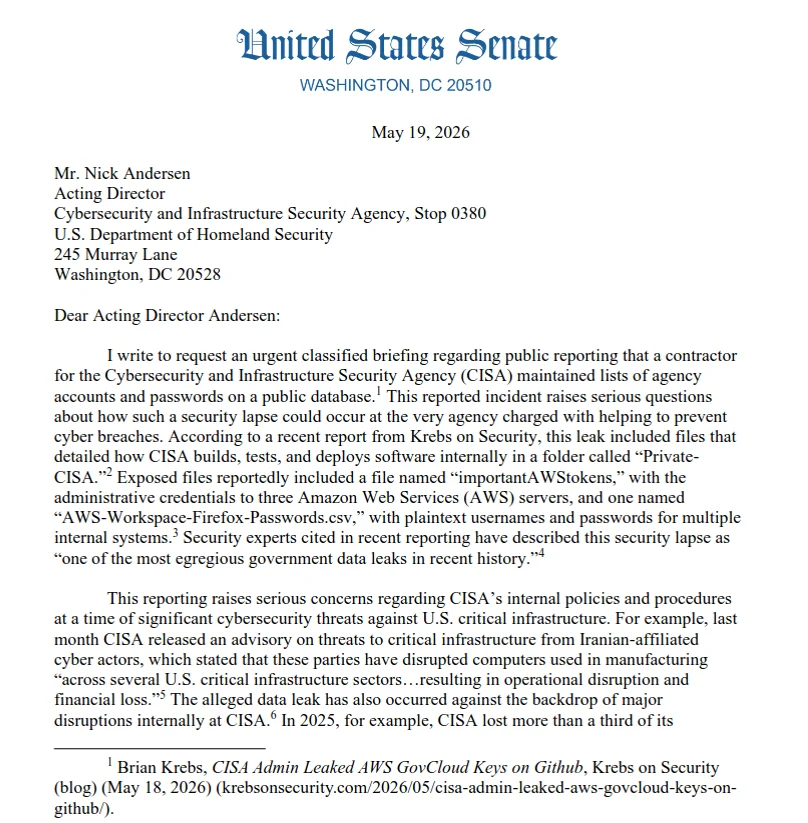
In a development that has sent shockwaves through the national security establishment, the U.S. Cybersecurity & Infrastructure Security Agency (CISA)—the very entity tasked with safeguarding the nation’s digital infrastructure—is currently reeling from a major security breach. Investigations have confirmed that a CISA contractor inadvertently, and in some cases intentionally, exposed a vast trove of sensitive internal credentials, including AWS GovCloud keys, on a public GitHub repository.
As the agency scrambles to contain the fallout, lawmakers in both the Senate and the House of Representatives have launched formal inquiries. The incident has exposed not only potential technical vulnerabilities within the agency but also deep-seated concerns regarding its internal culture and oversight mechanisms during a period of significant administrative transition.
The Genesis of the Breach: A "Private" Repository Goes Public
The security failure centers on a public GitHub repository titled "Private-CISA," which was discovered by security researchers and subsequently reported by KrebsOnSecurity. Forensic analysis suggests the repository was created in November 2025 by a contractor who possessed high-level administrative access to the agency’s internal code development platform.
The repository served as a digital "scratchpad" for the contractor, who used it to synchronize files between work and personal environments. In a move that defied standard cybersecurity protocols, the contractor explicitly bypassed GitHub’s built-in "secret scanning" protections, which are designed to detect and block the accidental uploading of plaintext credentials.
By disabling these safeguards, the contractor paved the way for a catastrophic exposure. The repository contained dozens of plaintext credentials, including access keys for AWS GovCloud—a specialized environment designed to host the most sensitive federal workloads—as well as configuration files, internal bookmarks, and employee passwords.
Chronology of the Incident
- November 2025: The "Private-CISA" GitHub repository is created. It begins to serve as an insecure synchronization mechanism for the contractor.
- April 2026: According to follow-up reporting, the repository gains its most sensitive and critical secrets during this month, significantly increasing the threat profile of the data exposure.
- May 18, 2026: KrebsOnSecurity publicly breaks the story, revealing the extent of the exposed credentials and the contractor’s role in disabling security protections.
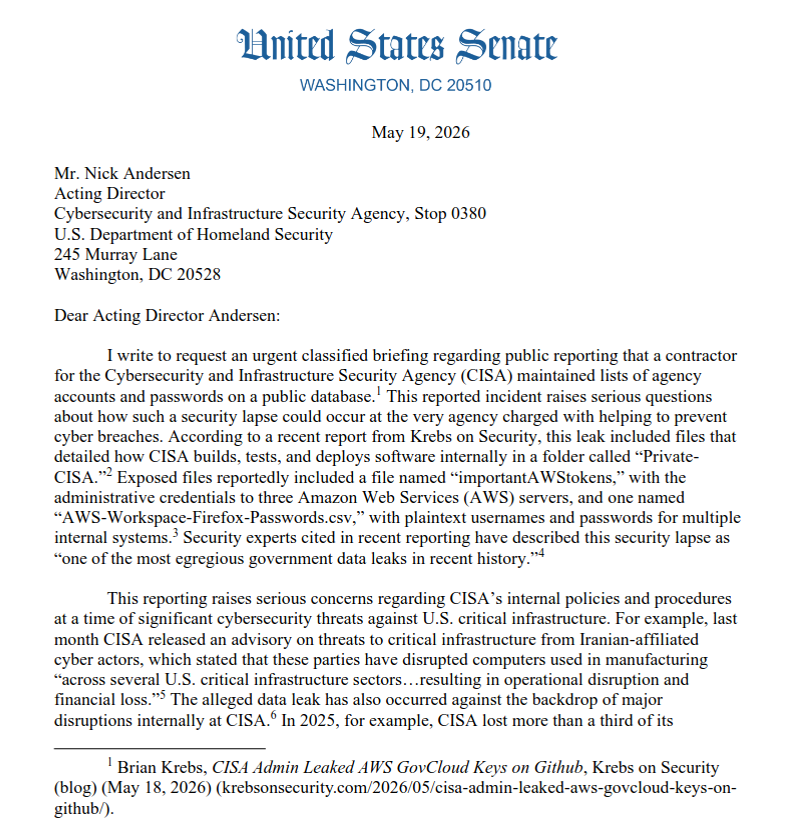
- May 19, 2026: Sen. Maggie Hassan (D-NH) issues a formal letter to CISA Acting Director Nick Andersen, demanding an immediate briefing and a full accounting of the breach. Simultaneously, Rep. Bennie Thompson (D-MS) and Rep. Delia Ramirez (D-Ill) co-sign a letter expressing "grave concerns" regarding the agency’s security posture.
- May 20, 2026: Dylan Ayrey, founder of Truffle Security, alerts CISA to an active, unrevoked RSA private key that granted full access to CISA’s enterprise GitHub organization. CISA begins the process of invalidating this specific key following the notification.
- Late May 2026 (Ongoing): CISA continues the arduous process of rotating and invalidating a vast array of leaked credentials, while congressional oversight committees prepare for hearings on the matter.
The Technical Fallout: A Roadmap for Adversaries
The danger posed by this leak cannot be overstated. According to security experts, the "Private-CISA" repository essentially provided a "roadmap" for state-sponsored threat actors to gain persistence within federal networks.
Dylan Ayrey, creator of the open-source security tool TruffleHog, highlighted the severity of the exposed RSA key. "An attacker with this key could read source code from every repository in the CISA-IT organization, including private repositories," Ayrey explained. Furthermore, the key allowed for the registration of rogue self-hosted "runners"—automated machines that execute software builds. By hijacking these CI/CD (Continuous Integration and Continuous Delivery) pipelines, an adversary could have injected malicious code directly into the agency’s software supply chain, potentially compromising systems across the federal government.
The nature of GitHub’s public data "firehose"—a real-time stream of all public commits—means that the window of exposure was not limited to security researchers. Foreign intelligence services, including those from Russia, China, and Iran, are known to monitor these streams with sophisticated automated tools. The fact that this data was available in plaintext suggests that if the information was not already harvested by hostile entities, it was only a matter of time before it was.
CISA’s Response: A Defensive Stance
CISA has officially acknowledged the breach but has remained largely tight-lipped regarding the specific timeline of the exposure. In an initial statement, the agency claimed, "There is no indication that any sensitive data was compromised as a result of the incident."
However, this assessment has been met with skepticism from lawmakers and cybersecurity professionals alike. When pressed on the continued availability of critical keys—such as the RSA token discovered by Ayrey—the agency issued a follow-up statement: "CISA is actively responding and coordinating with the appropriate parties and vendors to ensure any identified leaked credentials are rotated and rendered invalid."
Critics argue that the agency’s response time has been inadequate. Despite being notified by the security firm GitGuardian regarding the breach, reports indicate that several critical credentials remained active for more than a week before the agency took effective action.
Congressional Oversight and Internal Turmoil
The leak has hit CISA at a time of extreme vulnerability. Sen. Maggie Hassan’s letter to Acting Director Nick Andersen highlights a broader narrative of instability within the agency. CISA has recently undergone a massive reorganization following the departure of over one-third of its workforce, including the majority of its senior leadership, due to political buyouts and forced retirements.
"This reporting raises serious concerns regarding CISA’s internal policies and procedures at a time of significant cybersecurity threats against U.S. critical infrastructure," Sen. Hassan wrote.
In the House, Ranking Member Bennie Thompson and Rep. Delia Ramirez have focused their criticism on the management of third-party contractors. Their letter argues that the breach is symptomatic of a "diminished security culture." The lawmakers are demanding to know what vetting processes were in place for the contractor in question and why no oversight mechanism flagged the creation of a repository that explicitly violated agency data-handling policies.
The Human Factor: The Limits of Technical Control
While the immediate focus remains on credential rotation and threat hunting, the incident has reignited a long-standing debate in the cybersecurity community: Can you truly secure an organization against a rogue or negligent employee?
James Wilson, editor for the Risky Business podcast, noted that while organizations can implement top-down policies to prevent the disabling of security features, these are not foolproof. His co-host, Adam Boileau, argued that the problem is fundamentally human, not technical.
"This is a human problem where you’ve hired a contractor to do this work and they have decided of their own volition to use GitHub to synchronize content from a work machine to a home machine," Boileau noted. "I don’t know what technical controls you could put in place given that this is being done presumably outside of anything CISA managed or even had visibility on."
This perspective underscores a terrifying reality for federal agencies: even with the most advanced firewalls and threat-detection systems, the "insider threat"—whether malicious or merely negligent—remains the weakest link in the security chain.
Implications for Federal Cybersecurity
The "Private-CISA" incident serves as a wake-up call for the entire U.S. government. As federal agencies increasingly rely on contractors for software development and IT support, the lack of standardized, enforced security training for these temporary workers is a glaring hole in the national defense.
If an agency tasked with leading the nation’s cybersecurity defense can fall victim to such a rudimentary error, the question arises as to how many other federal departments are harboring similar "shadow" repositories filled with administrative secrets. The fallout from this incident will likely result in:
- Stricter Contractual Requirements: New, ironclad clauses in government contracts requiring mandatory, automated auditing of all developer environments.
- Increased Oversight: Congressional committees are expected to demand regular, unannounced audits of agency code repositories and third-party access logs.
- Cultural Reform: A push to rebuild the expertise lost during the recent leadership exodus, with a focus on restoring the "security-first" culture that CISA was originally built upon.
As the investigation continues, the focus remains on ensuring that the "Private-CISA" saga does not end in a wider exploitation of federal networks. For now, the agency remains in a state of high alert, attempting to clean up the digital footprints left behind by a single contractor’s poor judgment. The incident stands as a sobering reminder that in the world of cybersecurity, the greatest threat often comes from within.
 Sagoh
Sagoh  Evan Lee Salim
  Ammar Sabilarrohman