
 By Pevita Pearce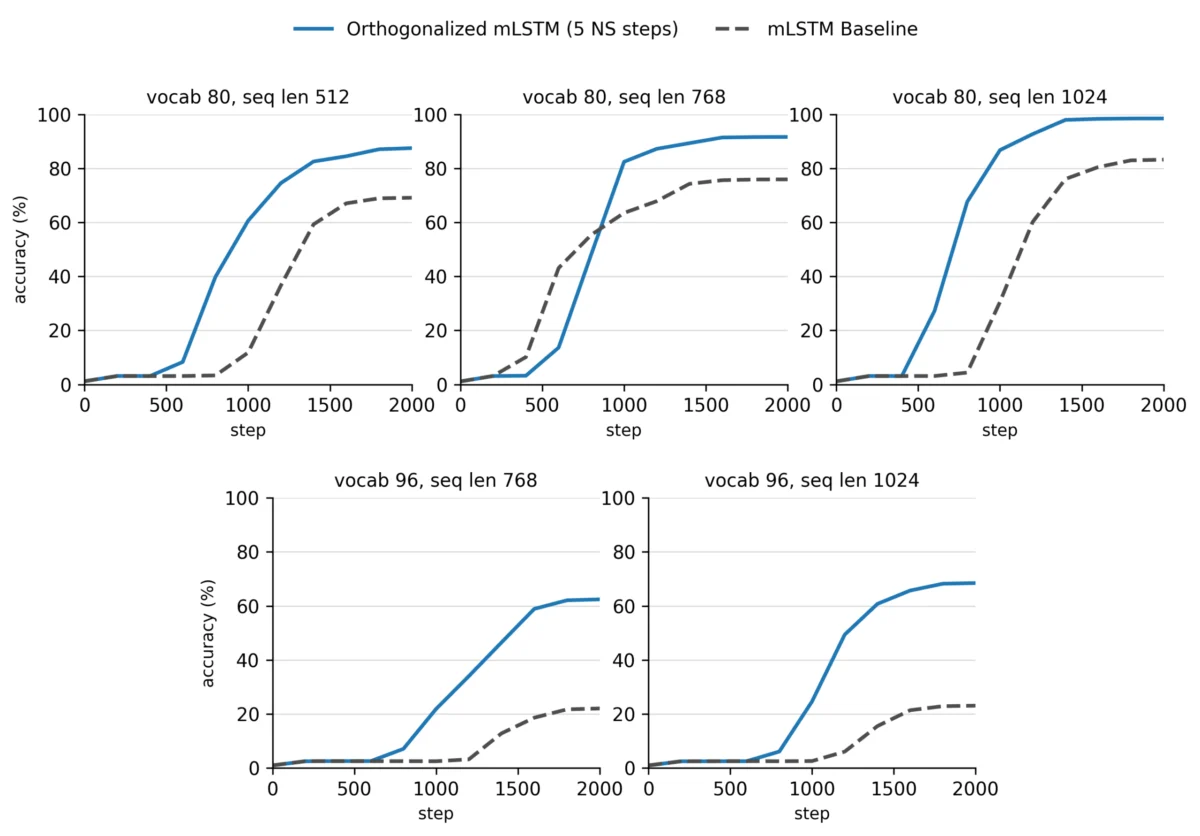
Date: June 30, 2026
Funding: Supported by Paradigm
In the modern era of artificial intelligence, the Transformer architecture has reigned supreme. By utilizing self-attention, Transformers allow every token in a sequence to attend to every other token, enabling a form of "associative recall" (AR) that previous architectures could only dream of. Yet, this supremacy comes at a steep price: quadratic computational overhead. As sequence lengths grow, the cost of attention balloons, making Transformers notoriously inefficient for long-horizon tasks, such as those found in complex reinforcement learning (RL) environments.
For engineers working on high-fidelity, long-term memory applications—like the Dreamer agent—the challenge is clear: we need the recall of a Transformer without the memory-burning cost of quadratic attention. The solution may lie not in inventing a new architecture from scratch, but in refining the "matrix memory" of the Long Short-Term Memory (LSTM) network.
The Quest for Efficient Associative Recall
For years, recurrent neural networks (RNNs) were the industry standard for sequential data, but they struggled with long-term dependencies. The emergence of the mLSTM (matrix-LSTM) has shifted this narrative. Unlike standard LSTMs that store information in a vector, the mLSTM utilizes a matrix memory, allowing it to store more complex, multi-dimensional associations.
Recent evaluations using the MQAR (Multi-Query Associative Recall) benchmark suggest that mLSTMs are significantly more capable than their predecessors. However, pure recall is often a sterile metric. In real-world environments, inputs are rarely clean; they are messy, noisy, and interleaved with irrelevant "distractor" tokens. To truly measure whether an RNN can handle the rigors of an unpredictable world, researchers are now turning to Noisy Associative Recall (NAR).
Understanding the Noisy Challenge
The MAD (Memory-Augmented Dynamics) suite provides a rigorous testing ground for NAR. In a typical MAD task, a model is presented with a stream of data: 0 9 3 10 12 13 15 14 0 9 5 8 2 9.
Here, the model must learn that key 0 maps to value 9. Crucially, it must ignore the distractors—tokens like 12-15 that occupy the space between the key and the value. A model that succeeds in NAR doesn’t just "remember" the sequence; it learns to filter signal from noise. Until now, standard mLSTMs have struggled to maintain this clarity when task complexity increases, often losing the "weaker" memory associations in the face of persistent, noisy updates.
Borrowing from the Optimizer Frontier
The breakthrough in this research was inspired by an unlikely source: Muon, a novel optimizer currently making waves in language modeling. Muon functions by orthogonalizing the momentum matrix, essentially ensuring that the directions in which the model updates its weights are spread out. By preventing a few dominant directions from "crowding out" the rest, Muon allows the model to preserve weaker, more nuanced memories.
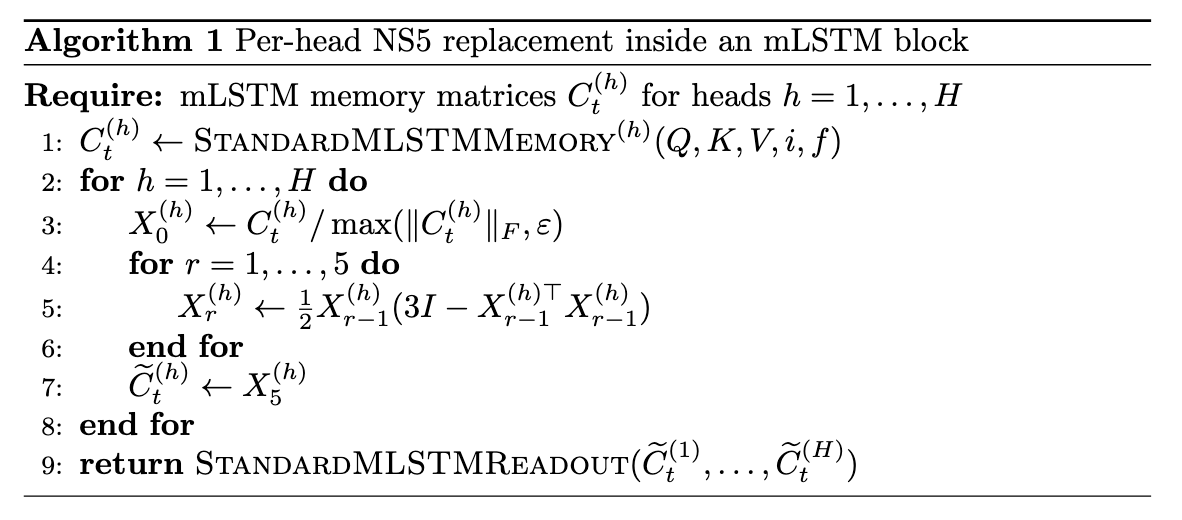
The research team hypothesized that if orthogonalization works for optimizers, it might work for the internal memory state of an mLSTM. By orthogonalizing the mLSTM’s memory matrix during the readout phase, the model is forced to represent its associations in a more balanced, geometric space. This prevents the "memory saturation" that typically plagues RNNs during long-sequence training.
Chronology of the Experimentation
To test this hypothesis, the researchers set up a series of controlled experiments comparing standard mLSTM baselines against their newly "orthogonalized" variants.
- Phase I: Baseline Definition. The team established a performance floor using standard mLSTMs on the MAD noisy-recall task, with
frac_noiseset to 0.8 to ensure a high level of difficulty. - Phase II: The Orthogonalization Implementation. They implemented a process using the Frobenius norm and five Newton-Schulz iterations. Crucially, they chose not to write the orthogonalized matrix back into the model’s recurrent state, discovering that doing so actually degraded performance. The intervention was kept strictly to the readout layer.
- Phase III: Comparative Testing. The models were trained using AdamW across a variety of vocabularies (80 and 96) and sequence lengths (512 to 1024).
- Phase IV: Result Aggregation. The team tracked validation accuracy over 2,000 steps, running 24 seeds per configuration to ensure statistical significance.
Supporting Data: When Small Interventions Yield Large Gains
The results, as illustrated in the experimental data, are compelling. In the "vocab 80" regime, the orthogonalized mLSTM consistently outperformed the baseline, but the real magic occurred in the more difficult "vocab 96" regime.
For sequences of length 1024 with a vocabulary of 96, the baseline model achieved a dismal 23.1% accuracy, with only 4 out of 24 seeds successfully learning the task. In contrast, the orthogonalized model jumped to 68.5% accuracy, with 16 out of 24 seeds reaching successful convergence.
Table 1: MAD Noisy Recall Performance Summary
| Regime | Orthogonalized | Baseline | Delta |
|---|---|---|---|
| Vocab 80, Len 512 | 87.5% | 69.1% | +18.4% |
| Vocab 96, Len 1024 | 68.5% | 23.1% | +45.4% |
These figures indicate that orthogonalization acts as a stabilizer. It does not necessarily change the model’s ceiling in easy tasks, but it fundamentally prevents the model from collapsing in hard, noisy, or long-context environments.
Official Perspectives and Technical Nuance
The research team emphasizes that this is a surgical intervention. By applying Newton-Schulz iterations during the readout, the researchers are trading a marginal increase in FLOPs (floating-point operations) for a massive gain in reliability.
"We are essentially teaching the model to keep its memories ‘orthogonal’ to one another," one lead researcher noted. "In a standard RNN, memories often interfere. By ensuring that the readout vectors are effectively perpendicular, we allow the model to access specific keys without the crosstalk of irrelevant, noisy distractors."
However, the team maintains a degree of professional caution. While the results are striking, they are limited to a synthetic environment (MAD) and relatively small model parameters (~80k). The industry must now ask: does this translate to the massive, multi-billion parameter models that dominate the current AI landscape?
Implications for the Future of AI
The implications of this research are twofold. First, it suggests that the "Transformer-only" era of AI development may be approaching a period of reconsideration. If we can achieve reliable, long-horizon associative recall in RNNs via lightweight algebraic interventions, the computational cost of AI could plummet, opening the door for complex agents that run on edge devices or in high-frequency control loops.
Second, this work highlights the growing importance of "geometric" deep learning. By treating the internal state of a neural network not just as a set of weights, but as a space that can be regularized and constrained through operations like Newton-Schulz iterations, we can squeeze significantly more performance out of existing architectures.
As the community looks toward the next generation of models, the lesson is clear: sometimes, the most effective way to solve a complex problem is to ensure the model’s memory is perfectly organized. Whether this approach holds up in the wild, against the chaotic data of real-world internet-scale training, remains the next great frontier for the research team and their peers.
For those interested in the technical implementation, the source code for the orthogonalized mLSTM experiment is available on the official project GitHub repository.
 rifanmuazin
  Layla Zulfa
  Evan Lee Salim