
 By Muslim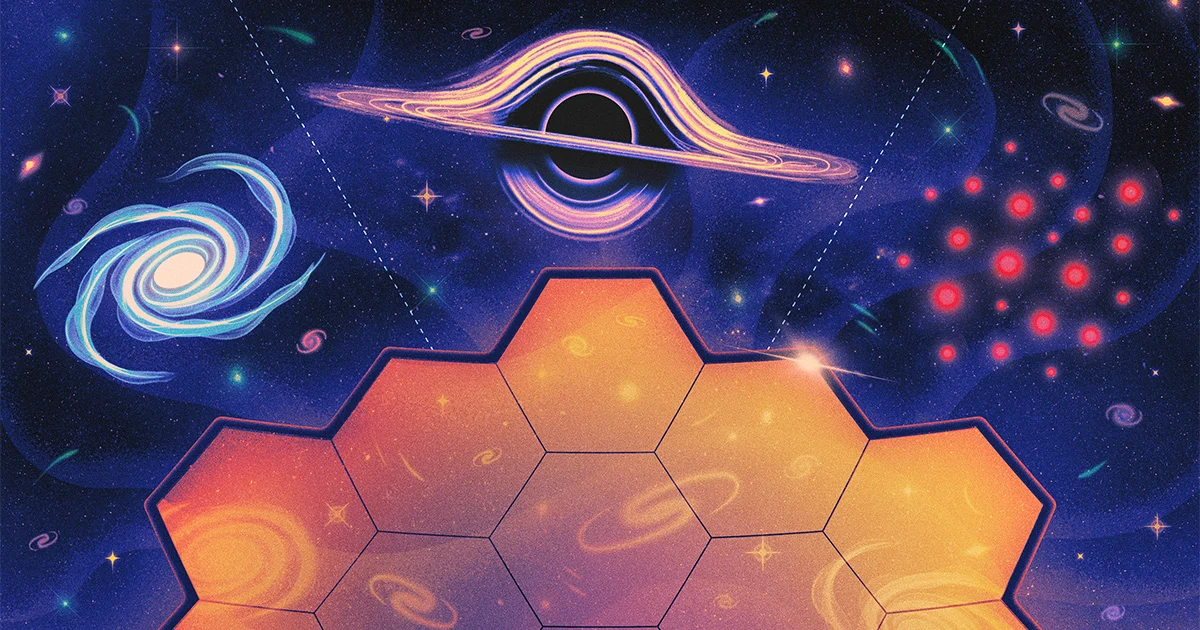
The James Webb Space Telescope (JWST), since its deployment in 2022, has served as a cosmic time machine, peering into the deepest recesses of the early universe. Yet, what it has revealed has caused more than just professional excitement—it has triggered a period of intellectual turbulence. Astronomers are currently grappling with a "crisis of origin," as observations of black holes and galaxies from the first billion years of cosmic history defy the established models of astrophysics. Where we once expected to see the slow, methodical assembly of the cosmos, the JWST has revealed a chaotic, rapid, and surprisingly mature universe, forcing scientists to rethink how the foundational structures of our reality came to be.
The New Frontier: Little Red Dots and Cosmic Anomalies
For astrophysicists like Charlotte Mason of the Cosmic Dawn Center in Copenhagen, the reality of the early universe is currently being scribbled on napkins and whiteboards. Mason has been obsessively studying "little red dots"—perplexing, compact objects that appear in hundreds of JWST images. Appearing roughly 650 million years after the Big Bang, these objects were completely invisible to previous generations of telescopes.
The primary hypothesis is that these dots represent black holes cocooned in thick, obscuring gas. However, the data remains contradictory. While some theorists propose that these objects are "black hole stars"—a theoretical construct where a dense shroud of gas emits light like a stellar atmosphere—the spectral analysis of these dots often fails to match the expected light-scattering patterns of uniform gas clouds. Instead, researchers are now testing models involving "clumpy" gas distributions, suggesting the environment surrounding these early black holes is far more dynamic and chaotic than originally theorized.
Chronology: A Universe That Grew Up Too Fast
To understand the magnitude of this discovery, one must look at the timeline of the early universe. Standard cosmological models suggested a slow "bottom-up" evolution: small dark matter halos gathered gas, which ignited into small, dim stars, eventually merging over billions of years into the massive structures we see today.
- T+200 Million Years: Dark matter halos coalesce, pulling in hydrogen and helium.
- T+280 Million Years: The most ancient galaxies detected by JWST emerge, already displaying surprising brightness and complexity.
- T+550 Million Years: Star formation rates begin to accelerate rapidly, creating established galactic structures far sooner than predicted.
- T+650 Million Years: The emergence of "little red dots," signifying the maturation of dense, high-energy objects.
The "problem" with this timeline is simple: the galaxies and black holes appear far too large and too bright to have formed in such a restricted timeframe. If the universe was "featureless and smooth" shortly after the Big Bang, the current speed of galactic assembly requires a fundamental shift in our understanding of early-universe physics.
The Mystery of the Bottomless Pits
Perhaps the most jarring discrepancy concerns supermassive black holes. Astronomers are observing black holes with the mass of a billion suns existing when the universe was only a few hundred million years old. According to Jenny Greene, an astrophysicist at Princeton University, explaining this growth is a "gymnastics" act of theoretical physics.
The Eddington Limit and the "Back Door"
Historically, black hole growth was constrained by the "Eddington limit"—a theoretical cap on how fast a black hole can feed before the heat of its own accretion disk blows the surrounding gas away. To reach a billion solar masses so quickly, these early black holes would have needed to bypass this limit. Recent computer simulations suggest "super-Eddington" accretion, where the accretion disk puffs up in a way that allows gas to funnel into the black hole at extreme rates, defying the standard radiation-pressure constraints.
The Direct Collapse Mechanism
An alternative, and perhaps more radical, theory is the "direct collapse" model. Instead of forming from the death of a single star, gargantuan clouds of gas may have collapsed directly into a black hole seed as large as 10,000 suns. This requires highly specific, "Goldilocks" conditions: low rotation and precise gas chemistry to prevent the cloud from fracturing into smaller star-forming regions. While researchers have identified a "naked" supermassive black hole—an object 50 million times the mass of the sun without any surrounding galaxy—it remains unclear if this process was common enough to explain the prevalence of such objects.
Diversity in the Cosmic Infancy
The assumptions of uniformity have also been shattered. Using the JWST’s Mid-Infrared Instrument (MIRI), researchers like Hakim Atek of the Paris Institute of Astrophysics have observed an unexpected level of diversity in early galaxies.
"The main surprise is the diversity of the properties of galaxies we are seeing at early epochs," Atek noted. Some galaxies appear to be "naked," having cleared away all their interstellar gas and dust through violent star-forming bursts, while others are teeming with raw materials. Furthermore, the presence of excessive nitrogen in some clusters points to a population of "massive stars" that lived and died with incredible speed, seeding the early universe with heavy elements far faster than traditional chemical evolution models allowed.
Official Responses and Theoretical Shifts
The scientific community is currently in a state of productive, if frantic, revision. At a recent conference in Helsingør, Denmark, over 100 experts gathered to synthesize these findings. The consensus is shifting away from "new physics" (like modified gravity) toward more complex models of early-universe behavior:
- Increased Efficiency: Early galaxies may have been significantly more efficient at converting gas into stars.
- Turbulent Star Formation: Periodic, massive bursts of star formation, rather than steady growth, could explain the observed luminosity.
- Numerical Simulations: Newer, high-resolution simulations are proving more capable of capturing the chaotic environment of the high-redshift universe, helping bridge the gap between observation and theory.
Rachel Somerville, a senior research scientist at the Flatiron Institute, notes that we have moved from having "too few galaxies" to "too many theories." The challenge now is not gathering data, but performing the comparative analysis required to determine which simulations align with the physical reality of the cosmic dawn.
Implications: The Quintessence of Dust
The study of the cosmic dawn is more than an exercise in mapping the stars; it is an investigation into our own lineage. As Lise Christensen of the Cosmic Dawn Center poignantly observed, "We’re looking back at what created us."
The reionization era—the period when the light from the first stars and black holes cleared the "fog" of the universe—was the moment the universe became transparent. It was the birth of the environment that eventually allowed for the creation of planets and, ultimately, life.
Shakespeare, writing in Hamlet, described the firmament as a "foul and pestilent congregation of vapors" and humanity as the "quintessence of dust." Science has now confirmed that he was remarkably close to the truth. We are indeed the progeny of that "golden fire" ignited billions of years ago. The elements that compose our bodies—carbon, oxygen, iron—were forged in the hearts of those first, impossibly massive stars and scattered across the void.
As the James Webb Space Telescope continues to beam back data, the "puzzle of existence" remains open. We are witnessing the infancy of our universe in unprecedented detail, a process that is stripping away our naive assumptions and replacing them with a more complex, volatile, and magnificent reality. For the researchers on the front lines, the uncertainty is not a cause for despair, but for exhilaration. Each new "little red dot" is not just a data point; it is a fragment of the story of how we came to be.
Editor’s note: The Flatiron Institute is funded by the Simons Foundation, which also funds this editorially independent magazine. Simons Foundation funding decisions have no influence on our coverage.
 rifanmuazin
  Layla Zulfa
  Evan Lee Salim