
 By rifanmuazin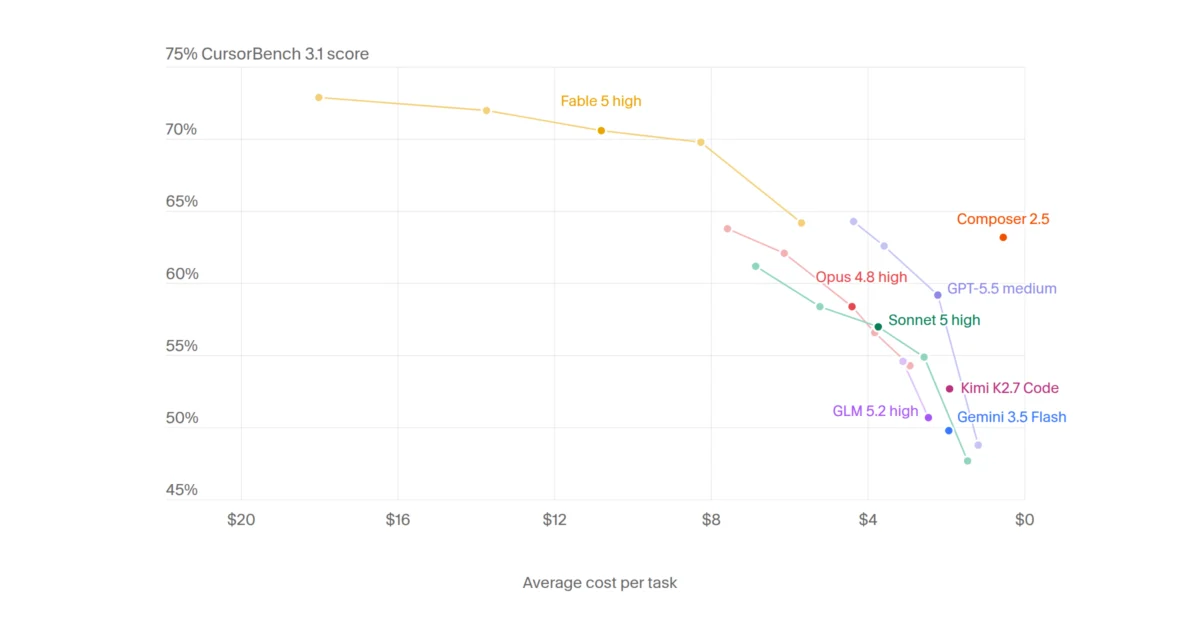
In the rapidly evolving landscape of artificial intelligence, the ability to automate complex software engineering tasks has become the ultimate "North Star" for model performance. As AI agents move from simple chat-based assistants to autonomous entities capable of managing multi-file repositories, the need for standardized, rigorous evaluation has never been more critical. Enter CursorBench 3.1, the latest iteration of the industry’s most demanding performance yardstick, which evaluates AI agents on real-world, ambiguous, and multi-file tasks harvested directly from actual Cursor user sessions.
The results of CursorBench 3.1 provide a fascinating, data-driven window into the current hierarchy of large language models (LLMs) and their proficiency in the nuanced, messy reality of professional software development.
Main Facts: The New Hierarchy of AI Coding
The release of the 3.1 data set has effectively reorganized the leaderboard, establishing new benchmarks for both absolute performance and cost-efficiency. At the top of the mountain sits Fable 5 Max, which secured a top-tier score of 72.9% in the benchmark. It is closely followed by other variations of the Fable 5 series, including the "Extra High" and "High" configurations, which maintain performance metrics consistently above the 70% threshold.
However, the headline isn’t just about raw accuracy. The data highlights a profound tension between computational power and economic viability. While the Fable 5 models dominate the top four positions, they do so at a significant cost, with the "Max" configuration averaging $18.02 per task.
In stark contrast, the emergence of highly efficient, lower-cost models—most notably Composer 2.5—has redefined the "price-to-performance" conversation. With a respectable score of 63.2% and an average cost of only $0.55 per task, Composer 2.5 presents a compelling case for developers seeking a balance between utility and budget management.
A Chronological Evolution of AI Benchmarking
To understand the significance of CursorBench 3.1, one must look at the progression of the benchmark itself. CursorBench was born from the necessity to move beyond synthetic coding challenges like HumanEval or MBPP, which often fail to capture the complexities of real-world software engineering—such as navigating legacy codebases, managing dependency hell, or interpreting vague natural language requirements from developers.
The Shift from 3.0 to 3.1
The transition from version 3.0 to 3.1 marks a pivot toward more "ambiguous" task definitions. In earlier iterations, benchmarks were often structured, providing the agent with clear, well-defined parameters. Version 3.1, by contrast, pulls from actual user sessions where the intent might be unclear, the files are disorganized, and the solution requires a series of iterative, trial-and-error steps.
This chronological shift mirrors the maturation of AI agents themselves. As models have moved from "code completion" engines to "agentic" systems, the testing environment has evolved to force these agents to demonstrate reasoning capabilities, contextual awareness, and the ability to self-correct when an initial approach fails.
Supporting Data: Parsing the Performance Metrics
The data provided in the 3.1 release is extensive, covering 36 distinct model configurations. By plotting the average cost per task against the benchmark score, a clear "efficiency frontier" emerges.
Top Performers and the Cost of Intelligence
The data reveals that there is a diminishing return on investment for high-end models. While moving from the Fable 5 Medium ($8.27) to Fable 5 Max ($18.02) nets an improvement in score from 69.8% to 72.9%, that ~3% gain comes at more than double the cost. For many enterprise applications, the "High" or "Medium" variants offer a more sustainable path to deployment.
Mid-Tier Competitors
The middle of the pack is heavily contested. The Opus 4.8 and GPT-5.5 families occupy the center of the chart. These models typically score between 55% and 64%, providing a reliable baseline for complex refactoring and feature implementation. Interestingly, models like GLM 5.2 and Kimi K2.7 Code are demonstrating that non-incumbent players are rapidly closing the gap, offering performance that rivals long-standing industry leaders at a fraction of the cost.
The "Flash" Revolution
The presence of Gemini 3.5 Flash at a 49.8% score with an average cost of $1.94 signals a shift in the utility of "distilled" or "flash" models. While they may not be the primary choice for complex architectural overhauls, their ability to perform at nearly 50% on these complex, multi-file tasks suggests they are becoming increasingly viable for routine, repetitive coding tasks, such as writing unit tests or generating documentation.
Official Responses and Methodology
The team behind CursorBench has been transparent about the methodology, emphasizing that the "Average Cost per Task" is calculated using a comprehensive aggregate of input, cache read, cache write, and output token pricing. By using published pricing, the benchmark ensures a level playing field for developers trying to estimate their own operational costs.
However, the creators are careful to issue a disclaimer: “Results are subject to variance; small differences in scores may not be statistically meaningful.” This is a crucial admission. In the world of AI, a 1% difference in benchmark score can often be the result of a slightly different prompt structure or even the randomness inherent in temperature-based sampling. The benchmark is intended to be a compass, not a ruler.
Implications for the Future of Software Development
The implications of the CursorBench 3.1 results are profound for three primary groups: developers, engineering managers, and AI model providers.
1. For Developers: The Death of the "One Model Fits All" Era
Developers are learning that the "best" model is context-dependent. The data suggests that for high-stakes architectural decisions, top-tier models like Fable 5 Max are worth the premium. However, for scaffolding, boilerplate generation, or simple bug fixes, the cost-efficiency of models like Composer 2.5 or even lower-tier GPT-5.5 variants is undeniable. The future of coding lies in "model-routing"—using the right tool for the specific task complexity.
2. For Engineering Managers: Economic Sustainability
The wide disparity in costs—ranging from $0.55 to over $18.00 per task—means that AI integration is no longer a fixed line item. Managers must now consider the "per-task" cost as a variable, potentially building systems that automatically select the model based on the complexity of the Jira ticket or GitHub issue. Failure to optimize this could result in massive, unexpected cloud infrastructure bills.
3. For Model Providers: The Pressure to Optimize
The market is clearly punishing models that are both expensive and underperforming. The "Middle-Tier" is becoming a graveyard for models that cannot provide a unique value proposition, whether through superior reasoning or extreme cost-efficiency. Providers are now locked in a race to see who can provide the highest "intelligence per dollar."
Conclusion: The Horizon
CursorBench 3.1 is more than just a list of winners and losers; it is a snapshot of an industry in the middle of a massive transition. We are moving away from the era of "AI as a toy" toward an era of "AI as a professional peer."
The fact that these models are now being evaluated on their ability to handle ambiguous, multi-file tasks—the very bread and butter of a software engineer’s daily life—is a testament to how far the technology has come. As we look toward the future, the next iteration of this benchmark will likely focus on even more complex agentic behaviors, such as the ability to write code that interacts with external APIs, manages deployment pipelines, and maintains long-term state across weeks of development.
For now, the message from the 3.1 results is clear: the bar for AI coding performance has been raised, the costs are being scrutinized, and the competition to become the definitive "AI Co-pilot" of the future has never been more intense. Developers who pay attention to these metrics today will be the ones who best leverage the powerful, automated, and cost-effective coding environments of tomorrow.
 Layla Zulfa
  Evan Lee Salim