
 By Sagoh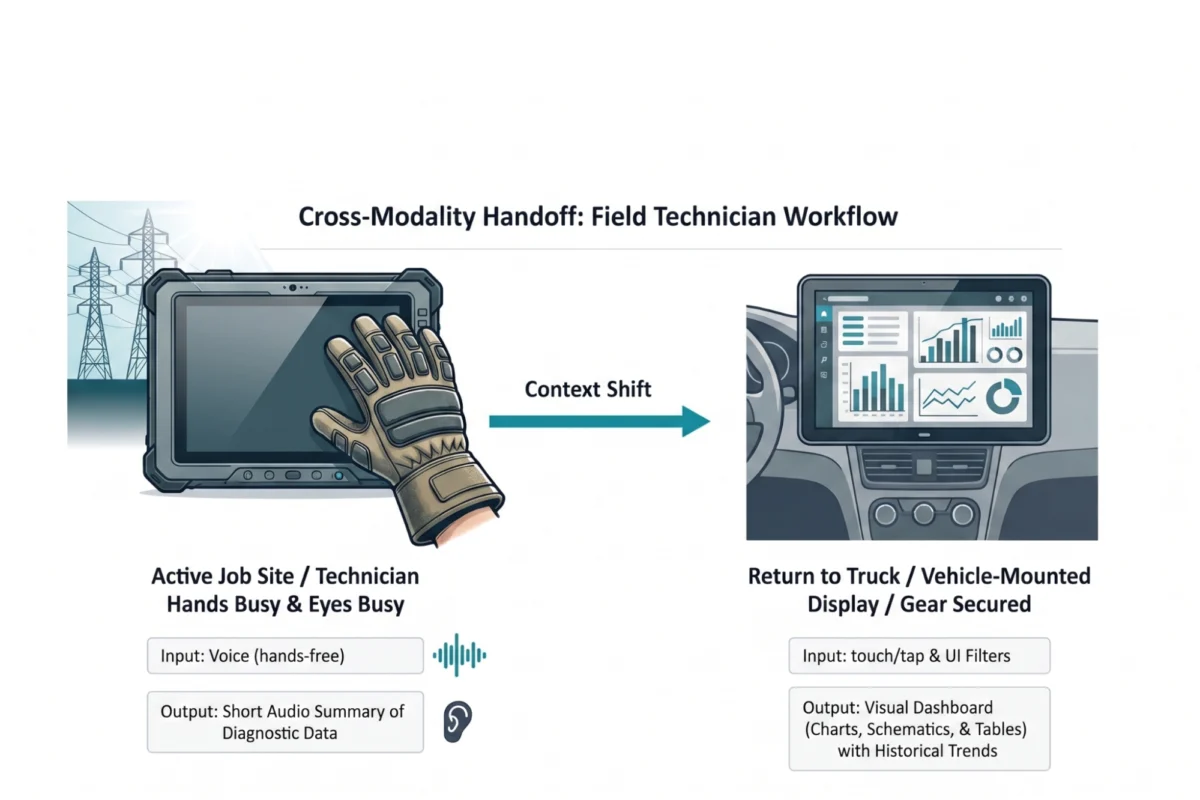
In the rapidly evolving landscape of artificial intelligence, a silent monotony has taken hold of product design. UX teams and developers across industries have fallen squarely into what design researchers call "conversational tunnel vision"—the reflex to default every AI capability into a text-based chat interface.
Because Large Language Models (LLMs) are fundamentally trained on dialogue, the tech sector has collectively decided that the chat bubble is the natural, universal home for every AI feature. But this one-size-fits-all mentality contradicts foundational user experience principles. Great UX is about matching modality to a user’s context, intent, and cognitive load, ensuring the interface adapts to the human, rather than forcing the human to adapt to the machine.
Main Facts: The Crisis of Mismatched Modality
The core issue facing modern AI product design is a widespread failure to align input and output modalities with real-world physical and mental constraints. Modality—the sensory channels through which humans interact with systems, including seeing, hearing, touching, speaking, and typing—dictates how effortlessly a user achieves their goal.
When product teams force complex tasks through a rigid chat interface, they impose a heavy psychological and physical tax.
- Input as a Linguistic Barrier: A blank chat box requires users to translate vague mental models into precise technical prompts, causing choice paralysis and unnecessary friction.
- Output as a Cognitive Burden: Long, scrolling blocks of text shift interpretive work onto the user. Text is a serial medium; forcing a professional to read paragraphs to find a single data point destroys efficiency and induces fatigue.
To escape this loop, product teams must shift from convention-driven design to evidence-based architecture using structured frameworks like the Task Audit and the Input/Output Alignment Matrix.
Chronology: The Evolution and Pitfalls of the Chatbot Era
The dominance of the chat interface did not happen by accident; it evolved alongside generative AI capabilities.
- The Breakthrough of Dialogue Systems (2022–2023): With the explosive public release of LLMs, the chat window emerged as the most intuitive proof-of-concept for text generation, summarization, and open-ended question answering.
- The Proliferation Phase (2023–2024): Organizations rushed to integrate LLMs into legacy systems, blindly wrapping enterprise tools, data analytics dashboards, and mobile utilities inside generic chat windows.
- The Awakening of the UX Community (Late 2024–Present): As user fatigue mounted and productivity gains plateaued in high-stakes environments, design practitioners began documenting the hidden costs of conversational tunnel vision. Case studies from hazardous industrial sectors forced a broader reckoning: the chat bubble is a powerful tool, but it is merely one instrument in a much larger toolkit.
Supporting Data: The High Cost of Cognitive and Physical Friction
Real-world scenarios expose the absurdity of defaulting to chat-based AI. Consider a traveler sprinting through a noisy airport terminal after a sudden gate change. They are dragging a heavy roller bag and balancing a cup of coffee.
When they open their airline app to check gate details, the AI interface fails completely:

- The Input Failure: It forces the user to stop, secure their coffee, and manually type a long booking reference into a tiny chat box.
- The Output Failure: Instead of displaying a high-contrast, glanceable gate number, the system returns a dense paragraph explaining atmospheric weather patterns, burying the vital piece of information at the very bottom.
+-------------------------------------------------------------------------+
|                  THE COGNITIVE SPECTRUM OF MODALITY                     |
+----------------------------------+--------------------------------------+
| INPUT MODALITIES                 | OUTPUT MODALITIES                    |
+----------------------------------+--------------------------------------+
| • Button / Tap (Low effort)      | • Push Notification (Ambient)        |
| • Voice                          | • Audio Summary                      |
| • GUI (Filters, Sliders)         | • Short Text Summary                 |
| • Natural Language Chat          | • Visual Dashboard                   |
| • Multi-modal (Image + Text)     | • Interactive Canvas                 |
| • Gesture (High effort)          | • Inline Confirmation (High effort)  |
+----------------------------------+--------------------------------------+
Data from enterprise deployments demonstrate that aligning modalities with user environments dramatically increases tool adoption. In industrial pilot programs where interface modalities were adapted to user workflows—such as substituting touchscreens with voice commands for gloved workers—diagnostic times dropped by 20%, and daily tool utilization soared.
Official Responses and Frameworks: The Task Audit
To combat conversational tunnel vision, leading UX researchers have introduced rigorous evaluation structures. Organizations are increasingly adopting the Task Audit and the Input/Output Alignment Matrix before writing a single line of code.
1. Contextual Inquiry and Observation
Designers must leave the office to observe users in their natural environments—whether that is a hospital ward, a warehouse floor, or an open-pit utility site. Observation uncovers hidden constraints, such as screen glare, mandatory personal protective equipment (PPE), or high ambient noise levels.
2. Focused Interviews
Structured interviews with end-users map mental models, identifying where verification anxiety or high reading density creates operational risks.

3. The Input/Output Alignment Matrix
By mapping user intent to specific sensory modalities, teams can systematically pair actions with optimal interfaces:
| User Intent | Optimal Input Modality | Optimal Output Modality | Environmental Fit |
|---|---|---|---|
| Quick Status Check | Voice or Single-tap Button | Audio or Push Notification | Hands-busy, Eyes-busy |
| Specific Detail Query | Natural Language Chat | Short Text Summary | Focused, low-density data need |
| Complex Analysis | GUI (Filters, Sliders) | Visual Dashboard | Desk-based, high-resolution screen |
| Creative Generation | Multi-modal (Image + Text) | Interactive Canvas | Design or drafting environment |
| Monitoring / Alert | Passive background system | Push Notification / Audio | Ambient awareness |
| Guided Task Completion | Structured Form / Wizard | Inline Confirmation | Focused workflow needing validation |
Implications: Building the Multi-Modal AI Ecosystem of Tomorrow
The implications of moving beyond conversational tunnel vision extend far beyond aesthetic preferences; they touch on safety, accessibility, and economic efficiency.
When developers treat chat interfaces as optional components rather than default solutions, several positive shifts occur:
- Enhanced Safety in High-Risk Fields: Workers in safety-critical roles—such as high-voltage electrical grid technicians or operating room surgeons—can interact with AI systems via voice or gesture, keeping their hands and eyes focused on immediate physical hazards.
- True Accessibility: Multi-modal design inherently broadens access, providing audio alternatives for visually impaired users and visual dashboards for neurodivergent individuals who struggle with dense blocks of text.
- Reduced Psychological Tax: By lowering adaptation load, products become more intuitive, leading to higher retention, lower error rates, and genuine user trust in AI systems.
As the tech industry matures, the race to build smarter underlying models must be matched by an equal commitment to human-centric interface design. The chat window will always have its place, but the future of AI belongs to adaptive, multi-modal ecosystems that respect the human being at the center of the experience.
 Nana Wu
  Nana
Nana 