
 By Raul Delapena Setiawan
By Investigative Staff
In a stunning legal rebuke that sends shockwaves through the multi-billion-dollar consumer data-broker industry, a New Jersey court has ordered the transfer of the high-traffic people-search domain Radaris.com—along with more than a dozen associated sister domains—to plaintiffs enforcing state privacy statutes.
For over a decade, Radaris.com operated as an untouchable behemoth in the online intelligence space, routinely ignoring consumer takedown requests and deploying an ever-shifting labyrinth of shell companies to evade accountability. That era of impunity came to a crashing halt following relentless investigative reporting, an aggressive litigation campaign spearheaded by Atlas Data Privacy Corp, and years of strategic obfuscation by the platform’s true masterminds.
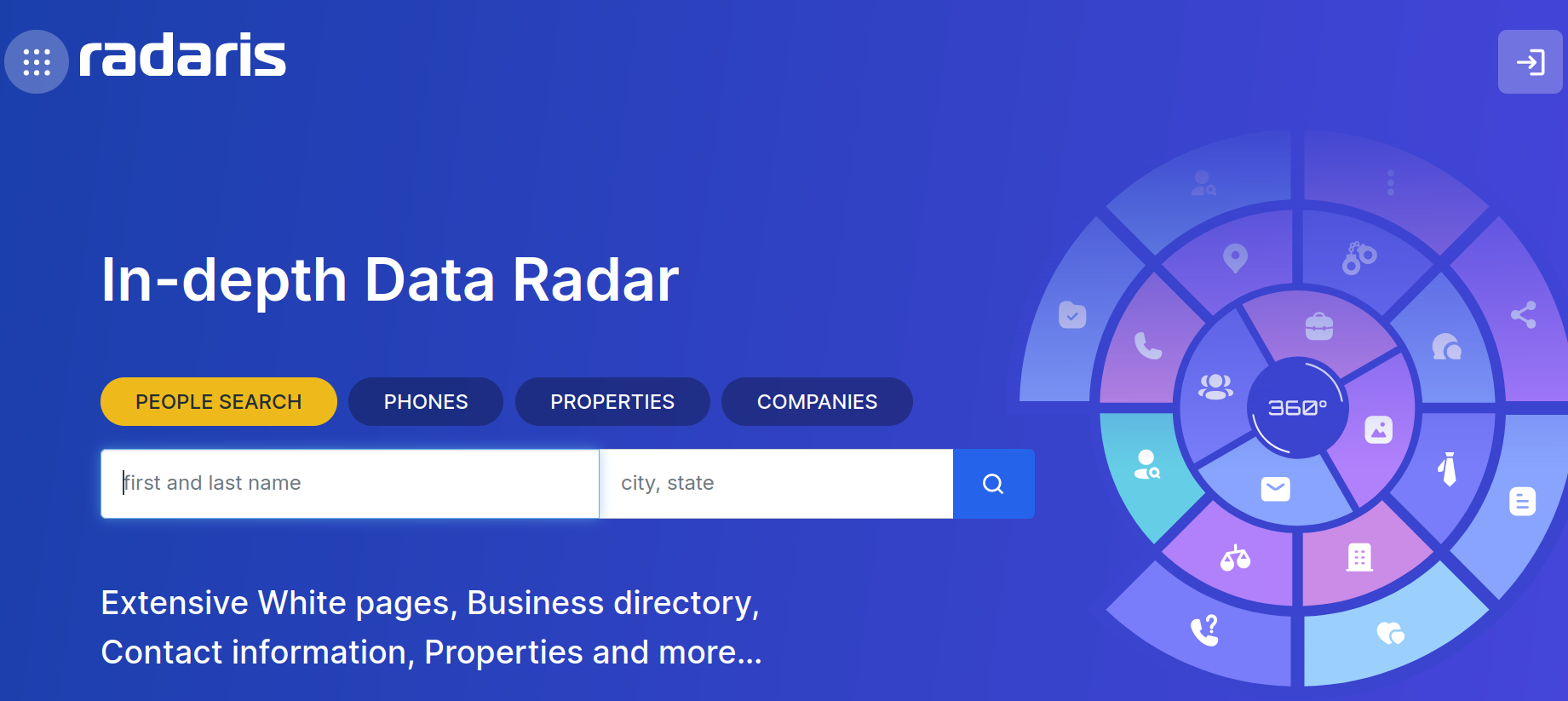
Today, visitors navigating to Radaris.com are met not with detailed personal dossiers of unsuspecting Americans, but with a stark notice from Atlas detailing the court-ordered domain transfer. The forfeiture signals a severe vulnerability in the operational armor of commercial data brokers who have long relied on international shell corporations, legal attrition, and procedural smoke screens to protect their bottom lines.
Main Facts: The Fall of an Intelligence Behemoth
The extraordinary legal showdown culminated in late August when a New Jersey judge ordered domain registry Verisign to transfer Radaris.com and 13 other domain names to Atlas. The action stems from ongoing litigation under Daniel’s Law, a stringent New Jersey statute designed to protect law enforcement personnel, judicial officers, and government officials by forcing commercial data brokers to purge their personal identifying information under threat of steep financial penalties.
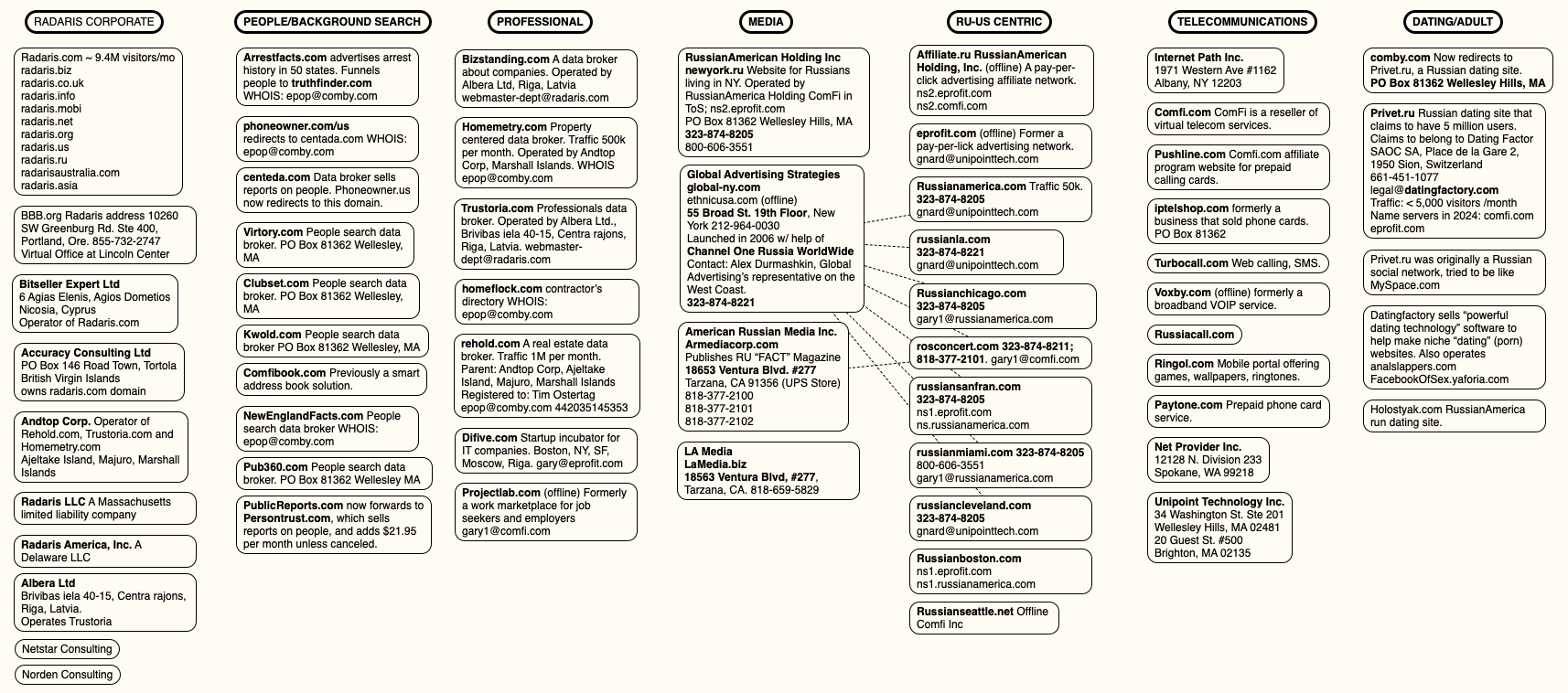
While Daniel’s Law specifically targets the exposure of public safety officials, the fallout from this case has fundamentally disrupted a sprawling, clandestine enterprise. Internal corporate documents and emails obtained during the litigation—numbering over 10,000 pages—reveal that Radaris is far from an isolated operation. Instead, it serves as the crown jewel of an interconnected network of at least 25 different people-search sites.
These platforms—including names like Veripages, Nuwber, and various affiliate programs—are administered by the same tight-knit group of individuals from the Boston area. They share payment processing pipelines, backend hosting infrastructure, and administrative mail domains. Together, this syndicate has quietly generated massive revenues, with Radaris alone pulling in approximately $42,000 monthly, and sister-site Veripages bringing in an estimated $45,000 a month through lucrative data-sharing and marketing partnerships.
Chronology: A Decade of Shell Games, Legal Maneuvers, and Defamation Threats
To understand how Radaris was finally brought to heel, one must trace a decade-long trail of corporate shell games, pseudonymous executives, and international jurisdiction hopping.
1. The 2017 Default Judgment and the "Island-Hopping" Phase
Radaris’s penchant for playing legal hide-and-seek is not new. In 2017, the company lost a major class-action lawsuit (Huebner v. Radaris, LLC) by default because it systematically failed to contest the claims in court. When plaintiffs attempted to collect on a $7.5 million default judgment, a judge ordered the transfer of the Radaris.com domain.
However, Radaris’s counsel at the time—Val Gurvits of the Boston Law Group—intervened on appeal, arguing that the lawsuit had failed to name the true owner of the domain: a Cyprus-registered entity known as Bitseller Expert Limited. The court halted the transfer, granting the defense a temporary victory.
Shortly thereafter, the operational control of Radaris shifted yet again. Bitseller stepped aside, replaced by Andtop Company, an entity hastily incorporated in the Marshall Islands in October 2020. This kicked off what plaintiffs’ counsel describes as the network’s "island-hopping" phase.
According to Matt Adkisson, president and CEO of Atlas, the data brokers continuously updated their terms of service to reflect management by fictitious or transient offshore entities based in tax havens such as the British Virgin Islands, Seychelles, and the Marshall Islands. When Atlas investigators probed one newly designated Marshall Islands management company, they discovered it was a complete phantom entity that did not legally exist.
2. The Launch of Atlas Data Privacy Corp and the Lubarsky Brothers
In February 2024, Atlas officially filed suit against Radaris under Daniel’s Law. Shortly after the lawsuit was initiated, security journalist Brian Krebs published an investigative deep dive unmasking the true operators of the empire: Igor and Dmitry (Dan) Lubarsky, Russian-born brothers residing in Massachusetts who manage a vast portfolio of people-search engines and Russian-language dating services.
The response from the brothers’ camp was swift and aggressive. Attorneys for the Lubarskys threatened a defamation lawsuit, demanding a retraction and public apology. They claimed the reporting was entirely inaccurate and insisted that the true owners of Radaris were innocent Ukrainians living in Ukraine.
When investigative journalists doubled down, revealing that the Lubarsky brothers had utilized a fictitious CEO named "Gary Norden" to pitch investors and issue press releases, defense counsel Val Gurvits ultimately conceded that his clients had indeed invented the fake executive persona.
3. Re-Filing and the August 2025 Seizure
Recognizing the systematic procedural delays and jurisdictional shell games, Atlas dramatically expanded its lawsuit in June 2025 to encompass the full family of Radaris-linked broker entities.

Facing an impending default judgment after repeated failures by the defendants to mount a legitimate defense, defense attorneys once again attempted procedural stall tactics, claiming improper service of process. Nevertheless, on August 26, the presiding judge ruled that the defendants had been afforded ample opportunities to defend the claims and had deliberately chosen stonewalling over compliance. The court ordered the immediate forfeiture and transfer of Radaris.com and its sister domains.
Supporting Data: The Interconnected Web of Surveillance Capitalism
The documentary evidence secured by Atlas during discovery provides a rare, transparent look inside the machinery of modern data-broker capitalism. The internal records expose how nominal legal fronts—including Radaris America Inc., Digital Orbit Corp, Core Solutions Group Inc., Lucky Solutions Inc., Virtura Corp, Veripages Inc., Nuform Solutions Inc., and Property Experts Inc.—functioned as mere administrative window dressing.
- Centralized Infrastructure: Discovery files verified that all corporate entities relied on a single unified technical backend, routing administrative, financial, and technical communications through specific email domains managed by the same small cadre of operators near Boston.
- Monetization and Industry Partners: The network’s revenue streams extended deep into the broader data-broker ecosystem. Financial audits revealed lucrative partnerships with the Lifetime Value Company (operator of PeopleLooker, PeopleSmart, and Bumper) and Onerep, a privacy-cleansing firm whose Belarusian founder was previously exposed by security researchers for operating competing people-search engines like Nuwber—effectively capitalizing on both the exposure and the removal of consumer data.
Official Responses and Legal Posturing
Legal representatives for Radaris have fiercely contested the legitimacy of the recent court orders, signaling that the legal war is far from over.
Attorney Victor Worms, who stepped in to handle the case following the initial default rulings, argued that the New Jersey court fundamentally overstepped its bounds.
"We have made a motion to vacate that default judgment on the grounds that it is void since a non-entity has no legal capacity to sue or be sued," Worms stated in correspondence regarding the seizure of Radaris.com. He added, "We also intend to pursue all appropriate appeals because we believe the transfer of Radaris.com amounts to a forfeiture in violation of various constitutional principles."
Conversely, plaintiffs’ counsel remains resolute. Raj Parikh, a partner at PEM Law who oversees Daniel’s Law litigation for Atlas, noted that the data broker industry’s historical success has relied entirely on exhausting plaintiffs through procedural attrition.
"In the past, they won by attrition," Parikh explained. "Plaintiffs’ attorneys tired of the procedural games and just gave up. That strategy worked for a decade, and it probably would have worked in this case too… But we were acutely aware of the threat this website posed to law enforcement officers and other public officials in New Jersey, and decided early on to commit whatever time and resources were necessary to remove that threat."
Broader Implications: The Constitutional Battleground and Legislative Blind Spots
While the seizure of Radaris.com represents a monumental tactical victory for privacy advocates, the broader war over data broker regulation remains trapped in a precarious legal and legislative crossfire.
1. The Constitutional Challenge to Daniel’s Law
Buoyed by the aggressive enforcement of Daniel’s Law in New Jersey—where at least 14 other states have introduced mirrored legislation—the broader data-broker industry has launched a coordinated counter-offensive. Approximately 150 consumer data broker firms currently targeted by Atlas lawsuits have successfully forced at least 70 of those cases into federal court.
The industry argues that Daniel’s Law is constitutionally overbroad and constitutes a direct violation of First Amendment protections regarding the publication of public records. While the U.S. Court of Appeals for the Third Circuit weighs the matter, legal analysts anticipate the ultimate showdown will land before the U.S. Supreme Court. Meanwhile, the legal fragility of these state-level statutes was underscored in August 2025, when a federal district court ruled West Virginia’s version of Daniel’s Law "facially unconstitutional."
2. The Federal Regulatory Vacuum
According to privacy expert Justin Sherman, author of the forthcoming book The Middlemen, state-level statutes like Daniel’s Law—while vital for public safety officials—only scratch the surface of a much deeper, systemic crisis fueled by congressional inaction.
Sherman points out that federal lawmakers face relentless, well-funded lobbying campaigns from Big Tech, social media giants, cryptocurrency advocates, and artificial intelligence proponents. These industries routinely argue that restricting data scraping and data collection will cripple the American economy.
Furthermore, state-level privacy frameworks almost universally carve out sweeping exemptions for records categorized as "public" or "government documents." This includes voting registries, marriage licenses, property filings, motor vehicle databases, court dockets, and criminal records. As a result, commercial surveillance companies continue to legally harvest and aggregate baseline public records into granular, monetized dossiers on everyday citizens.
Sherman emphasizes that the dangers of this unregulated environment extend far beyond people-search directories. He points to the catastrophic data breach at IDScan.net, which exposed the driver’s license information of more than 153 million Americans after records collected for age-verification purposes were weaponized on the dark web.
"The average person can look at Daniel’s Law and have a perfectly normal reaction, which is that everyone should be covered, not just police and judges," Sherman noted. "But we don’t need more wake-up calls. We’ve had eight million wake-up calls already on the need for better privacy laws. The lack of comprehensive federal privacy law is not for a lack of knowledge, and anyone claiming otherwise is either not reading the news or kidding themselves."
As the legal battles surrounding Radaris.com and Daniel’s Law grind toward appellate courts, the forfeiture serves as a historic milestone. It proves that even the most deeply entrenched, offshore-shielded data brokers can be held accountable when plaintiffs possess the resources, patience, and investigative resolve to tear down their corporate facades. Yet, until Congress enacts comprehensive 21st-century privacy protections, the underlying ecosystem of data harvesting will continue to adapt, pivot, and profit at the expense of public privacy.
 Sagoh
Sagoh  Evan Lee Salim
  Ammar Sabilarrohman