
 By Asep Darmawan
In an era where the audio industry is aggressively gravitating toward the “Harman Target”—a research-backed, neutral sound signature that prioritizes clinical accuracy—the high-end headphone market remains a defiant outlier. While budget and mid-range audio equipment have finally caught up to the 2012 research suggesting that most listeners prefer a balanced, uncoloured profile, the flagship tier of the industry continues to operate by a different set of rules.
At the center of this debate is the HiFiMan HE1000 Stealth. Representing the latest iteration of a lineage that dates back to the original $3,000 release in 2015, the HE1000 Stealth is not an attempt to appease the masses. Instead, it is a piece of sonic art—a bold, specialized, and arguably risky tuning that eschews the "neutral" mandate in favor of a grand, expansive, and highly emotional listening experience.
The Evolution of the "End Game" Philosophy
For years, the audiophile community has been locked in a tug-of-war between two schools of thought: the clinical, transparent reproduction of sound, and the immersive, colored presentation that turns listening into an event.

Recent years have been a golden age for the former. Affordable gear like the Sennheiser HD 480 Pro Plus and the Crinear Reference have proven that one does not need to spend thousands of dollars to achieve a reference-grade, neutral sound. These devices offer exceptional clarity at the $400 mark, making high-fidelity audio more accessible than ever.
However, the world of $1,000+ headphones remains a sanctuary for specialization. The HiFiMan HE1000 Stealth ($949) serves as a case study for this philosophy. It does not aim to be "correct" in the way a measurement rig defines correctness; it aims to be captivating. For the high-end enthusiast, these headphones are less about technical precision and more about the "soul" of the music.
Technical Specifications: The Anatomy of the HE1000
To understand why the HE1000 occupies such a unique space, one must look at the engineering that powers it. Released in its current "Stealth" iteration in December 2022, the headphone features:

- Driver Technology: 100 mm planar magnetic driver with open-back architecture.
- Impedance: 32Ω, making it relatively efficient for a planar set.
- Sensitivity: 93dB/mW.
- Build Materials: CNC-machined aluminium frame, wood-printed vinyl trim, real leather headband, and hybrid micro-fibre/synthetic leather pads.
- Weight: 458g.
The use of a 100mm planar magnetic driver is the heartbeat of the HE1000. This large surface area allows for a level of transient response and physical presence that dynamic drivers often struggle to replicate. While the build includes a mix of premium materials, the "wood-look" veneer remains a point of contention—at this price point, some enthusiasts argue that genuine wood should be a prerequisite.
The Sound Profile: Sculpting Space and Dimension
Putting on the HE1000 for the first time is an exercise in scale. The most immediate characteristic is the sheer sense of space. Unlike intimate, vocal-forward headphones that place the performer directly in front of your nose, the HE1000 pushes the soundstage outward.
The Midrange Recession
The secret to this spatial magic lies in a deliberate, psychoacoustic tuning choice. HiFiMan designs their open-back flagships with a dip in the upper midrange frequencies (roughly 1.25kHz–2.5kHz). By "scooping" this region, the headphones push vocals and lead instruments back, creating a sensation of depth and width.
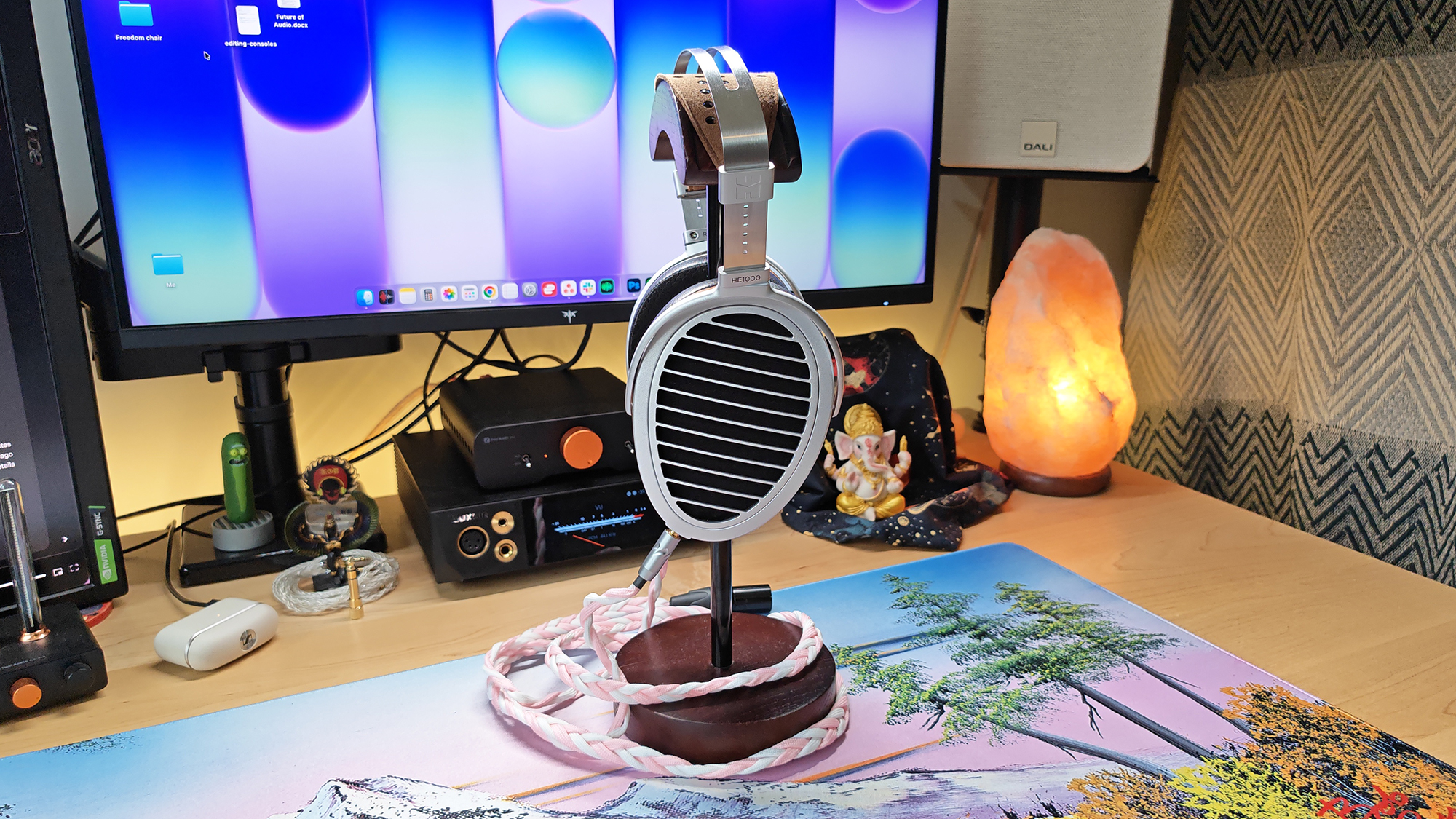
While this creates an airy, non-fatiguing presentation where complex arrangements can "breathe," it does come with a caveat: a loss of natural intimacy. For purists, this might feel like a dilution of the artist’s intent. However, for those who value separation and the "grandness" of a concert hall, the effect is transformative.
Bass and Treble Dynamics
The bass response on the HE1000 is a masterclass in control. It lacks the "bloomy" or over-boosted mid-bass found in lesser consumer headphones. Instead, it offers a linear, textured extension into the sub-bass. It is not the hardest-hitting bass on the market—products like the Sony MDR-MV1 offer more visceral slam—but the precision and articulation of the HE1000’s planar drivers ensure that the low end is always perfectly integrated into the overall signature.
The treble, however, is where the HE1000 demands caution. There are distinct peaks around the 6.5kHz–7.3kHz range and a further spike at 9kHz. For the majority of tracks, these peaks provide the "spice" that gives the music its characteristic shimmer and clarity. But for tracks with aggressive high-hats or electronic squelches, it can verge on fatigue. It is a sharp, analytical edge that keeps the sound from ever feeling "veiled."

The Testing Environment: A Transparent Path
To evaluate the HE1000 properly, it was paired with a Luxsin X8 DAC/Amp, utilizing a Custom Cans ultra-low capacitance balanced litz cable (the "Flump"). This configuration was chosen specifically to ensure that the source material remained as uncolored as possible, allowing the unique character of the headphones to shine through without the interference of a warm or dark amplification signature.
Through this setup, the HE1000 demonstrated that it does not need a "correction" via EQ. It is a complete, albeit specialized, package.
Implications for the Future of High-End Audio
The persistence of products like the HiFiMan HE1000 suggests a bifurcated future for the audio market.

- The Rise of the Reference: As measurements become more available and consumer education improves, the "neutral" tuning will continue to dominate the mid-tier market. Manufacturers are increasingly aware that if a product doesn’t measure well, it risks being ignored by the modern, data-driven consumer.
- The Sanctuary of Subjectivity: The high-end tier will likely double down on "character." As manufacturing technology lowers the barrier to entry for decent sound, the "flagship" status will be defined by the courage to be different. The HE1000 proves that there is still a massive audience for headphones that prioritize "fun," "scale," and "emotion" over strict adherence to the Harman Target.
Final Verdict: Is it Your "End Game"?
The term "End Game" in the audiophile world refers to the final purchase—the set of headphones that satisfies you enough to stop the search.
If you are a listener who demands clinical accuracy, absolute timbre correctness, and vocal intimacy, the HE1000 is not your End Game. For you, a more neutral set, such as the HEDD D1, would likely be a superior choice.
However, if you view listening as an event—a ritual where you want to be transported into a massive, shimmering, and exquisitely detailed soundscape—then the HE1000 is not just a purchase; it is an experience. It is a headphone that refuses to follow the crowd, choosing instead to lean into its own, singular vision of what music should sound like.

It is, in every sense of the word, an exception. And in a world of increasingly homogenized sound, that is perhaps its greatest virtue. Whether you see the HE1000 as a masterpiece of sound engineering or a divergence from neutrality, one thing is certain: it is a set of headphones that demands to be heard.
 Asro
Asro  Azzam Bilal Chamdy
  Lina Hope