
 By Nana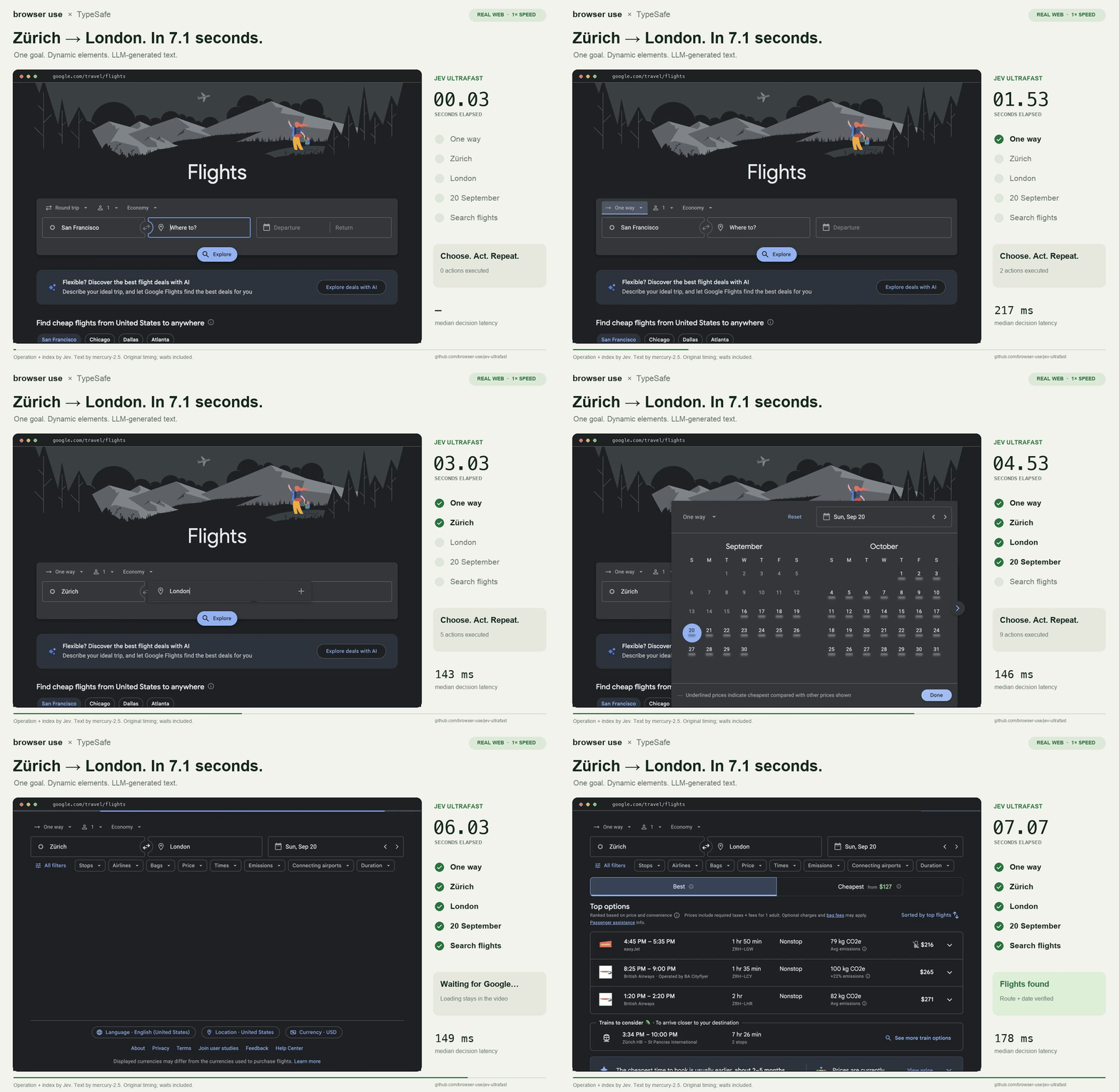
In the rapidly maturing field of artificial intelligence, the ability for software agents to interact with the modern web as effectively as a human has long been a "holy grail." While LLMs have mastered language, they have historically struggled with the messy, dynamic, and high-latency environment of a web browser. Enter Jev, the latest breakthrough from TypeSafe. By rethinking how an agent perceives and interacts with the Document Object Model (DOM), Jev has achieved performance speeds that challenge previous benchmarks, completing complex tasks—such as booking flight searches—in just over seven seconds.
Main Facts: A New Paradigm in Browser Automation
Jev represents a departure from traditional "screen-parsing" agents that often rely on heavy, slow vision models to interpret browser windows. Instead, Jev utilizes a dynamic, indexed action space. When the agent loads a webpage, it generates a structured table of elements—buttons, comboboxes, text fields, and inputs—each assigned a specific index.
Rather than attempting to "see" the page, the agent processes these indexed elements, allowing it to make rapid, high-confidence decisions on which UI components to engage. The operations available to the agent are tightly controlled: CLICK, TYPE_TEXT, SELECT, SCROLL_UP, SCROLL_DOWN, WAIT, DONE, and BLOCKED.
Crucially, the system architecture optimizes the network round trip. Because the agent separates the decision-making process into distinct heads—one for selecting the operation and another for selecting the target element—the system avoids the "hallucination" common in multi-modal agents. By feeding the agent only compatible elements for a given operation, TypeSafe has created a system that is not only faster but significantly more reliable.
Chronology: From Concept to Sub-Ten-Second Execution
The development of Jev was driven by a specific engineering goal: reducing the latency overhead that has plagued earlier browser-agent iterations.
The Early Phases
Initial testing focused on the fundamental disconnect between LLM processing time and browser responsiveness. Early prototypes suffered from "bloat," where agents spent unnecessary tokens parsing irrelevant DOM elements. By stripping away extraneous data and focusing on an indexed element table, the team at TypeSafe significantly reduced the input size for their LLM calls.
The Optimization Sprint
The team focused on streamlining the "loop"—the cycle where the agent observes the page, decides on an action, and executes that action. Through rigorous optimization, they managed to reduce the number of browser protocol calls from over 1,000 in early test runs down to approximately 101. This 90% reduction in protocol chatter was the primary catalyst for the dramatic decrease in execution time.
The Milestone: Zurich to London
The defining moment for the project came during a live-demonstration benchmark. The agent was tasked with navigating to Google Flights, selecting a flight from Zurich to London, and verifying the results. The system completed the entire sequence—including page loads, text generation for search queries, and final verification—in exactly 7.073 seconds. This served as a proof-of-concept that autonomous agents could operate within the "human-speed" window, making them viable for real-time productivity tasks.
Supporting Data: Performance and Precision
The technical documentation for Jev provides a transparent look at the agent’s efficiency. In controlled, alternating tests, the latest version of the agent demonstrated a 25% reduction in median task time compared to its predecessors.
Comparative Metrics
| Metric | Previous Iteration | Jev Ultrafast |
|---|---|---|
| Median Task Time | 9.450s | 7.092s |
| Browser Protocol Calls | 1,092 | 101 |
| Success Rate (3/3 trials) | 100% | 100% |
These metrics are particularly impressive when one considers the complexity of modern web pages. Google Flights, for instance, is a notoriously complex application with dynamic loading, complex dropdowns, and anti-scraping protections. The fact that Jev can navigate these obstacles without relying on site-specific "hard-coded" scripts—instead using general-purpose logic—suggests that the underlying policy is highly robust and transferable to other domains, such as Wikipedia navigation or hotel filtering.
The Architecture of Reliability: Why It Moves
One of the most persistent issues in web automation is the "stale element" problem, where an agent attempts to click a button that has already been refreshed or obscured by a pop-up. Jev addresses this through a native "freshness guard." Before any action is executed, the system re-validates the state of the DOM.
Furthermore, Jev’s design ensures that the model output is never directly executed as code. The agent produces a small, structured JSON object that the executor parses. This "human-in-the-middle" architectural choice acts as a sandbox, preventing the model from outputting malicious shell commands or arbitrary JavaScript. This design philosophy prioritizes security alongside speed, making it an attractive framework for enterprise integration.
Implications: The Future of Autonomous Agents
The implications of the Jev project extend far beyond a faster flight search. By lowering the barrier for browser-based automation, TypeSafe is effectively democratizing the "digital assistant."
1. The Death of API-Dependent Integration
Currently, most software services rely on REST APIs to communicate. If a service does not provide an API, integration is nearly impossible. Jev demonstrates that if a service has a web interface, it is potentially programmable. This could lead to a future where software interoperability is achieved through UI-agent interaction rather than back-end API development.
2. Enterprise Productivity and Scaling
For businesses, the ability to automate routine tasks—such as data entry, report generation, or multi-platform research—without building custom middleware is a massive efficiency gain. Jev’s small, readable code base (organized into clear modules for agent logic, snapshotting, and browser communication) suggests that it is ready for deployment in production environments.
3. Challenges and Future Limitations
Despite its success, the team behind Jev is quick to point out the current limitations. The agent is currently designed for standard HTML and ARIA-compliant controls. It does not yet natively support complex, non-standard interfaces such as canvas-based games, deeply nested frames, or drag-and-drop file uploads. Furthermore, while it performs well on single-user tasks, it is not yet a multi-agent system capable of managing high-concurrency workflows.
Conclusion: A New Standard for Browser Interaction
TypeSafe’s Jev Ultrafast is more than just a speed upgrade; it is a fundamental rethinking of the agent-web interface. By shifting the burden of intelligence away from heavy vision-based models and toward a structured, indexed, and high-performance execution loop, Jev has bridged the gap between theoretical AI research and practical, high-speed utility.
As the development community begins to experiment with the library, the focus will likely shift toward increasing the complexity of tasks the agent can handle. With an open-source footprint that allows developers to audit every step of the agent’s logic, Jev provides the transparency and reliability necessary to move AI agents from the "experimental" category into the "essential" category for modern desktop and cloud computing. Whether through optimizing existing browser workflows or enabling entirely new classes of software interaction, Jev is clearly at the forefront of the next wave of autonomous computing.
 Lina Hope
  Ammar Sabilarrohman