
 By Jia Lissa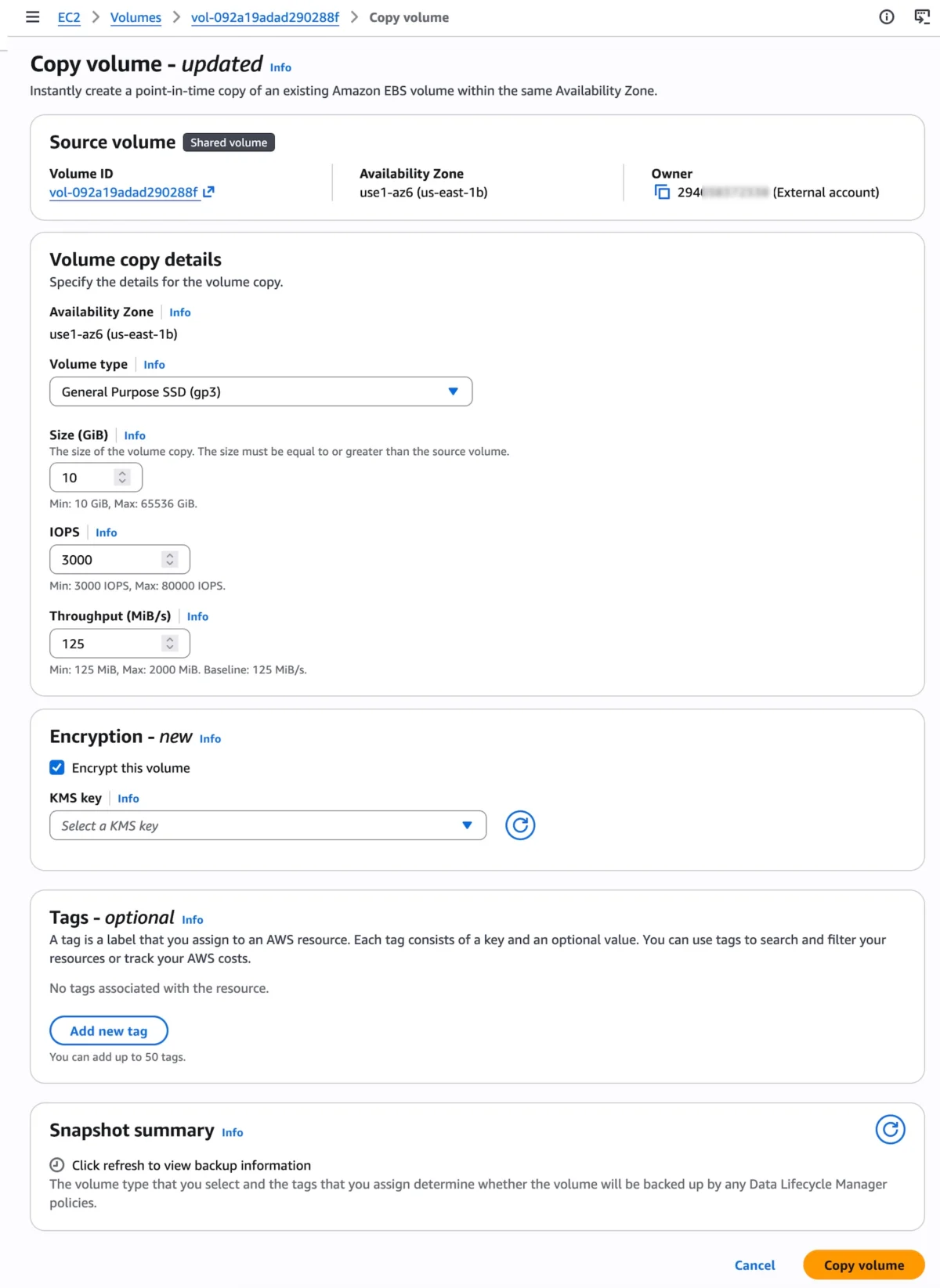
SEATTLE — In a move designed to streamline multi-account enterprise architectures and accelerate software development lifecycles, Amazon Web Services (AWS) has announced a powerful extension to its storage portfolio. Building upon the foundation of Amazon Elastic Block Store (Amazon EBS) Volume Clones introduced last year, AWS now supports cross-account volume cloning. This capability allows cloud administrators and DevOps engineers to securely copy EBS volumes across distinct AWS accounts, complete with the option to re-encrypt data using target-specific AWS Key Management Service (AWS KMS) keys.
The feature bridges a long-standing architectural gap for organizations operating under strict security and multi-account governance models, such as those utilizing AWS Control Tower or AWS Organizations. By enabling the seamless yet secure transfer of production-grade data snapshots into isolated testing, staging, and experimentation environments, AWS is empowering engineering teams to work with high-fidelity, up-to-date datasets without compromising production security.
Main Facts: What is Cross-Account EBS Volume Cloning?
At its core, the new feature extends the instantaneous point-in-time snapshot capabilities of Amazon EBS volume clones beyond the boundaries of a single AWS account. Previously, EBS volume clones allowed users to instantly duplicate storage volumes within the same Availability Zone, circumventing the traditional time and I/O bottlenecks associated with standard snapshot-to-volume restoration workflows.
With today’s update, this capability goes multi-account. Key operational highlights include:
- Cross-Account Portability: Organizations can share and duplicate EBS volumes directly from a source account to one or more designated target AWS accounts.
- Integrated Security and Re-Encryption: Target accounts can optionally re-encrypt the incoming volume clone using their own localized AWS KMS keys, satisfying stringent compliance, regulatory, and corporate data-isolation mandates.
- Native AWS Integration: The workflow relies on AWS Resource Access Manager (AWS RAM) for permission management and the Amazon EC2/EBS console or APIs for execution.
- Automation and AI Readiness: Teams can orchestrate these tasks programmatically via standard AWS APIs, the AWS Command Line Interface (CLI), or by leveraging modern AI coding workflows utilizing the AWS Model Context Protocol (MCP) Server and associated developer plugins.
Chronology: The Evolution of EBS Storage Cloning
To understand the significance of this release, it is helpful to examine how AWS has systematically evolved its block storage replication and cloning mechanisms over the years:
The Traditional Snapshot Era
For over a decade, creating a new environment from an existing Amazon EBS volume relied on a multi-step process:

- Creating an Amazon EBS snapshot of the source volume (which incrementally backs up data to Amazon S3).
- Waiting for the snapshot to complete.
- Provisioning a brand-new EBS volume from that snapshot in the target location.
While reliable, this process introduced latency, consumed compute time for initial volume warming in certain configurations, and complicated cross-account sharing because it required managing snapshot permissions, sharing IAM policies, and manually provisioning volumes in every destination account.
The Introduction of Volume Clones (Last Year)
AWS revolutionized this workflow by introducing native EBS Volume Clones. Instead of routing data through S3 via snapshots, volume clones created instantaneous, pointer-based copies of block storage within the same Availability Zone. These clones leveraged underlying storage virtualization to deliver immediate data availability, allowing developers to spin up heavy databases or large file systems in seconds rather than hours. However, these clones were strictly confined to the boundaries of the account in which they were created.
The Cross-Account Milestone (Today)
Recognizing that modern enterprise workloads are rarely confined to a single AWS account—often distributed across sandbox, development, staging, and production accounts for security isolation—AWS has removed the account barrier. The introduction of cross-account volume clones marries the instantaneous speed of local volume cloning with the collaborative flexibility of AWS RAM, solving a major friction point for enterprise DevOps pipelines.
Supporting Data and Architectural Mechanics: How It Works in Practice
Implementing cross-account EBS volume cloning involves a coordinated workflow between the source account owner and the target account administrator. Here is a detailed breakdown of how the mechanism operates under the hood:
Step 1: Initiating the Share via AWS RAM
The workflow begins in the source account, where the volume owner designates which external accounts or organizational units should have access to the storage asset.
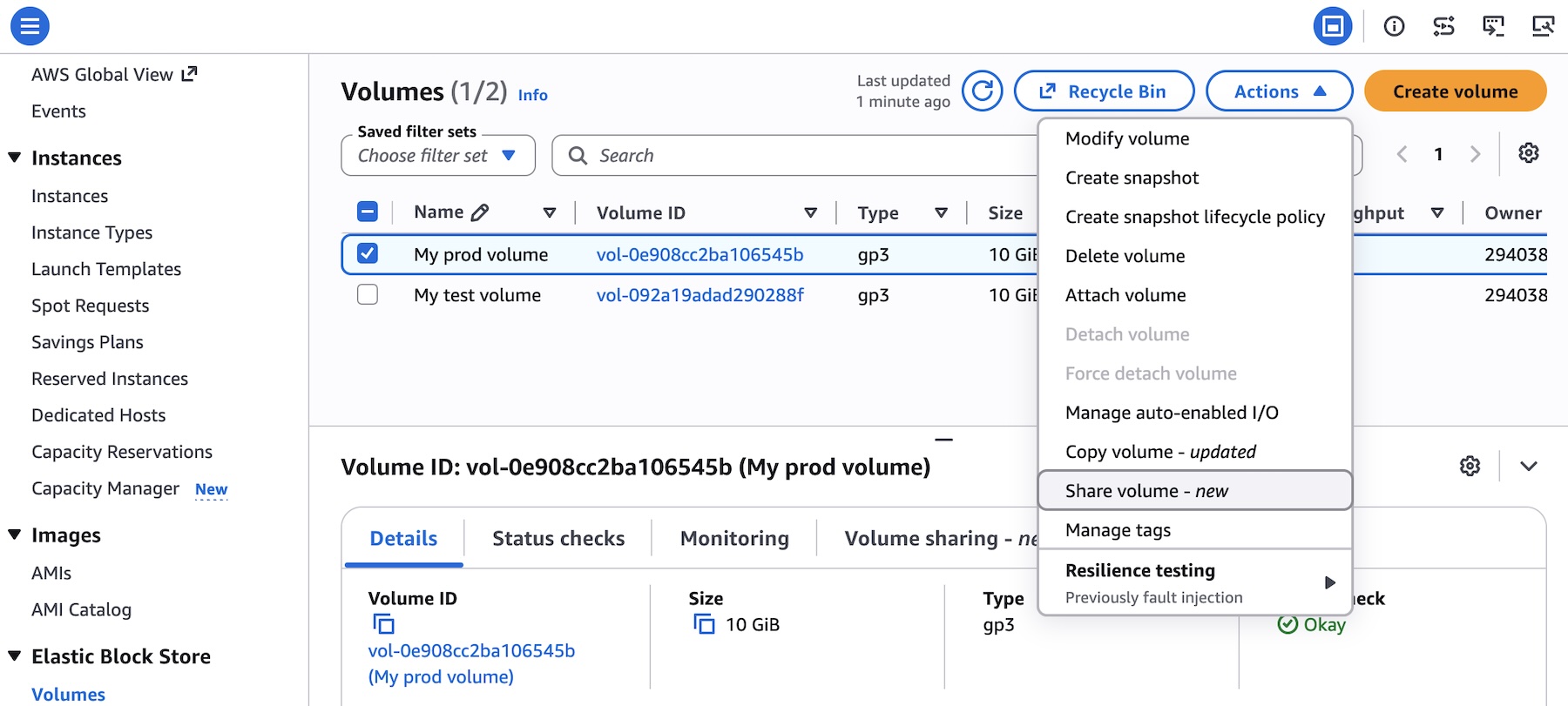
- In the Amazon EBS console, the user selects the target volume and chooses the Share volume option.
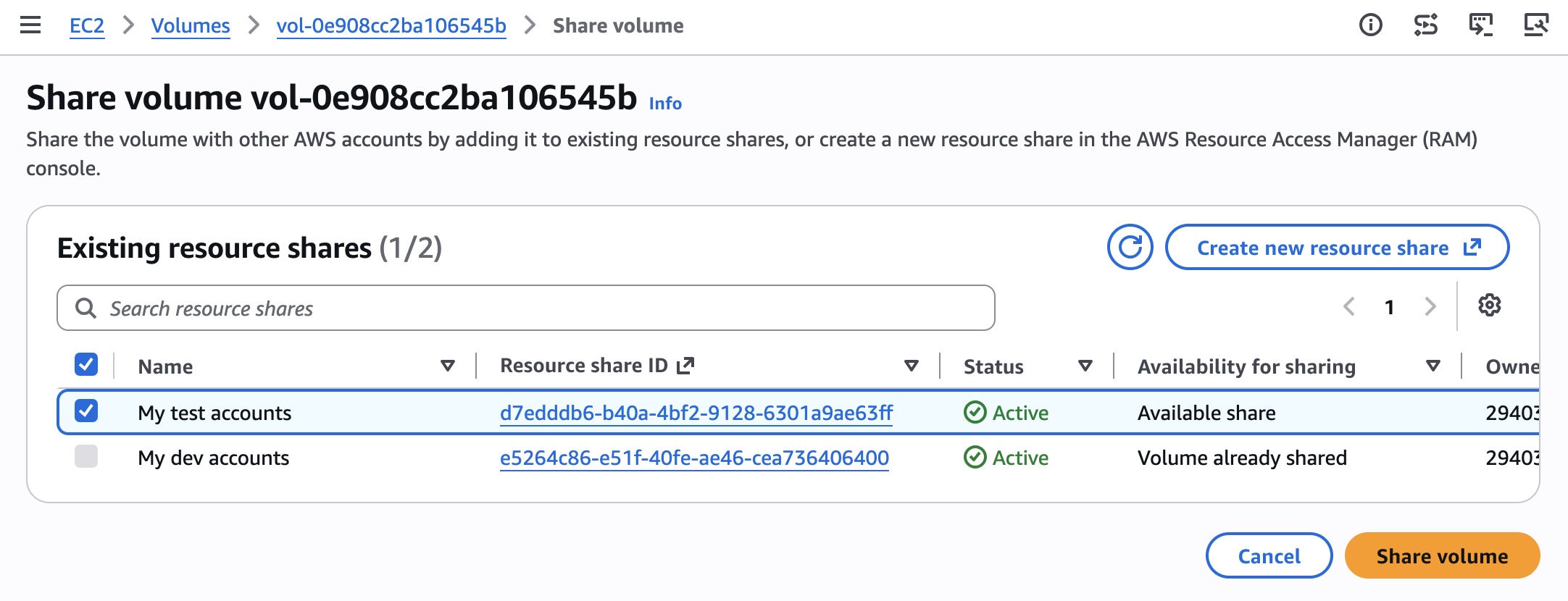
- The console interfaces directly with AWS Resource Access Manager (AWS RAM). Users can either add the volume to an existing resource share or construct a brand-new resource share specifying the target AWS account IDs or AWS Organization ARNs.
- Once configured, confirmation of the share status appears dynamically within the Volume sharing tab of the volume’s detail page in the source console.
Step 2: Accepting the Resource Share in the Target Account
Security by design dictates that resources cannot be forced upon an external account without consent.
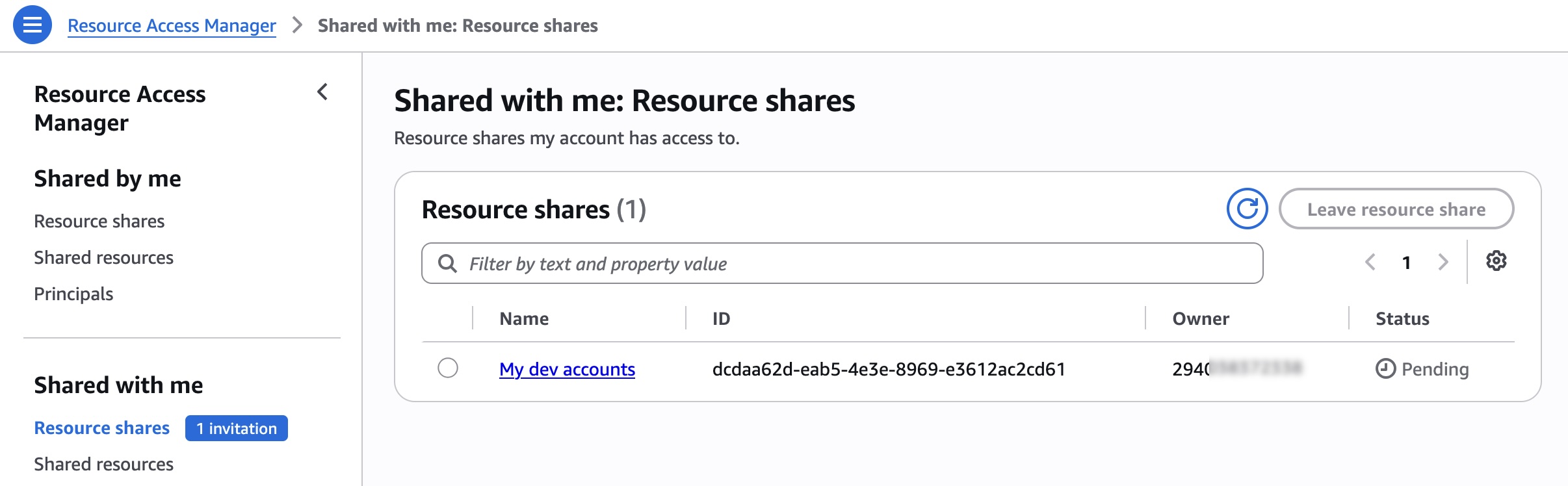
- The administrator of the target AWS account must navigate to the AWS RAM console and explicitly accept the incoming resource share invitation.
- Once accepted, the shared volume immediately materializes within the EBS volume dashboard of the target account, clearly marked as a shared asset.
Step 3: Executing the Clone and Re-Encryption
With the resource share active, the target account possesses read access required to duplicate the data.
- Within the target account’s EBS console, the administrator selects the shared volume and clicks Copy volume.
- During this initiation phase, the target administrator can define custom parameters, most notably selecting an alternate AWS KMS key native to the target account. This ensures that even if the source data was encrypted under a production KMS key, the resulting clone in the development environment adheres strictly to the security posture and key rotation policies of the target account.
Programmatic and AI-Driven Operations
For organizations practicing Infrastructure as Code (IaC) or automated CI/CD pipelines, graphical consoles are only part of the story. AWS has ensured full API and CLI coverage for cross-account volume operations. Furthermore, development teams utilizing modern AI-assisted coding tools can interact with documentation and construct automation scripts seamlessly by integrating the AWS MCP Server and relevant IDE plugins, minimizing the learning curve for developers writing custom integration scripts.
Official Responses and Strategic Implications
The release has drawn positive commentary from AWS leadership and cloud architects alike, highlighting its alignment with modern enterprise architecture principles.

Enhancing DevSecOps and Data Freshness
In enterprise software development, a persistent challenge is the "stale data problem." Developers often test applications against old, sanitized datasets that do not reflect the scale, skew, or edge cases found in production. Consequently, critical bugs frequently bypass staging environments and surface only after deployment.
By enabling secure cross-account cloning, AWS allows enterprises to automate the daily or weekly refresh of development and staging databases using real, production-grade data schemas—while maintaining strict access boundaries. Because the operation is instantaneous and bypasses traditional slow snapshot restorations, CI/CD pipelines can spin up fresh environments on demand.
Security and Compliance Benefits
From a governance perspective, the integration with AWS RAM and AWS KMS addresses key compliance frameworks (such as SOC 2, HIPAA, and GDPR):
- Least Privilege Access: Production accounts do not need to hand over permanent credentials or broad IAM roles to development teams. Access is mediated securely through resource shares that can be revoked at any time.
- Data Sovereignty and Encryption Control: Because target accounts can re-encrypt cloned volumes using their own KMS keys, auditing who holds the decryption keys remains clean and unambiguous. Production security teams retain absolute control over production keys, while development teams manage their own testing keys.
Availability and Future Outlook
Cross-account volume clones for Amazon EBS are generally available starting today across all AWS Regions that currently support standard Amazon EBS Volume Clones. Organizations looking to verify regional support can consult the official AWS Capabilities by Region documentation.
Cloud administrators are encouraged to test the feature directly within the Amazon EC2 and EBS consoles. AWS has also opened feedback channels via AWS re:Post for Amazon EBS and standard AWS Support avenues to gather user telemetry and feature requests for subsequent iterations of the service.
As enterprises continue to scale their multi-account footprints, capabilities like cross-account EBS cloning signal a clear trajectory: removing operational friction without ever sacrificing the security boundaries that underpin modern cloud computing.
 Ali Ikhwan
  Dwi Wanna
  Lina Irawan