
 By Nana Muazin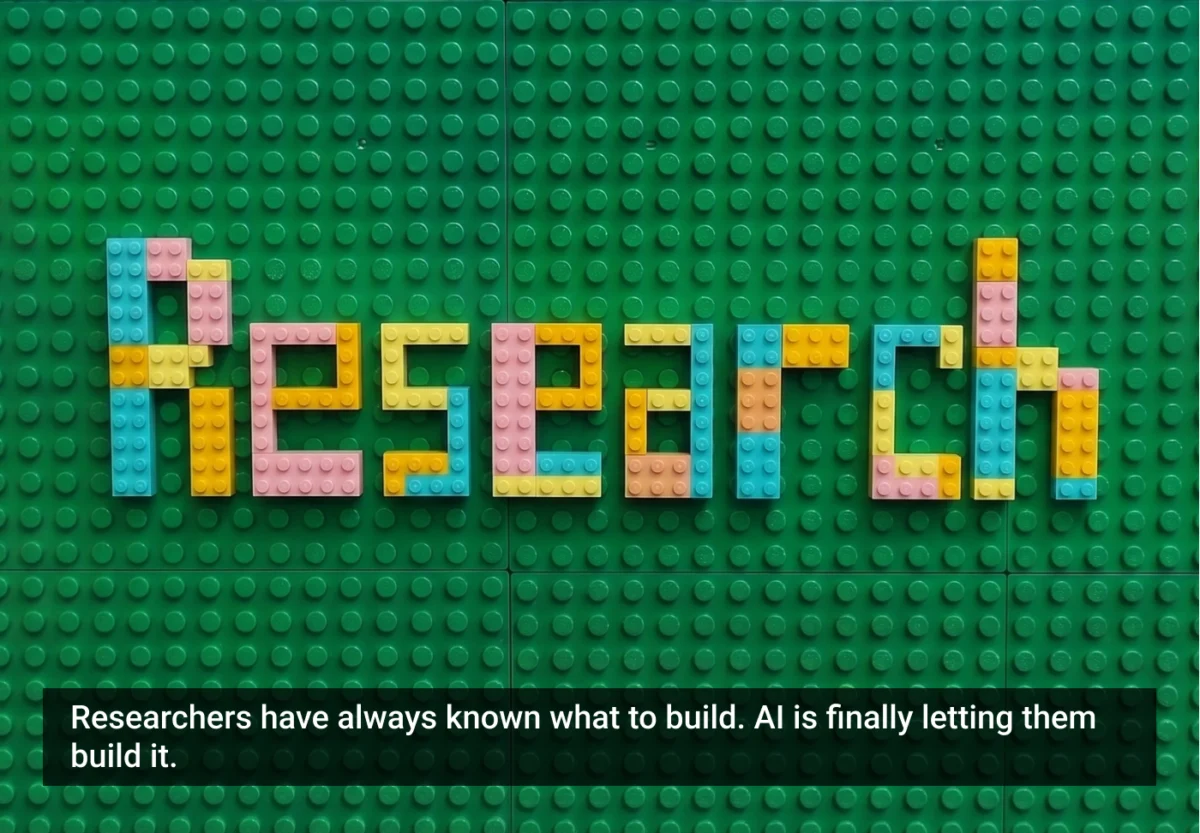
From freeze-dried backpacking food and community-driven refugee dinners to sophisticated personal finance applications and exhibits at the prestigious V&A Museum, a quiet revolution is taking place across the professional landscape. These are not the traditional outputs of corporate product roadmaps or venture-backed tech incubators; they are the handiwork of researchers.
For decades, user experience (UX) researchers, consumer insights professionals, and behavioral strategists operated comfortably one step removed from direct delivery. Their role was to advise, influence, and translate human behavior into strategic recommendations for others to build. Today, propelled by the democratization of artificial intelligence and shifting labor markets, that barrier is dissolving. Researchers are increasingly stepping out of the advisory seat and into the role of the creator.
Main Facts: The Great Convergence of Research and Making
The transformation of researchers into makers represents a fundamental shift in the knowledge economy.
- The Democratization of Creation: Advanced AI coding tools, no-code platforms, and automated operational frameworks have significantly lowered the technical barriers to entry. Researchers can now prototype, test, and ship digital and physical products with unprecedented speed.
- The Shift from "Could" to "Must": What began as experimental exploration with generative AI tools has hardened into organizational mandates. Driven by structural changes in product teams and post-pandemic labor market corrections, many researchers face growing pressure from employers to prototype, code, and build solutions independently.
- The "Researcher-Maker" Identity: Rather than abandoning their core competencies, successful practitioners are adopting hyphenated professional identities—such as researcher-founder, researcher-developer, and researcher-artist—fusing empirical rigor with entrepreneurial execution.
- The Core Tension: While the technical capacity to build has never been more accessible, researchers face unique psychological and structural barriers, including overcoming internal risk aversion, managing financial runways, and reconciling empathetic user advocacy with the pressures of monetization and cash flow.
Chronology: From Advisory Insights to Direct Execution
To understand how the research discipline reached this inflection point, it is helpful to trace the evolution of the profession over recent years.
Phase 1: The Advisory Era (Pre-2023)
Historically, the ecosystem of product development maintained strict functional silos. Product managers drove strategy, software engineers wrote code, designers handled visual execution, and researchers diagnosed user problems. Researchers measured their impact through influence—hoping their insights would sway decision-makers in the C-suite. Frustrated by power structures that kept them far from direct customer interaction, many researchers felt their recommendations were frequently ignored or diluted.
Phase 2: The Horizon of Potential (2023–2024)
As generative AI tools emerged, the initial sentiment among researchers was one of exploratory optimism. Articles such as Hopeful Futures for UX Research captured a wave of potential: what could researchers achieve if they had direct access to creation tools? During this window, AI was viewed as a creative multiplier—an assistant that could generate wireframes, draft documentation, and accelerate synthesis.
Phase 3: The Mandate to Build (Present Day)
Over the past year, that exploratory "could" rapidly transitioned into an organizational "should," and in many cases, a commercial "must." With corporate innovation labs restructuring and traditional job markets contracting, researchers began taking matters into their own hands. Individuals like Neha, founder of the anthropological personal finance app Incluya, and Jen, creator of a portable photo booth business, illustrate this leap. Driven by necessity and vision, they stopped waiting for executive buy-in and began building products based on their own firsthand insights.
Supporting Data and Case Studies: Voices from the Field
Interviews with over 20 researcher-makers reveal common patterns in how professional identities evolve when professionals cross the boundary from insight generation to commercial execution.
The Power of Provisional Selves
Organizational psychologist Herminia Ibarra’s framework of "Provisional Selves" (1999) describes how professionals transition into new identities by experimenting with trial personas, imitating role models, and gradually internalizing new behaviors. Across the stories of contemporary researcher-makers, Ibarra’s cycle is clearly visible.
However, unlike traditional career pivots, researchers attempting to become founders often struggle because the transition is mischaracterized purely as a matter of acquiring technical tools. In reality, the primary obstacle is psychological: giving oneself permission to claim a hyphenated identity.
Case Study: Neha and Incluya
Working in a corporate innovation lab, Neha watched high-potential ideas get funded or killed by executives far removed from the customer. Frustrated, she asked a pivotal question: "Why is a researcher not a CEO? Well, I’m a researcher. Why am I not CEO?"
When the traditional job market contracted, Neha founded Incluya, a personal finance app rooted in anthropological principles. Within a year, she led a team of ten through a closed beta. Yet, her researcher instincts initially slowed her down as she weighed every angle. Her solution? Time-boxing decisions to maintain commercial momentum while preserving research-backed integrity.
Case Study: Brian and the AI Kids Club
Brian, who studied computer science and creative writing before moving into user research, runs the AI Kids Club, teaching children to think critically and create with artificial intelligence. Brian argues that UX researchers are uniquely positioned to build products, particularly in the age of AI.
"When I learned to do sales, I realized that actually it’s empathy; it’s storytelling," Brian notes. "Good sales is discovery. Good sales is understanding the other person—is there a thing that you can meaningfully do to help them?" Despite this advantage, Brian notes that building is not for everyone; a significant portion of the research community remains uninterested in the mechanics of commercial shipping.
Official Responses and Industry Implications
The emergence of the researcher-maker paradigm has sparked intense debate within design and product communities regarding the future of specialized roles.
- The Pro-Maker Perspective: Industry advocates argue that as AI commoditizes execution and delivery, the primary differentiator for successful products is discovery—knowing which problems actually matter and for whom. Because discovery is the core competency of researchers, proponents argue that researchers are uniquely equipped to build products that solve genuine human problems rather than chasing empty metrics.
- The Skeptical View: Critics and cautious practitioners point out the severe operational and psychological hazards of this transition. Building a business requires skills that run counter to traditional research training, such as aggressive cash flow management, pitching to skeptical investors, and making peace with shipping imperfect outputs. Furthermore, the romanticized narrative of the "solopreneur" relying entirely on AI agents can lead to extreme isolation and burnout.
- The Economic Reality Check: Industry analysts emphasize that the decision to become a maker is rarely made in a vacuum. Layoffs, economic precarity, and regional disparities mean that "following your dreams" is often an economic survival strategy rather than a purely creative choice. Those with financial safety nets, supportive partners, or venture runway find the transition far less punishing than those operating without a safety buffer.
Future Implications: Navigating the Hybrid Identity
As organizations continue to flatten and AI tooling becomes standard practice, the professional landscape will likely see a permanent blurring of lines between analysis and execution.
- Redefining Impact: Researchers will increasingly be evaluated not just on the quality of their decks or insight reports, but on their ability to translate qualitative empathy into tangible, working prototypes and viable ventures.
- The Evolution of Corporate Research: Forward-thinking companies will need to create internal pathways for intrapreneurship, allowing researchers to pilot products and internal tools without being forced out of the organization by rigid job descriptions.
- Embracing the Hyphen: For individual practitioners, the path forward relies on rejecting the false binary of being "just a researcher" or "just a founder." By embracing a more expansive definition of creativity—whether through software, community building, physical products, or artistic design—researchers can harness their unique superpowers to shape the future on their own terms.
Ultimately, the rise of the researcher-maker proves that the skills defining great research—curiosity, rigor, empathy, and a relentless focus on human needs—are the very same skills needed to build a better, more thoughtful world.
 Sagoh
Sagoh  Dwi Wanna
  Pevita Pearce