The contemporary corporate landscape operates under a pervasive, largely unverified assumption: that consumers and enterprise employees are perpetually hungry for more artificial intelligence. From boardrooms to product sprints, tech leaders operate as if every user craves new AI-driven features, autonomous agents, and chatbots integrated into every facet of daily life.
However, emerging user experience (UX) data, workplace productivity studies, and adoption metrics paint a dramatically different picture. The reality on the ground reveals that most people do not want more AI—at least not in the intrusive, workflow-disrupting manner envisioned by tech executives.
Key insights driving this paradigm shift include:
Low Adoption and High Friction: Despite high deployment costs and steep corporate investments, many standalone AI features suffer from remarkably low user adoption and retention rates.
AI is Not a Value Proposition: Simply labeling a tool as "Powered by AI" fails to create intrinsic value for customers. Instead, AI frequently acts as a bolt-on tool that disrupts established work patterns.
The Productivity Paradox: Rather than reducing workloads, poorly integrated AI tools often intensify administrative burdens, driving up time spent on messaging, email, and error-checking.
The Rise of "AI-Second" Design: Users do not want AI-first replacements for human creativity; they want "AI-second," ambient, and humble automation that quietly handles mundane tasks in the background.
Chronology: The Evolution of the AI Fatigue Phenomenon
To understand how the technology sector arrived at the current impasse between corporate ambition and user resistance, it is helpful to trace the timeline of AI integration over recent years:
Late 2022 – 2023: The Generative AI Gold Rush
Following the public rollout of large language models, tech companies rushed to retrofit existing software suites with generative AI capabilities. The prevailing ethos was "move fast and break things," with businesses assuming that any AI integration would be automatically welcomed by users.
2024: The First Wave of Pushback and Hallucination Realities
As tools matured, organizations began noticing the hidden costs of AI. Users spent significant time identifying and correcting AI "hallucinations." Software developers and enterprise workers realized that generating text or code via prompts often created more editorial cleanup work than drafting from scratch.
2025: Productivity Studies Reveal the Backlash
Comprehensive workplace studies (incorporating data from platforms like ActivTrak, Harvard Business Review, and major news outlets) demonstrated that AI adoption correlated with spikes in after-hours work, increased messaging volume, and heightened cognitive fatigue. The narrative shifted from "AI saves time" to "AI intensifies work."
2026: The UX Reckoning and the Shift Toward "AI-Second"
By early 2026, user experience researchers and industry analysts began pushing back aggressively against the hype cycle. Industry thought leaders highlighted that users are not looking to replace human artistry, relationships, or critical thinking with synthetic alternatives. The conversation pivoted toward human-centric design, calling for software that respects existing mental models rather than forcing users to adapt to erratic algorithms.
Supporting Data: What the Metrics Reveal
The disconnect between corporate expectations and user sentiment is heavily quantified by recent research across UX design, labor economics, and enterprise efficiency.
1. The Productivity Study Findings
Data compiled from major workplace productivity trackers highlight the unintended consequences of uncalibrated AI integration:
Email and Chat Volume: Time spent managing emails surged by 104%, while chat and messaging tool usage jumped by 145% in heavily automated environments.
Extended Workweeks: Weekend work metrics showed increases of 46% on Saturdays and 58% on Sundays, suggesting that digital tools have blurred boundaries rather than saving time.
Cognitive Focus Decline: Measured "focus mode" time dropped by 9%.
Error Escalation: Costly operational mistakes rose by 39%, directly linked to the time spent processing and filtering low-quality output ("AI slop"), which increased by 41%.
2. Vulnerability and Exposure Across Job Sectors
Research from GovAI and the Brookings Institution, highlighted by The Washington Post, maps out how different professions interact with AI automation:
High Exposure: Knowledge-intensive fields like software development, public relations, and legal drafting face intense structural exposure to automation.
Low Exposure: Physical, hands-on, and high-empathy or crisis-response roles—such as firefighters and manual trades—demonstrate high resilience.
The Core Insight: Even within high-exposure jobs, the most rewarding, creative, and intuitive aspects of human work cannot be easily replaced. When AI attempts to automate the core essence of these roles rather than assisting with the boring administrative overhead, it triggers deep resistance.
Official Responses and Expert Perspectives
Industry analysts, UX veterans, and corporate leaders have increasingly voiced caution regarding the headlong rush into ubiquitous AI features.
Writing for the Nielsen Norman Group, usability experts have repeatedly emphasized that "Powered by AI" is not a value proposition. UX design patterns show that when software introduces features that require users to constantly monitor, prompt, and error-check a black-box system, it places an unfair cognitive tax on the end-user.
Bo Young Lee captured the public sentiment regarding creative and personal boundaries in a widely shared industry statement:
"I don’t want to read books written by AI. I don’t want to gaze upon paintings by AI. I don’t want AI to teach my children. I don’t want to have an AI therapist. I don’t want AI making my medical decisions. I want AI to do all the physical and mental labor that taxes me so I can read books written by humans and go to art galleries to engage with art made by humans. I want AI that makes my life easier rather than forces me to change myself."
Furthermore, organizational development experts note that AI acts as an organizational amplifier. If a company suffers from poor data hygiene, broken internal communication, and political silos, throwing generative AI tools at the problem will not fix the underlying rot. Instead, it surfaces those internal inconsistencies directly to the customer or employee, who is then forced to untangle the corporate mess.
Implications for Product Design, Business Strategy, and the Future of Work
The realization that everyday users are growing fatigued by uninvited, intrusive AI features carries profound implications for product managers, software designers, and corporate strategists.
1. Moving from "AI-First" to "AI-Second"
The market is beginning to favor tools that are "AI-second." Rather than forcing users to interact with a chat interface or an unpredictable generative box for every task, successful products utilize ambient, subtle, and humble automation. This design philosophy places AI in the background—handling file sorting, routine data formatting, or background error-checking—while leaving the user firmly in control of decisions, creative direction, and critical evaluation.
2. Respecting Existing Mental Models
Humans have spent decades fine-tuning their cognitive frameworks for how they interact with software, solve problems, and collaborate. Effective tools adapt to these established mental models rather than forcing users to learn entirely new interaction paradigms. If a feature disrupts a user’s flow state by requiring constant prompt engineering and hallucination verification, it fails the baseline usability test.
3. Redefining Productivity
True productivity is not merely about increasing output velocity; it is about protecting the cognitive bandwidth required to do high-quality work. When corporate metrics prioritize raw shipping speed over thoughtful execution, they erode employee satisfaction and craftsmanship. Designing for humans means giving people the time to think, create, and enjoy their work, rather than drowning them in a deluge of machine-generated content that requires constant policing.
4. A Human-Centric Path Forward
Ultimately, the future of interface design does not belong to a world where humans serve as babysitters to autonomous agent swarms. It belongs to systems that respect human agency. As the industry recalibrates, the mandate for product designers is clear: use automation to eliminate the dull, administrative friction of daily life, thereby returning time and headspace to the human experiences, relationships, and creative pursuits that matter most.

 By Raul Delapena Setiawan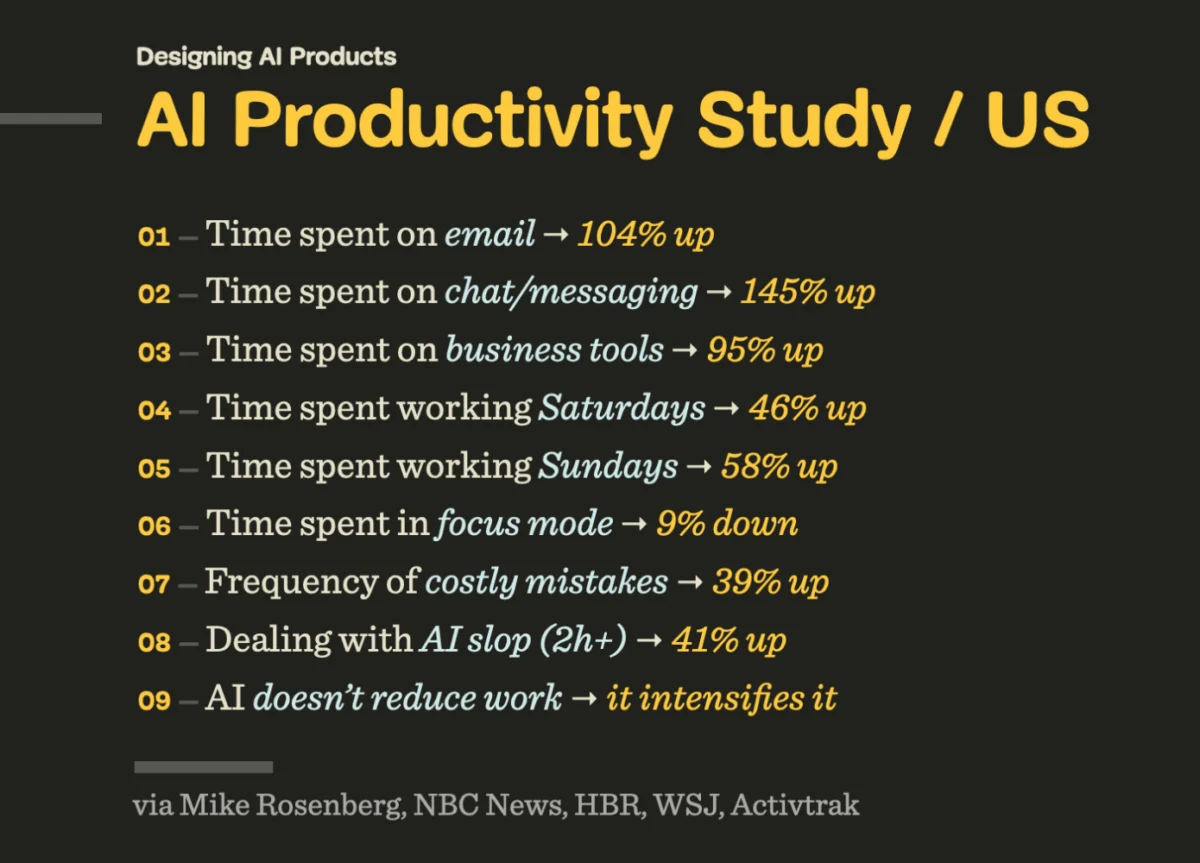


 Sagoh
Sagoh  rifanmuazin
  Azzam Bilal Chamdy