
 By Raul Delapena Setiawan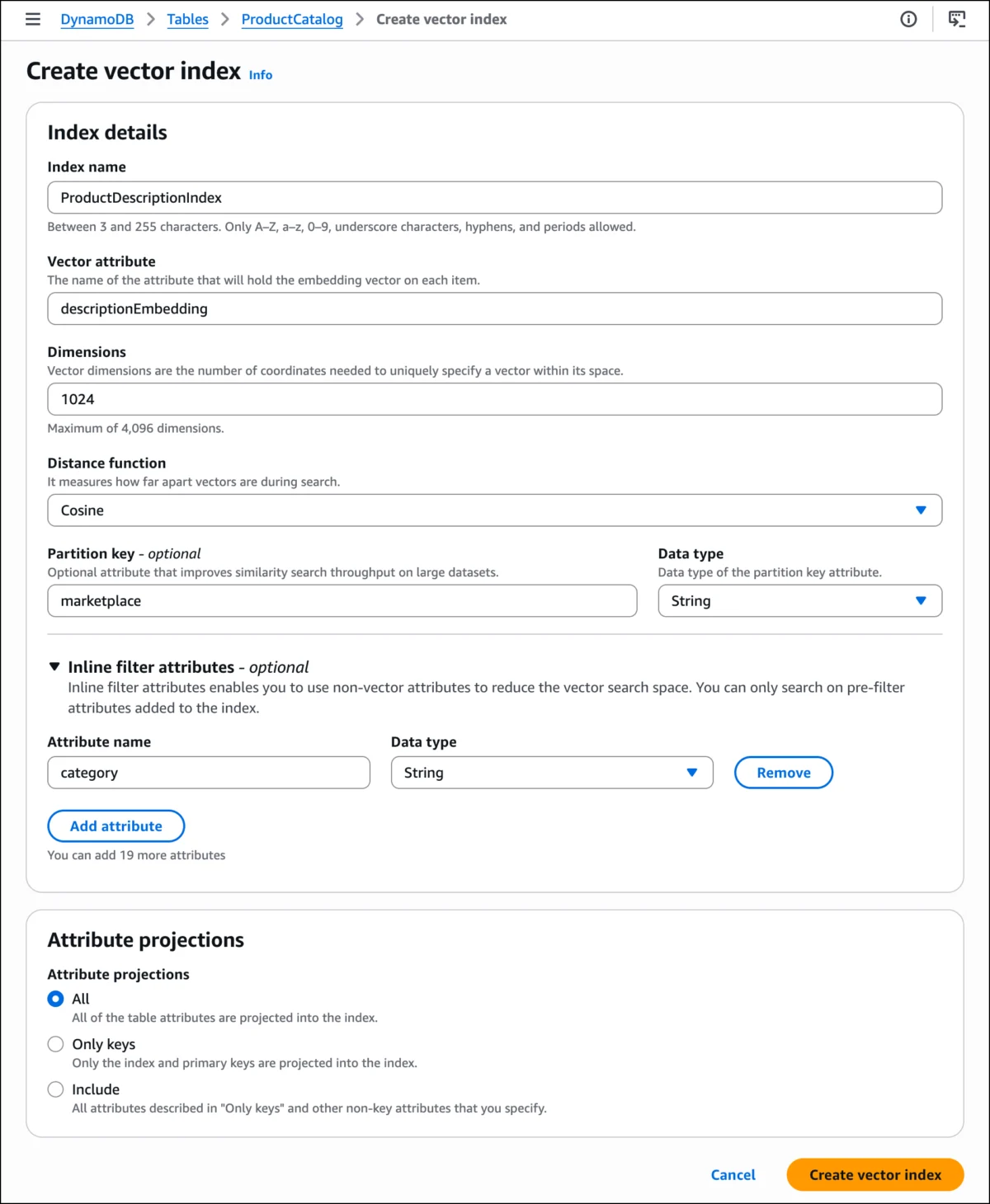
SEATTLE — In a major development for cloud architects and database administrators worldwide, Amazon Web Services (AWS) has announced the general availability of native vector search in Amazon DynamoDB. This major update allows developers to store vector embeddings directly alongside their operational data within DynamoDB tables, eliminating the historical necessity of maintaining separate, dedicated vector stores or complex synchronization pipelines.
Designed to deliver single-digit millisecond latencies at a 99%+ recall rate, the new capability scales horizontally to support workloads of virtually any size, including trillions of vectors. By bridging the gap between transactional databases and generative artificial intelligence (AI) infrastructure, AWS aims to drastically simplify the deployment of semantic retrieval, Retrieval-Augmented Generation (RAG), personalized recommendation engines, agentic memory, and anomaly detection systems.
Main Facts: What is Native Vector Search in DynamoDB?
The introduction of vector search brings advanced machine learning capabilities directly into the core architecture of Amazon DynamoDB without introducing new data types or requiring complex infrastructure provisioning.
- Serverless and Zero-Maintenance: True to DynamoDB’s foundational serverless design, the vector search feature requires no servers to provision, patch, or manage. It operates with zero downtime maintenance, no versioning hurdles, and no explicit maintenance windows.
- Architecture and Pricing: Vectors and operational data now share the same underlying serverless infrastructure and utilize DynamoDB’s familiar pay-per-request pricing model, removing the data movement, licensing, and operational overhead associated with auxiliary vector databases.
- High Performance at Scale: The service guarantees single-digit millisecond query latencies with over 99% recall accuracy, capable of scaling across trillions of vectors with unrestricted storage limits.
- Core Technical Specifications:
- Supports embedding dimensions up to 4,096.
- Accommodates three primary distance functions: Cosine, Euclidean, and Dot Product.
- Features inline filtering to narrow down query scopes dynamically.
- Seamlessly stores vector embeddings as standard
Listdata types consisting of float values, populated via regularPutItemorUpdateItemAPI operations.
Chronology: The Evolution Toward Native Database AI Integration
The path to integrating vector capabilities natively into operational databases reflects the rapid acceleration of generative AI workloads over recent years.

The Era of Separate Silos (Pre-2023)
As large language models (LLMs) and transformer architectures gained mainstream adoption, application developers rushed to build semantic search engines and RAG applications. However, traditional operational databases like DynamoDB were optimized exclusively for key-value and document data access patterns. To run similarity searches using high-dimensional vectors, architects were forced to adopt a multi-database pattern: maintaining operational data in DynamoDB while copying and synchronizing vector embeddings to dedicated, specialized vector databases. This introduced friction, including data synchronization lag, increased infrastructure costs, and complex pipeline management.
The Shift Toward Convergence (2023–2025)
As enterprise reliance on AI agents, semantic retrieval, and contextual personalization deepened, the industry recognized that artificial intelligence could no longer be treated as an isolated, downstream layer. Database vendors began pursuing architectural convergence—bringing vector indexing directly into the database engines where operational data already resides.
General Availability (Current Announcement)
AWS has officially bridged this architectural divide for DynamoDB users. By introducing a native vector index type, integrated distance calculations, and the SearchVectors API, AWS has streamlined AI application development, moving from complex multi-service architectures to an integrated, single-database paradigm.
Supporting Data: Performance, Capabilities, and Implementation Mechanics
To understand the practical impact of this release, it is helpful to examine the underlying mechanics and technical parameters governing DynamoDB’s vector search architecture.

Technical Metrics & Capabilities
| Feature | Specification |
|---|---|
| Max Dimensions | Up to 4,096 dimensions |
| Supported Distance Functions | Cosine, Euclidean, Dot Product |
| Recall Accuracy | 99%+ recall rate |
| Query Latency | Single-digit millisecond latency |
| Result Retrieval | Up to 100 results (Top K) per query via SearchVectors API |
| Filtering Capabilities | Inline exact-match filtering on non-vector attributes |
A Step-by-Step Implementation Walkthrough
Implementing vector search within an existing table—such as an online sporting goods catalog (ProductCatalog)—involves three core phases:
-
Preparing the Table:
Developers generate vector embeddings from textual attributes (e.g., product descriptions) using foundational models like Amazon Bedrock Titan Text Embeddings, Cohere Embed, or OpenAI embedding models. These numerical representations are then written back to the table items as a new attribute (e.g.,descriptionEmbedding) using standard AWS SDKs, the AWS CLI, or CloudFormation templates. Because DynamoDB treats vectors simply as standard lists of numbers (Listof floats), no radical schema migrations or custom data types are required. -
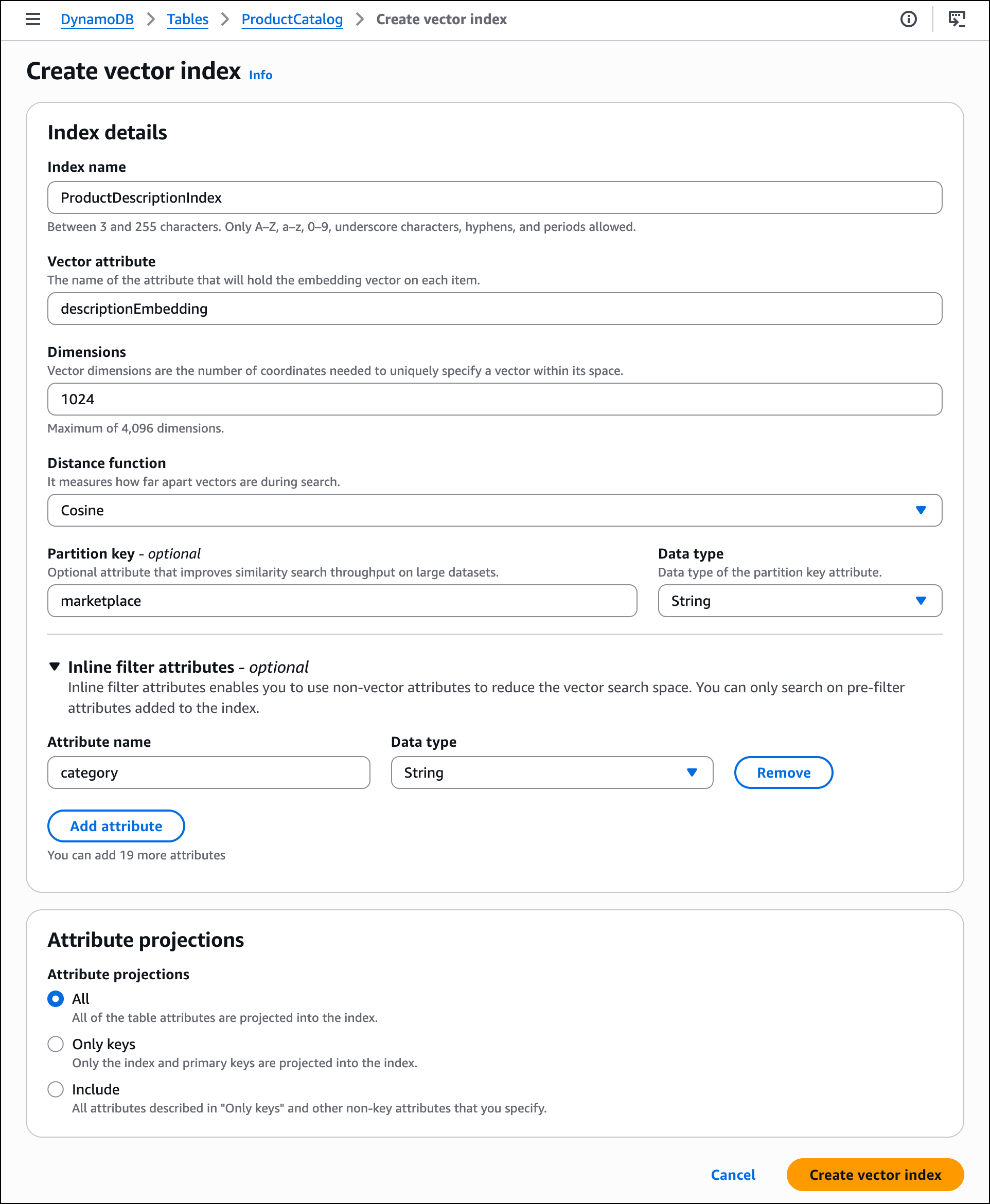
Creating the Vector Index:
Through the DynamoDB console or infrastructure-as-code tools, administrators configure a new vector index by specifying:- Index Name: e.g.,
ProductDescriptionIndex. - Vector Attribute: The attribute holding the list of floats.
- Dimensions: Matching the exact output dimension size of the chosen embedding model.
- Distance Function: Typically Cosine for evaluating the angular semantic similarity of text embeddings.
- Partition Key: Optionally designating an attribute (like
marketplace) to distribute vectors horizontally across partitions, ensuring that high-throughput queries remain scoped and predictable. - Inline Filters: Designating attributes (like
category) to support exact-match filtering during search execution.
- Index Name: e.g.,
-
Executing Vector Queries (
SearchVectorsAPI):
When a user inputs a natural language query (e.g., "lightweight running shoes for summer"), the application converts the text into a query vector using the same embedding model. TheSearchVectorsAPI accepts this query vector, aTop Kparameter (returning up to 100 results), partition keys, and filter conditions. DynamoDB then computes similarity scores and returns the most relevant items alongside standard operational attributes (such asname,price, andproductId) in a unified response.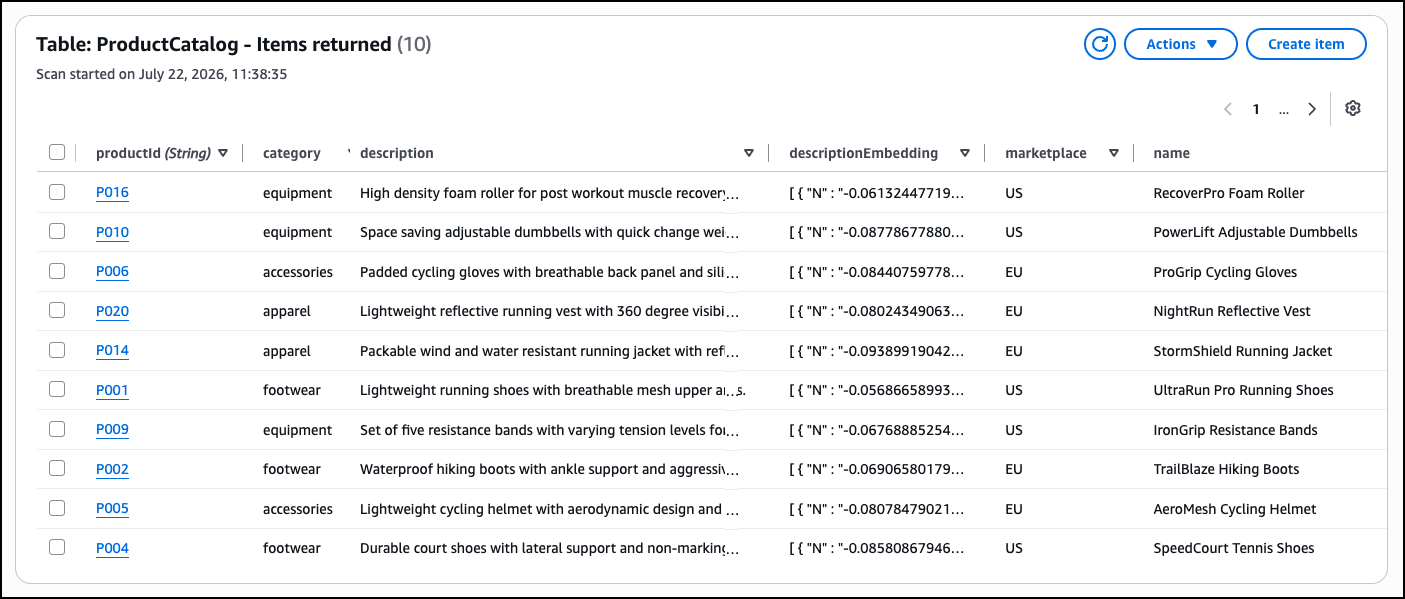
Official Responses and Strategic Vision
Industry analysts and AWS engineering leads emphasize that this release directly addresses customer pain points regarding operational overhead and system complexity.
According to product statements accompanying the launch, the primary goal was to eliminate the operational tax of data duplication. By allowing operational records and vector embeddings to share identical serverless guardrails, teams can innovate faster without worrying about infrastructure bottlenecks or capacity provisioning.
Furthermore, integration with modern tooling—such as the AWS MCP Server and developer plugins for AI coding assistants—signals a broader commitment by AWS to make vector search capabilities accessible to developers working directly within intelligent coding and agentic workflows.
Implications: What This Means for Developers, Enterprises, and the Cloud Ecosystem
The introduction of native vector search in Amazon DynamoDB carries profound implications for software architecture, enterprise budgets, and the future trajectory of application development.
1. Simplified Enterprise Architecture
For organizations heavily invested in the AWS ecosystem, the elimination of external vector stores simplifies system design. Developers no longer need to write custom event-driven synchronization pipelines (such as using Amazon DynamoDB Streams coupled with Lambda functions to push updates to an external database). Fewer moving parts translate directly to reduced points of failure, lower maintenance overhead, and cleaner security postures.
2. Accelerated AI Application Development
Building context-aware applications—such as enterprise knowledge bases, smart recommendation engines, and agentic memory systems—often stalled due to the complexity of managing disparate data stores. With vector search natively available in a foundational database like DynamoDB, rapid prototyping transforms into production-ready deployment with minimal friction. Developers can query operational stock, pricing, and semantic relevance in a single database round-trip.
3. Economic Efficiencies
Maintaining separate database clusters incurs dual costs: provisioning idle capacity for vector stores, paying licensing fees for specialized third-party vector databases, and absorbing the operational costs of engineering talent dedicated solely to cross-system data synchronization. DynamoDB’s pay-per-request pricing model extends seamlessly to vector indexes, ensuring that organizations only pay for the compute and storage resources they actively consume.
4. Regional Availability
Vector search in Amazon DynamoDB is generally available starting today across all commercial AWS Regions, as well as AWS GovCloud (US) Regions, empowering enterprises with strict regulatory and compliance requirements to immediately integrate generative AI capabilities into their production workloads.
 rifanmuazin
  Iffa Jayyana
  Siti Muinah