
 By Ali Ikhwan
At Autodesk University 2026 in Las Vegas, the tech giant unveiled a short film titled Robots of the Wild West. It was, by all accounts, a technical showcase—a demonstration of the bleeding-edge generative AI capabilities now being integrated into Autodesk’s ecosystem. Yet, the most significant moment of the presentation wasn’t a seamless transition or a photorealistic explosion. It was a glaring continuity error.
In one sequence, a character sits down at a table; moments later, in a subsequent shot, the same character is inexplicably positioned across the corner from their companion. It is the kind of mistake that would be a career-ender for a junior editor, yet here it was, front and center on a massive conference screen.
Maurice Patel, Autodesk’s Vice President of Media & Entertainment (M&E) Industry Strategy, didn’t shy away from the glitch. In fact, he owned it. Speaking in the quiet aftermath of the event’s keynotes, Patel revealed that his team knew exactly where the error was, tried to prompt it away, and ultimately failed. They decided that starting the generation process over would have cost more than the demo warranted. It is a humble, revealing admission that highlights the current "uncanny valley" of generative AI: it is brilliant at sparks of inspiration but profoundly incompetent at the foundational discipline of storytelling.
The Architecture of AI: Tasks, Shots, and Worlds
To understand why a table placement error matters, one must understand how Autodesk categorizes AI’s current trajectory. According to Patel, we are currently living in the era of "shots," while the "holy grail"—persistent, physics-aware worlds—remains a distant objective.
Patel breaks down the AI utility spectrum into three tiers:

- Tasks: Highly specialized, narrow-model applications. Tools like MotionMaker, integrated into Maya, excel here because they are trained on specific physical behaviors—locomotion for humans, horses, and dogs, with feline models currently in development.
- Shots: The domain of current generative video. This is where Robots of the Wild West exists. It is inherently unstable. Run the same prompt twice, and you receive different results. Alter one variable, and the model may unravel other aspects of the scene you were happy with.
- Worlds: Fully coherent, persistent, physics-governed environments that can be prompted into existence. This remains, in Patel’s view, a myth for the time being.
The table incident is a microcosm of the "shot" problem at scale. When the generative process reaches a point of diminishing returns—where rephrasing prompts no longer yields progress—the filmmaker is often forced to either accept the "hallucination" or restart from scratch. For Autodesk, the solution isn’t to hope for a more powerful "God model" that does everything; it is orchestration. By utilizing Flow Studio and the 3D Editor + Canvas, creators can now block cameras, define character performance in 3D, and provide a skeletal framework that prevents the AI from wandering too far into the absurd.
Chronology of a Disruption: From Digital Compositing to Generative Prompts
Patel’s perspective is informed by a career that spans the evolution of digital artistry. He remembers the early days of digital compositing using Avid, a time when the industry was undergoing a similar existential anxiety. Back then, "rotoscoping" and "optical compositing" were the scary new frontiers.
"Everything I’ve experienced with AI," Patel notes, "is that you still need artists who have a vision, who drive this AI, because the AI itself is actually terrible."
The chronology of this shift is moving at a breakneck pace:
- The Manual Era: Creators relied on raw technical skill, animation curves, and frame-by-frame manipulation.
- The Digital Transition: Tools like Maya revolutionized the workflow, turning a niche craft into a massive global industry employing hundreds of thousands.
- The Generative Inflection Point: We are now in the "early days" of the AI journey, where we have traded animation curves for text prompts, yet the fundamental requirement—human taste—remains unchanged.
Patel argues that AI isn’t just replacing jobs; it is changing them and, crucially, democratizing them. Just as the digital revolution allowed more people to enter the VFX field, generative tools are lowering the barrier to entry. However, the "art" of the animator remains the same: it is the ability to make a performance shine, to understand the "soul" of a character—something a model trained on a million rabbits can never truly replicate because it lacks the human context of what makes a character iconic.

The Cost of "AI Slop" vs. The Value of Innovation
A recurring theme at AU26 was the economic pressure facing the entertainment industry. Major studio blockbusters have ballooned in budget, with some games and films reaching $200 million in production costs. This has forced studios into a cycle of safe, repetitive content—sequels and reboots—to mitigate risk.
Patel sees AI as a potential pressure valve for this financial tension. If lower budgets are required to produce high-quality work, studios may be more willing to experiment, echoing the success of low-budget horror outfits like A24 and Blumhouse.
However, there is a dark side to this efficiency: "AI slop."
Patel is skeptical of viral stories claiming feature-length films were produced for a mere $2,000. He suggests that such figures often ignore the hidden costs of massive compute power, which, if accounted for, would be astronomical. If the filmmaker does not care about the artistic output—if they are merely chasing a trend—the result is often hollow, uninspired, and structurally flawed.
Official Responses and Strategic Implications
Autodesk’s strategy, as outlined by Patel and his colleagues, is one of "orchestration over automation." They do not believe in a single model that will replace the creative process. Instead, they envision a future where real footage, computer-generated (CG) assets, and AI-generated elements are mixed seamlessly.
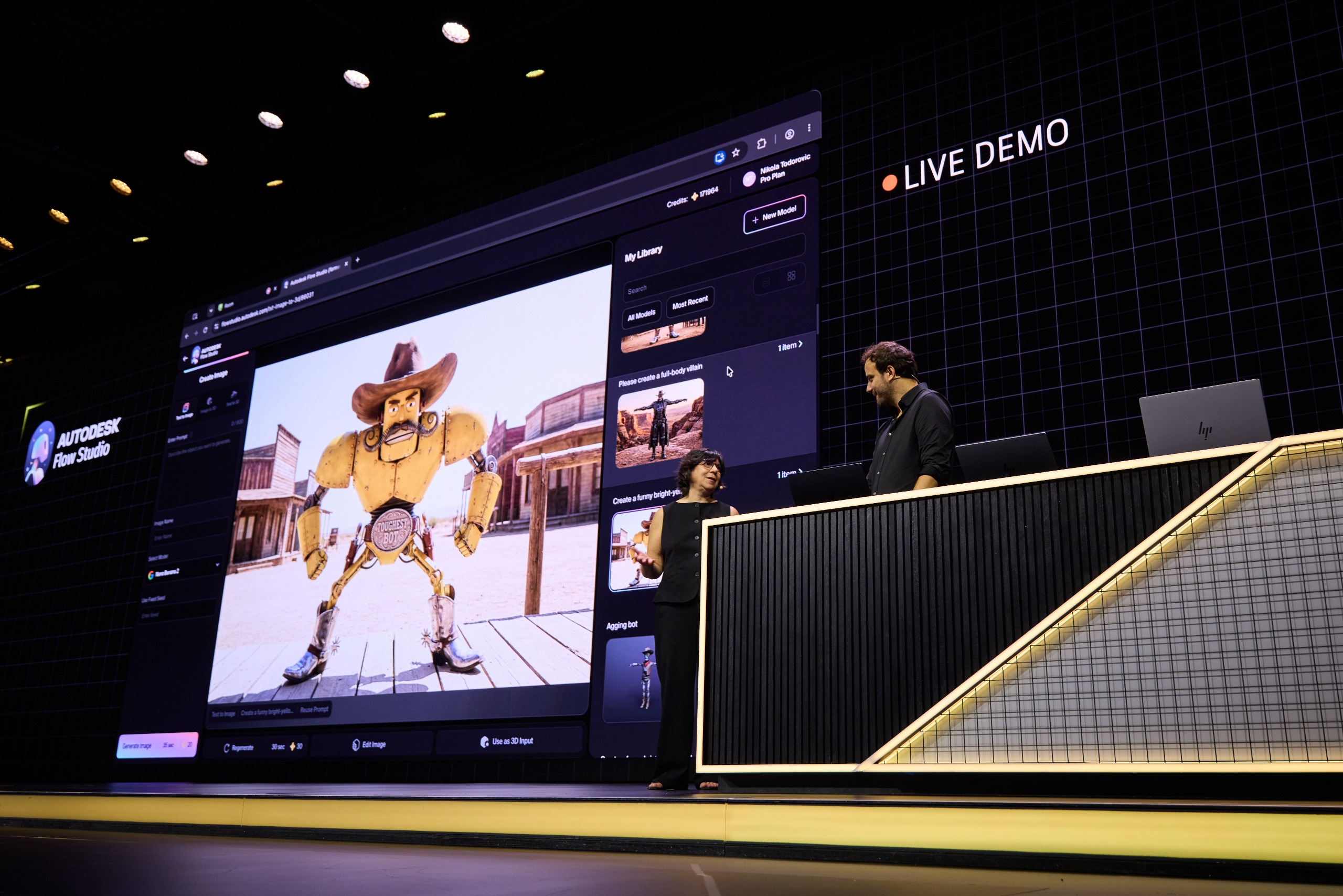
"Sometimes it’s just quicker to shoot a fire and use that," Patel jokes, gesturing to the practicality of traditional filmmaking. This pragmatic approach is why Autodesk is pushing Flow Studio. They want to ensure that if a creator wants to use AI, they do so within a 3D environment that provides the constraints necessary for professional-grade output.
The implications for the industry are profound:
- Quality Control: As the market becomes flooded with AI-generated content, the "flaws" (like the table error) will become a differentiator. Professional work will be defined by the absence of these errors, which only human oversight can provide.
- The New Skill Set: The future animator won’t just be a master of curves; they will be an orchestrator of models. They will need to know when to use AI for background generation and when to rely on manual animation for character beats.
- Sustainability: The push for lower costs must be balanced against the environmental and financial cost of heavy compute. The industry is currently in a "love-hate" relationship with this technology—it is, in Patel’s words, "scary, but also kind of fun."
Conclusion: The Human Imperative
The continuity error in Robots of the Wild West is, ultimately, a gift to the creative community. It serves as a reminder that even when a company as powerful as Autodesk attempts to automate the creative process, the results are fallible.
The "happy accident" of AI—the ability to generate something unexpected—is where the technology shines. But the "directed content"—the emotional, logical, and structural integrity of a film—is where the human artist is not only relevant but indispensable.
As we look toward the future of digital art, the message from the floor of AU26 is clear: AI is a tool, not a director. It can generate a million rabbits, but it cannot create Bugs Bunny. The technology is currently in its infancy, and while the "slop" may dominate the headlines today, the future of the industry lies in the hands of those who use these tools not to replace their imagination, but to amplify it. The ghost in the machine is, and will remain, human.
 Jia Lissa
  Neng Nana
  Azzam Bilal Chamdy